


Plenty of Korean learners can read Hangul within a week and still can’t follow a single line of their favorite K-drama a year later. The gap between those two points is where most apps quietly stop helping.
So what’s the best app to learn Korean? It depends on your stage. Hangul and your first few hundred words are a memorization job, and several apps handle that well. After that, you need hundreds of hours of real Korean you can follow, and very few apps are built for that. LingQ is.
Below is an honest comparison of the Korean apps worth your time in 2026, what each one does well, where each one runs out, and how to combine them.
The quick answer
The best app to learn Korean past the beginner stage is LingQ, because it lets you learn from real Korean content (K-dramas on Netflix, YouTube, podcasts, webtoons and news) with instant word lookups and a count of every word you know. For your first few weeks, pair it with a structured beginner app like LingoDeer or Duolingo to learn Hangul and basic grammar. For speaking, add a tutor.
| App | Best for | Stage | Free option |
|---|---|---|---|
| LingQ | Reading and listening to real Korean | Late beginner to advanced | Yes, with limits |
| LingoDeer | Structured grammar for beginners | Absolute beginner | First lessons |
| Duolingo | A free, structured course with a daily habit | Beginner to upper intermediate (B2) | Yes |
| Talk To Me In Korean | Grammar explained by Korean teachers | Beginner to intermediate | Many free lessons |
| Anki | Custom flashcards with spaced repetition | All levels | Yes (iPhone app is paid) |
| Pimsleur | Speaking and listening on the go | Beginner | Free trial |
| italki | Speaking with a tutor | Late beginner and up | No, pay per lesson |
Free options checked November 2026. Prices and plans change, so check each app’s site.
Why most Korean apps stall after the beginner stage
Most Korean apps teach you about Korean in small, controlled pieces: a letter, a word, a sentence built for the lesson. That works for the first month. Then it stops working, for three reasons.
Korean needs a lot of exposure. The US Foreign Service Institute puts Korean in its hardest category for English speakers, at roughly 88 weeks (2,200 class hours) of study. No set of bite-sized exercises adds up to that. You need content you can keep consuming for months.
Korean grammar only clicks in context. Particles like 은/는 and 이/가, and verb endings that change with politeness, are hard to learn from rules alone. You’ll understand the difference between 은/는 and 이/가 far better after meeting both a few hundred times in real sentences.
Real Korean doesn’t sound like textbook Korean. Friends speak in casual 반말, officials and shop staff use polite 존댓말, and dramas switch between the two in the same scene. Apps built on polite, scripted sentences rarely prepare you for an episode of a K-drama or a Korean YouTube vlog. (More on this in our guide to Korean slang.)

That’s the honest answer to the question learners keep asking on Reddit: is there an app that actually teaches you Korean? Some apps get you started. To get further, you need an app built around real content.
Takeaway: once you can read Hangul, spend at least half your study time on real Korean, not exercises, and build up to two thirds as it gets easier.
The best apps to learn Korean, by stage
These are listed in roughly the order you’ll need them, from your first Hangul letter to understanding native content.
1) LingoDeer: best for structured beginner grammar
Verdict: the clearest grammar notes of the gamified apps, but it runs out at the intermediate level.
LingoDeer was originally built for Asian languages, and it shows. Lessons introduce Hangul, then build up particles, verb endings and politeness levels step by step, with short grammar explanations after each unit. It’s a good fit if you like knowing why a sentence works.
- Use it for: your first 1 to 3 months, alongside Hangul practice
- Move on when: you can follow simple grammar notes and want to read real Korean
- Cost: the first lessons are free, then a subscription
2) Duolingo: best free structured course
Verdict: a much bigger course than it used to be, and a solid free backbone for your first year, but everything in it is still Korean written for the app.
Duolingo’s Korean course has grown a lot. In 2026, Duolingo extended Korean (along with eight other major courses) from roughly A2 to B2 on the CEFR scale, which is upper intermediate. The update added more advanced lessons along with new reading and listening practice, and it’s available to free users. If you dismissed Duolingo Korean a few years ago as a beginner-only app, it’s worth a second look.
The limit is the material itself. Every sentence, story and audio clip in Duolingo is made for Duolingo: scripted, carefully leveled and recorded for learners. That’s useful practice, but it isn’t the Korean you started learning for. A K-drama, a variety show or a Korean YouTuber talking at full speed is messier, faster and full of casual speech, and you only get comfortable with it by spending hours with the real thing. A B2 course on Duolingo makes you a strong Duolingo learner. Understanding native Korean still takes native Korean. We go deeper on this in can you become fluent with Duolingo?
- Use it for: a free daily course from Hangul through the intermediate levels
- Pair it with: real Korean content as soon as you can read Hangul, rather than waiting until you finish the course
- Cost: free with ads; paid plans remove ads and add features
3) LingQ: best for reading and listening to real Korean
Verdict: the best app for the stage where most learners stall: moving from textbook Korean to the Korean people actually speak and write.
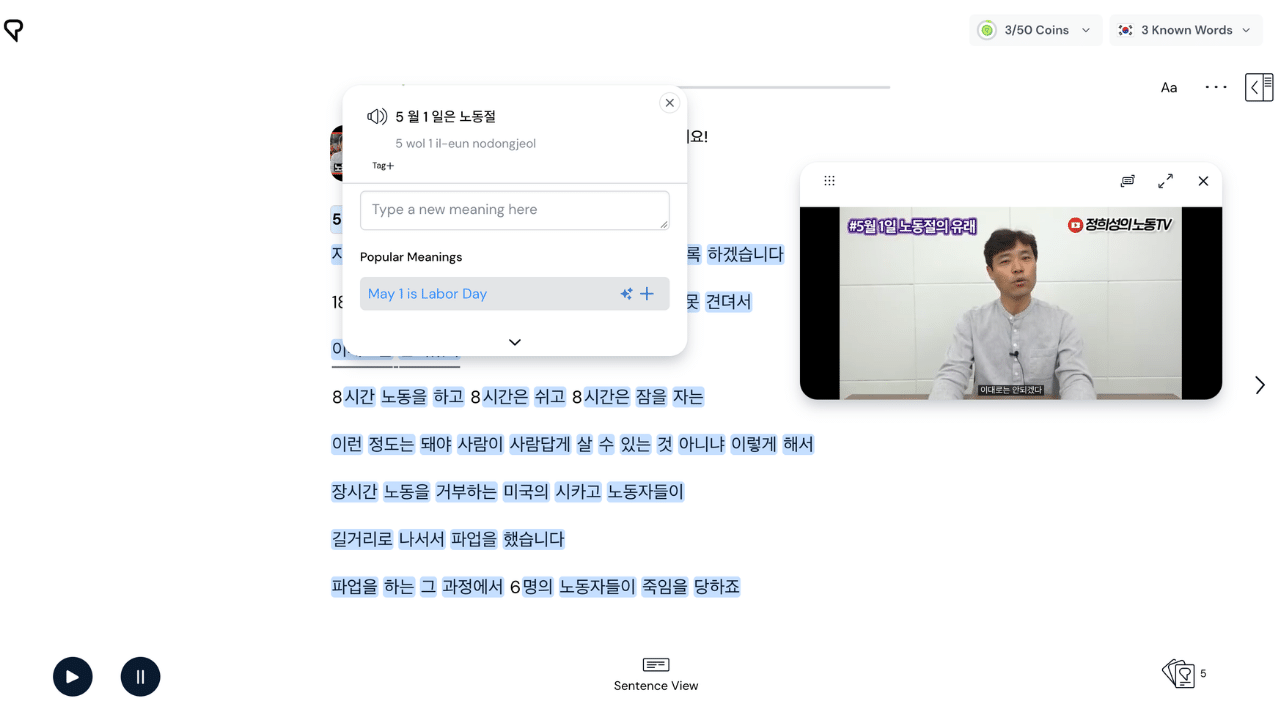
LingQ was co-founded by Steve Kaufmann, who speaks more than 20 languages. It’s built on a simple idea: you learn a language by reading and listening to a lot of content you can mostly understand, and looking up the rest.
Here’s what that looks like in practice:
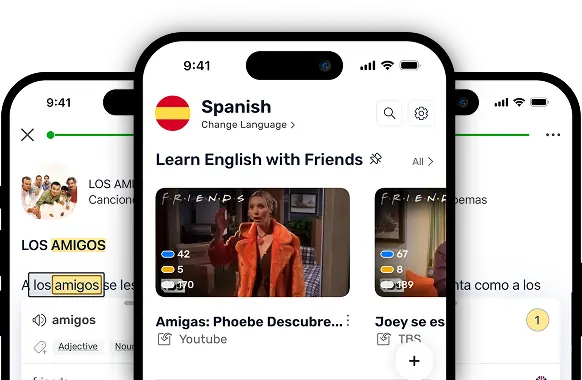
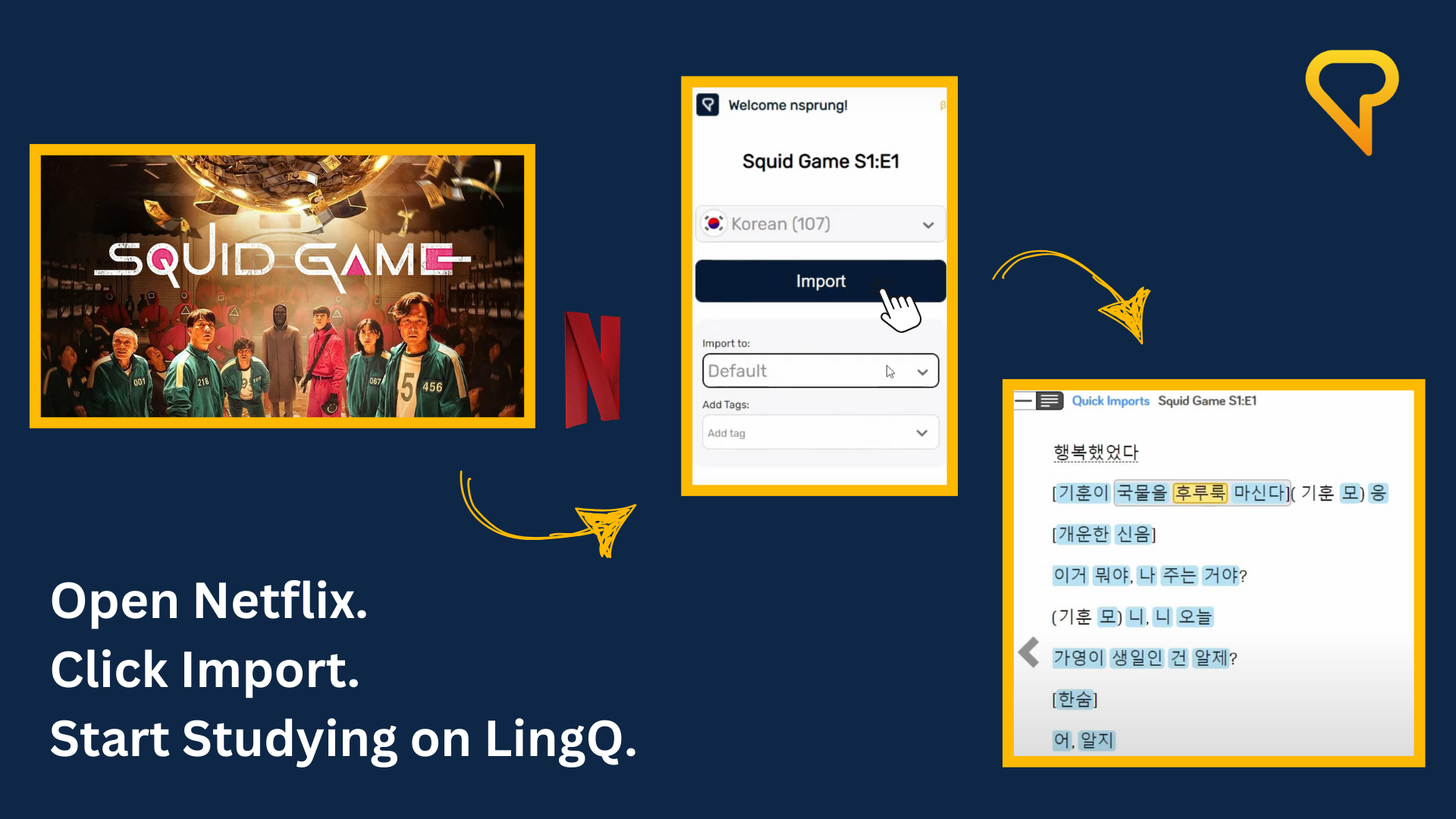
- Learn from Korean you actually want to understand. Import a YouTube video, a Netflix episode’s subtitles, a news article, an ebook or a podcast. LingQ turns it into an interactive lesson with text and audio, so the K-drama you’re watching becomes your textbook.
- Tap any word for its meaning. Unknown words are highlighted in blue. Tap one to see its romanization, popular meanings and links to Korean dictionaries like Naver and Daum, then save it.
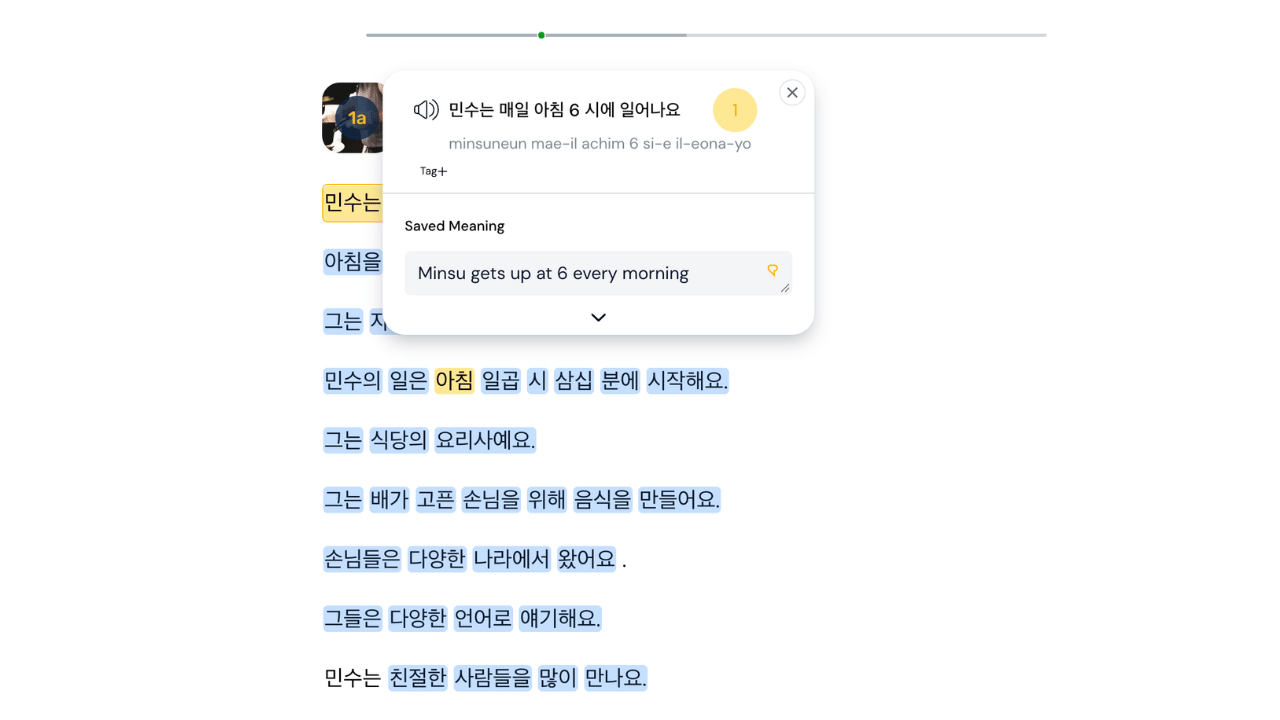
- Watch your vocabulary grow. Every word you save moves through stages as you meet it again, from new to known. LingQ counts your known words, which is a far better measure of progress than a streak.
- Start with beginner content made for learners. LingQ’s Korean library includes graded lessons such as Mini Stories, short stories with audio that repeat core vocabulary, so you have something readable before native content.
- Review without leaving your content. Saved words feed into flashcards and review activities, so you don’t need a separate vocabulary app for words you’ve met while reading.
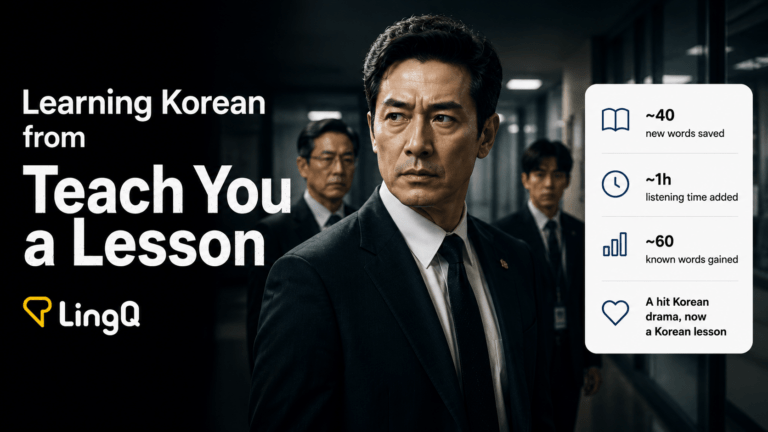
Importing a show takes one click with the LingQ browser extension. Here’s what it looks like with Squid Game:
Where LingQ is weaker: it isn’t designed to teach Hangul from zero, and it doesn’t give you structured grammar lessons. Learn the Korean alphabet first (most people can read it within a week), and keep a grammar reference handy. After that, LingQ can be the center of your study.
- Use it for: the bulk of your study time, from late beginner onward
- Best paired with: a grammar resource (LingoDeer or Talk To Me In Korean) and, later, a tutor for speaking
- Cost: free to start; Premium unlocks unlimited saved words and lessons (see LingQ Free vs Premium)
If you’re ready to move past exercises, start reading Korean on LingQ for free.
4) Talk To Me In Korean: best for grammar explanations
Verdict: the clearest grammar explanations for English speakers, from a team of Korean teachers based in Seoul.
Talk To Me In Korean (TTMIK) has a large library of audio and video lessons organized by level, much of it free, plus textbooks and paid courses. It pairs well with LingQ: when you meet a grammar pattern in a story, look up the TTMIK lesson on it, then go back to reading.
- Use it for: one grammar lesson a few times a week
- Cost: many lessons are free; full courses need a paid membership
5) Anki: best for custom flashcards
Verdict: the most flexible flashcard app, and free on most devices, but you build the system yourself.
Anki is a spaced repetition engine. Download a shared deck (such as a core vocabulary deck for the TOPIK exam) or make your own cards from sentences you’ve read. Keep it short: flashcards work best as a supplement to reading, not a replacement for it.
- Use it for: 10 minutes a day of vocabulary reviews
- Watch out for: spending more time making cards than reading
- Cost: free on desktop, web and Android; the iPhone app is a one-time purchase
6) Pimsleur: best for speaking practice on the go
Verdict: good for pronunciation and basic conversation while you commute; slow for vocabulary.
Pimsleur’s 30-minute audio lessons prompt you to answer out loud. It builds speaking confidence and good pronunciation early. It covers a small vocabulary and almost no reading, so treat it as a supplement.
- Use it for: commutes and walks in your first months
- Cost: free trial, then a subscription
7) italki: best for speaking with a real person
Verdict: the fastest way to turn what you understand into what you can say.
On italki, you can book one-on-one video lessons with Korean tutors. Speaking becomes much easier once you’ve built up comprehension, so many learners start tutoring after a few months of reading and listening.
- Use it for: 1 to 2 conversation lessons a week once you can follow simple Korean
- Cost: pay per lesson; rates are set by each tutor
What about Babbel, Busuu and Rosetta Stone?
Babbel doesn’t offer Korean, so it’s out for Korean learners (see our Babbel review for the languages it does cover). Busuu has a Korean course, but it only covers the beginner levels (A1 and A2). Rosetta Stone offers Korean, but its picture-matching method explains almost no grammar, which makes Korean’s particles and verb endings slow to pick up.
Takeaway: pick one app per job. A beginner course to start, a grammar resource, LingQ for real content and, later, a tutor.
The best free apps to learn Korean
You can get surprisingly far without paying. A free setup that covers every stage:
- Structured course: Duolingo (free with ads), which now runs from Hangul through B2
- Grammar: Talk To Me In Korean’s free lessons
- Vocabulary: Anki on desktop or Android, with a shared deck
- Real content: LingQ’s free account, using its Mini Stories and graded beginner lessons, plus imports of free Korean content from Korean YouTube channels
- Dictionary: the free Naver Dictionary app for looking up words and example sentences
The paid upgrade that makes the biggest difference is the one that removes limits on the tool you use most. For most learners past the first few months, that’s their reading and listening app.
Takeaway: start free. Pay only for the app you open every day.
How to combine Korean apps into a routine
The mistake most learners make is spreading 30 minutes across five apps. Each app ends up getting too little time to work. Instead, give most of your time to real content and keep the drilling short.

Here’s a 45-minute daily routine for a learner who already reads Hangul:
| Time | App | What you do |
|---|---|---|
| 10 min | Anki or LingQ flashcards | Review vocabulary from yesterday’s lesson |
| 30 min | LingQ | Read and listen to one lesson; save new words |
| 5 min | Talk To Me In Korean | Look up one grammar point you met while reading |
On busy days, keep the LingQ lesson and drop the rest. Listen to the same lesson again on your commute: hearing a story you’ve already read is one of the easiest ways to build listening skill.
Once you can follow simple stories without much lookup, start importing episodes of Korean dramas on Netflix, and add one or two tutor sessions a week on italki to talk about what you’ve been watching.
Takeaway: start with at least half your time on real Korean, build up to two thirds, and keep the rest for short reviews.
FAQs
What is the best app to learn Korean?
LingQ is the best app for learning Korean beyond the basics, because you learn from real content like K-dramas, YouTube and podcasts with instant word lookups. Absolute beginners should learn Hangul first, and can use a structured course like Duolingo or LingoDeer alongside LingQ.
Is Duolingo good for learning Korean?
Yes, and it covers more than it used to: Duolingo’s Korean course now runs up to B2 (upper intermediate) and includes reading and listening practice. It isn’t enough on its own to understand real Korean, though, because all of its content is scripted for the app. Pair it with native content like K-dramas and YouTube.
What's better than Duolingo for Korean?
For clearer grammar explanations, LingoDeer and Talk To Me In Korean explain more than Duolingo. For understanding native Korean, LingQ is a better choice, because it teaches through real Korean content instead of app-made lessons. See our list of Duolingo alternatives for more options.
What is the best free app to learn Korean?
Duolingo and Talk To Me In Korean’s free lessons cover the basics at no cost. For reading and listening, LingQ’s free account gives you beginner lessons and lets you import free Korean content from YouTube and the web.
Does Babbel have Korean?
No. Babbel doesn’t offer a Korean course. Korean learners usually start with LingoDeer, Duolingo or Talk To Me In Korean, then move to LingQ for real content.
Can you learn Korean with just an app?
Apps can take you a long way, especially if one of them gives you lots of real Korean to read and listen to. To speak well, add conversation practice with a tutor or language partner once you can follow simple Korean.
Start learning Korean with LingQ
The best app to learn Korean is the one that gets you reading and listening to real Korean as early as possible. Learn Hangul, then let the content you love do the heavy lifting: the dramas you watch, the YouTubers you follow, the music you already have on repeat.
LingQ’s free account gives you beginner Korean lessons with audio, one-tap word lookups and a count of every word you learn. Import one video or episode you’re curious about and see how much you can already follow.
Try LingQ free and start learning Korean →
Keep reading: How to learn Korean: a complete beginner’s guide · The best language learning apps in 2026 · The Korean alphabet: a beginner’s guide to Hangul
Cover photo by Theodore Nguyen on Pexels.
 Learning Korean?