
How to Learn Korean: A Complete Beginner’s Guide (2026)
 LingQ
15 Oct 2026
LingQ
15 Oct 2026
Maybe it started with a K-drama you couldn’t stop watching, or a song you’ve had on repeat for a week. Now you want to understand what’s being said without waiting for subtitles. Good news: Korean is very learnable, and the first step is easier than most people expect.
The short answer: learn Hangul (the Korean alphabet) first, which takes most people a few days. Then spend most of your time reading and listening to Korean you enjoy, like dramas, YouTube, podcasts and webtoons, and pick up grammar along the way. Speaking comes more easily once you understand a lot.
This guide walks you through each step, with a simple daily routine and answers to the questions beginners ask most.
Is Korean hard for English speakers?
Korean takes time, but some parts are much easier than its reputation. The US Foreign Service Institute puts Korean in its hardest group, alongside Japanese, Chinese and Arabic, estimating about 88 weeks (2,200 class hours) of study to reach professional proficiency (Korea Times). That’s a diplomat’s target, though. You can understand a lot of everyday Korean long before then.
What’s easier than you’d think:
- The alphabet. Hangul was designed to be simple, and most beginners can read it within a few days.
- No tones and no gendered nouns. Unlike Mandarin or Vietnamese, pitch doesn’t change a word’s meaning.
- Verbs don’t change for “I,” “you” or “they.” One verb form works for every person.
What takes more time:
- Word order. Korean puts the verb at the end of the sentence (subject, object, verb).
- Particles. Small markers after nouns show who is doing what to whom.
- Speech levels. Korean changes verb endings depending on who you’re talking to, from casual to polite to formal.
- Vocabulary. Few words look like English ones, so you’ll need lots of exposure to remember them.
The good news is that vocabulary and grammar both stick faster when you meet them again and again in content you enjoy. That’s the approach this guide takes.
Step 1: Learn Hangul first
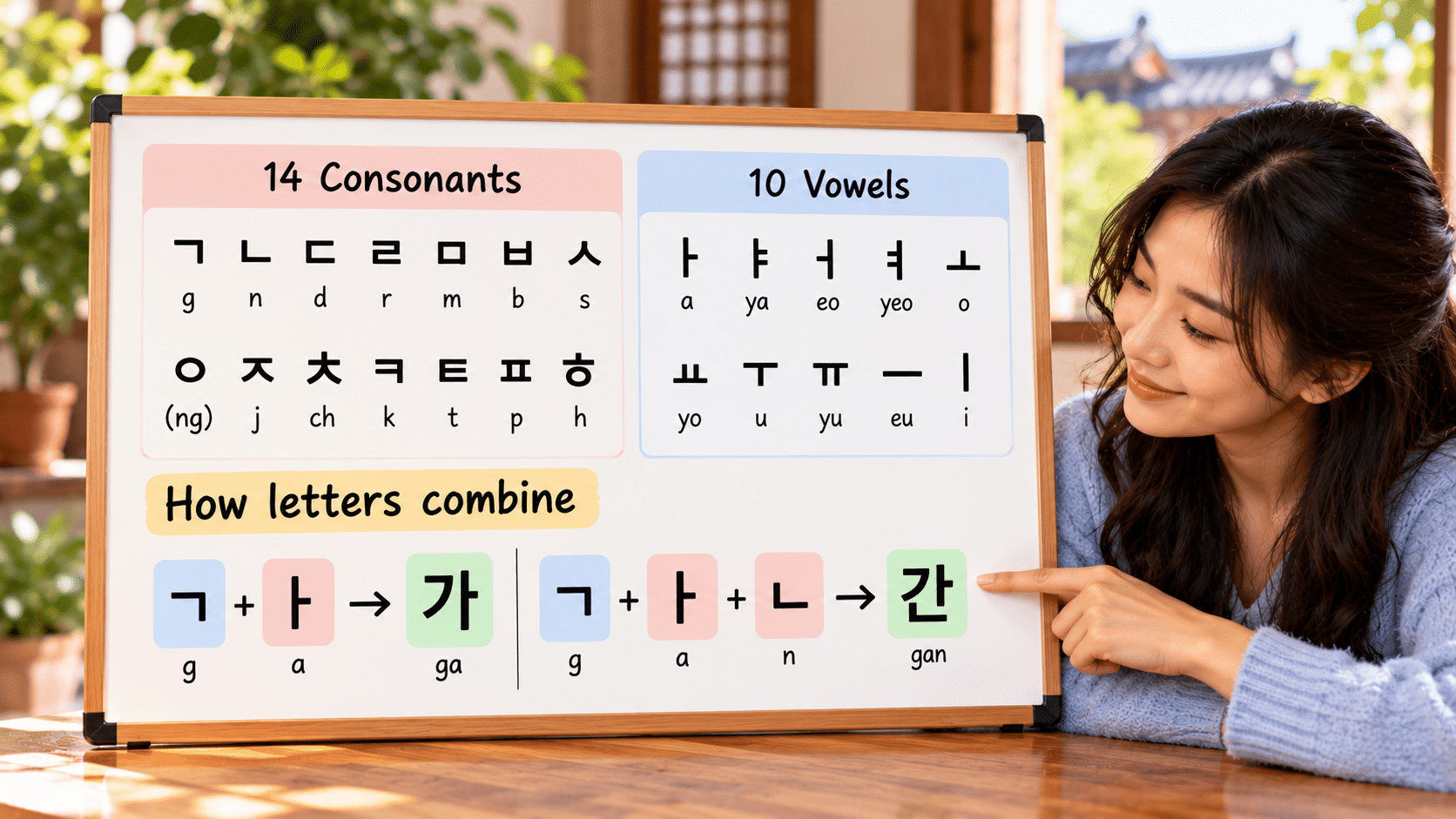
Learn to read Hangul before anything else, because it unlocks everything that follows. Hangul has 24 basic letters, 14 consonants and 10 vowels, and was created in the 15th century under King Sejong to be easy to learn.
The letters combine into syllable blocks. For example, ㄱ (g) + ㅏ (a) makes 가 (ga), and adding ㄴ (n) below gives 간 (gan). Once you know the letters and how blocks are built, you can sound out any Korean word, even before you know what it means.
Skip romanization (writing Korean in English letters) as soon as you can. It gets the sounds wrong and slows down your reading later.
For a letter-by-letter walkthrough with pronunciation tips, see our guide to the Korean alphabet (Hangul).
Step 2: Build vocabulary with Korean you enjoy
The fastest way to grow your vocabulary is to read and listen to lots of Korean you actually like. You’ll meet the most useful words again and again in context, so they stick without endless flashcard drills.
Start with content made for learners, like short graded stories, and move to native content as you understand more. Good places to find Korean you’ll want to come back to:
- K-dramas and films. Start with slice-of-life shows, which use everyday language. See our picks for Korean dramas on Netflix and Korean movies on Netflix.
- YouTube. Vlogs and talk channels are great for natural, spoken Korean. Try these YouTube channels for learning Korean.
- Podcasts. Perfect for commutes and chores. Here are some Korean podcasts for different levels.
- Webtoons. Short episodes, everyday dialogue and pictures that help you guess meaning.
- K-pop lyrics. Fun for motivation, but song lyrics bend grammar, so mix them with spoken content.
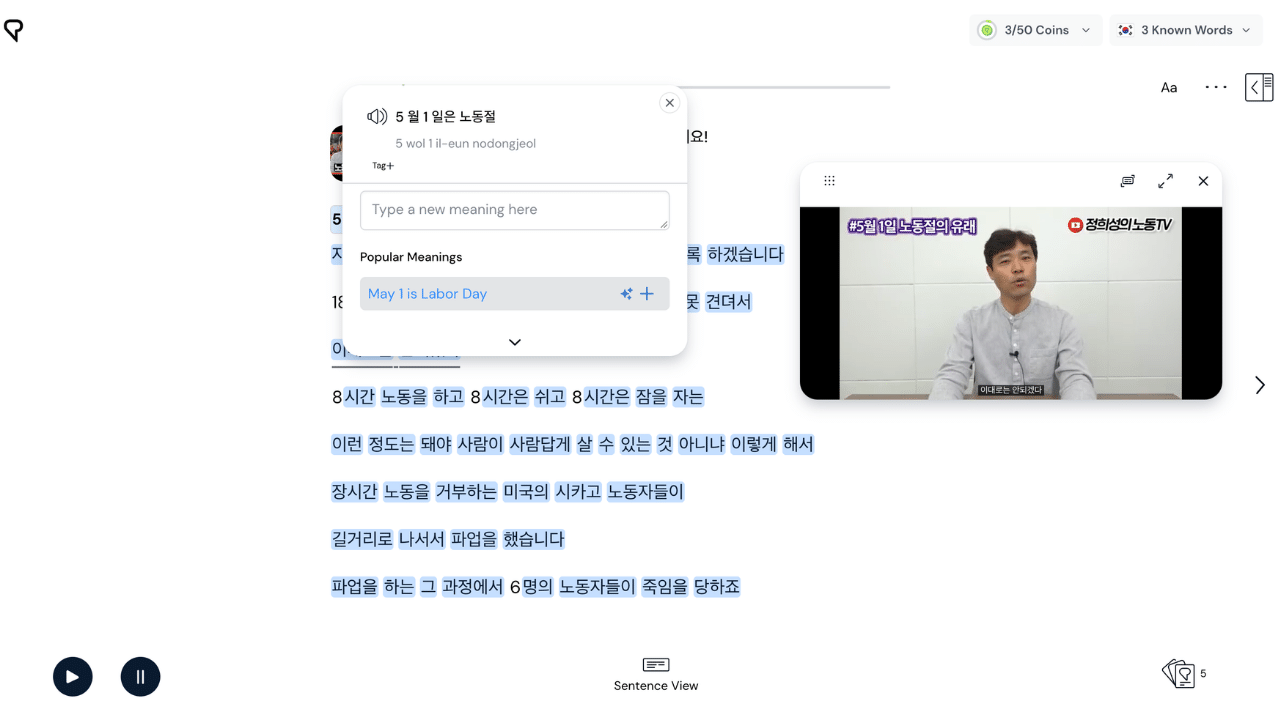
Pick things you’d watch or read anyway. You’ll spend more time with Korean, and time spent is what drives progress. When you’re ready for casual speech, our guide to Korean slang helps decode what you hear in dramas.
Step 3: Pick up grammar as you go
You don’t need to master grammar before you start enjoying Korean. Learn the basics, then let your reading and listening show you how they work in real sentences.
Three patterns are worth knowing early:
- Verb at the end. 저는 커피를 마셔요 (jeoneun keopireul masyeoyo) means “I drink coffee,” but word for word it’s “I coffee drink.”
- Particles. In that sentence, 는 marks the topic (“as for me”) and 를 marks the object (coffee). The most common pairs are 은/는 (topic), 이/가 (subject) and 을/를 (object).
- The polite ending -요. Verbs ending in -아요/어요 are polite but friendly, safe with almost anyone. Start here, and learn casual and formal speech later as you hear them.

When something confuses you, look it up, then move on. Seeing a pattern dozens of times in context teaches it better than memorizing a rule once.
Step 4: Listen a lot, then start speaking
Speaking gets easier the more Korean you’ve heard, so build a strong listening base first. Listen to the same content more than once. The first time you catch a few words, and by the third time whole phrases make sense.
When you’re ready to speak, start small:
- Shadowing. Play a short clip and repeat it out loud, copying the rhythm and intonation.
- Talk to yourself. Describe what you’re doing in simple Korean while you cook or walk.
- Find a partner. A tutor or language exchange partner gives you real conversation once you can follow simple speech.
Don’t worry about mistakes. Everyone sounds rough at first, and the more you’ve listened, the faster your speaking catches up.
How LingQ helps you learn Korean
LingQ is built around the approach in this guide: learn Korean from content you enjoy, and let vocabulary and grammar grow from there.
- Read and listen together. Lessons pair Korean text with audio, so you train your eyes and ears at the same time.
- Tap any word. See its meaning instantly and save it as a LingQ to review later. No switching to a dictionary app.
- Import what you love. Bring in YouTube videos, Netflix shows, podcasts, articles and ebooks, and turn them into interactive lessons.
- Start at your level. The Korean library has lessons for beginners, so you can build up to native content at your own pace.
- Watch your progress. LingQ tracks the words you know, so you can see your Korean vocabulary grow week by week.
LingQ co-founder Steve Kaufmann learned Korean the same way, through reading and listening to content he found interesting.
Start learning Korean on LingQ for free
A simple daily routine for beginners
Thirty to sixty minutes a day, done consistently, beats a long session once a week. Here’s a routine that fits most schedules:
| Time | Activity |
|---|---|
| 10 minutes | Review the words you saved yesterday |
| 15–20 minutes | Read and listen to a new lesson or a short piece of native content |
| 10–20 minutes | Listen again on the go: a podcast, drama scene or lesson audio |
| 5–10 minutes | Shadow a short clip or say a few sentences out loud |
In your first week, swap the reading block for Hangul practice until you can read comfortably. After that, keep the routine light enough that you’ll actually do it every day.
FAQ
It depends on your goal and how much time you put in. The FSI estimate for professional proficiency is about 2,200 class hours, but you can follow simple conversations and easy content much sooner.
Yes. With so much Korean content online, self-study works well, especially if you read and listen every day. A tutor or exchange partner helps once you want to practice speaking.
Most beginners can read Hangul within a few days to a week of short daily practice. Reading quickly takes longer and comes with practice.
The Test of Proficiency in Korean is the official Korean language exam. It has six levels: TOPIK I covers levels 1–2, and TOPIK II covers levels 3–6. Most learners take it for study or work in Korea, but you don’t need it to start learning.
Start learning Korean today
Learning Korean comes down to four steps: learn Hangul, spend most of your time with Korean you enjoy, pick up grammar as you go, and speak once you’ve listened a lot. Keep it daily and keep it fun, and the hours add up faster than you’d expect.
Ready to start? Read and listen to Korean at your level, look up any word with a tap, and import the dramas and videos you already love.
Twenty minutes a day beats a weekend of drilling.
Read and listen to things you’d have read anyway — LingQ counts every word you pick up along the way.
- 5M+ learners
- 4.7★
- Free to start


You might also like