

Khmer Language: Facts, Difficulty, and How to Start Learning
 Tyler Tolman
14 Oct 2026
Tyler Tolman
14 Oct 2026
TL;DR
Khmer is Cambodia’s official language, spoken by around 21 million people, and its script holds the Guinness World Record for longest alphabet at 74 letters. However, the writing system is more approachable than you’d think once you learn its logic. Overall, Khmer is a genuinely challenging language for English speakers (FSI Category III, ~1,100 hours). The fastest way to learn Khmer entails consistent listening and reading with real content, not memorization.
Cambodia’s Khmer language (ភាសាខ្មែរ) doesn’t receive the same level of attention among language learners as Spanish or Japanese do. However, the Khmer language merits a closer look. Its uses a distinct script. In fact, Khmer holds the Guinness World Record for the longest alphabet on Earth. Furthermore, this language unlocks the history of one of Southeast Asia’s great civilizations, the Khmer Empire, which built Angkor Wat.
Here’s a rundown on the Khmer language, and how to approach learning it if you’re starting from zero.
How Many People Speak Khmer?
Khmer is the official language of Cambodia. Around 21 million people speak Khmer, roughly 19 million as a first language. There are additional Khmer-speaking communities in eastern Thailand and southern Vietnam. It belongs to the Austroasiatic language family, a group that also includes Vietnamese, though the two aren’t mutually intelligible.
Is Khmer Hard to Learn?
For English speakers, yes. The US Foreign Service Institute places Khmer in Category III, its middle-difficulty tier, estimating roughly 1,100 class hours (44 weeks of intensive study) to reach professional proficiency. For reference, that puts Khmer in the same bracket as Russian, Hindi, and Turkish. An English speaker needs significantly more time to learn Khmer than a Category I language (Spanish, Dutch, etc.).
The biggest hurdles are the script (more on that below) and a sound system with vowel distinctions that don’t transfer cleanly to English. Khmer grammar, on the other hand, is quite approachable. There are no verb conjugations, no grammatical gender, and a consistent word order.
The Khmer Alphabet Holds a World Record
Here’s the fact that surprises most people: Khmer’s script has 74 letters, 33 consonants, 23 vowels, and 12 independent vowels. It’s officially recognized by Guinness World Records as the longest alphabet in the world. A handful of those letters have fallen out of modern use entirely, preserved mostly as historical artifacts of the script’s evolution.
Technically, linguists classify Khmer script as an abugida (or alphasyllabary) rather than a true alphabet: each consonant carries a built-in vowel sound that gets modified by diacritical marks, rather than every sound getting its own separate letter the way English works. That’s partly why the letter count looks so large.
The script itself traces back to the Pallava script of South India, adapted into Khmer starting around the 7th century alongside the spread of Hinduism and Buddhism into the region. It later influenced other Southeast Asian scripts, including Thai.
74 letters sounds intimidating, but don’t let it stop you from starting. You don’t need to master the script before you can begin engaging with the language. Memorizing symbols isn’t the same as reading fluidly. Reading and listening to real (level-appropriate) content will teach you the patterns.
The Best Way to Approach Learning Khmer
Given how different Khmer is from English, both in script and in sound, the instinct is often to front-load formal grammar study. Resist that. Khmer’s grammar is actually one of its more forgiving aspects. The real skill to build when learning Khmer (or any language) is comprehension. Through consistent immersion, you prioritize recognizing the script, following the sounds, and absorbing sentence patterns.
Here’s a practical approach to learning Khmer:
- Study Khmer script early. Familiarize yourself with seeing, hearing, and writing the symbols.
- Spend the bulk of your time listening to and reading Khmer content, even before you understand most of it.
- Start with shorter, simpler content that you can easily repeat, and gradually increase the difficulty.
- Build your listening and reading comprehension to a point in which you’re comfortable with natural speech.
- Gradually place greater emphasis on speaking and writing for more well-rounded fluency.
How LingQ Supports Learning Khmer
LingQ added Khmer to its library specifically because learners asked for it. When it comes to pursuing a less commonly taught language, finding the right resources is a challenge in itself. LingQ helps you create your own learning material. Transform real content into personalized language lessons. Reading and listening simultaneously with an interactive transcript is a game changer. LingQ renders material that would otherwise be too difficult more comprehensible, expanding your options as a Khmer learner.
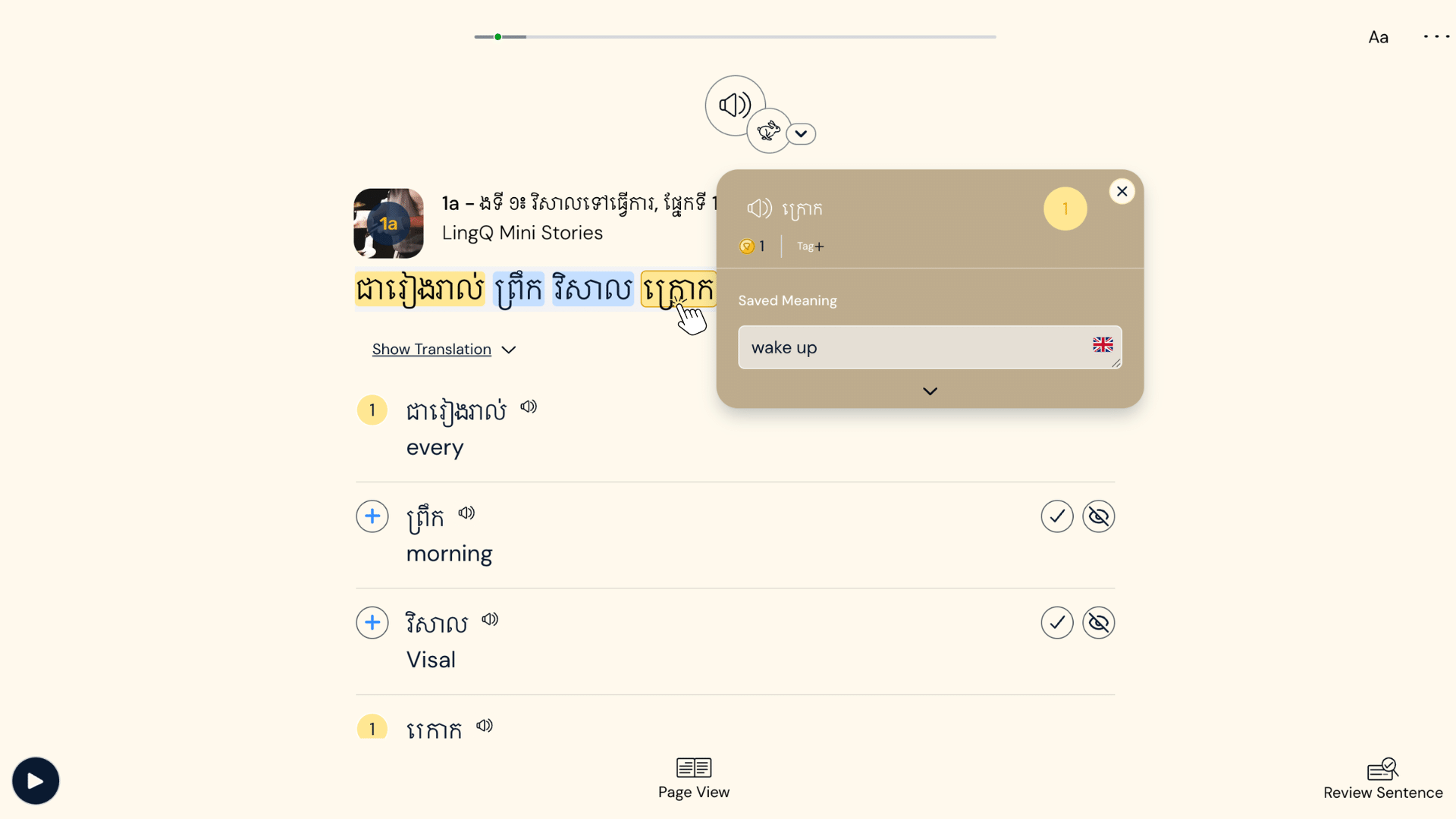
LingQ’s Khmer Mini Stories course is built specifically to take beginners through the basic patterns of the language without front-loading grammar terminology, and you can also import your own Khmer content (YouTube videos, podcasts, articles) and turn it into a lesson with word tracking built in.
LingQ’s Khmer library is a good place to start, regardless of what’s drawing you to this language in the first place.
FAQs
Yes, moderately so. The US Foreign Service Institute places it in Category III, roughly 1,100 class hours to reach professional proficiency, similar to Russian or Hindi. The script and sound system are the main challenges; the grammar is comparatively simple.
Khmer’s script holds the Guinness World Record for longest alphabet at 74 letters, though technically it’s an abugida rather than a true alphabet, each consonant carries a built-in vowel sound modified by diacritics, which is part of why the count looks so high. A few of the 74 letters are archaic and no longer used in modern writing.
About 21 million, roughly 19 million as a first language. It’s the official language of Cambodia, with minority-language status in parts of Thailand and Vietnam.
Not directly. Khmer belongs to the Austroasiatic language family (which includes Vietnamese, though they aren’t mutually intelligible), while Thai belongs to a completely different family (Kra-Dai). The Khmer script did historically influence the Thai script, though.
Learn the basic logic of the script early on, then prioritize consistent listening and reading with real content over memorizing all 74 letters in isolation or front-loading formal grammar. Comprehension builds faster through exposure than through memorization alone.
Twenty minutes a day beats a weekend of drilling.
Read and listen to things you’d have read anyway — LingQ counts every word you pick up along the way.
- 5M+ learners
- 4.7★
- Free to start

