Korean has two complete sets of numbers, and you’ll need both in your first week. Order two coffees, ask the time or say how old you are, and you use one system. Pay for those coffees, give your phone number or say today’s date, and you use the other.
It sounds intimidating, but the rules are consistent. This guide gives you both systems with charts, shows exactly when to use each, and covers big numbers, time, age, money and the counters you’ll hear every day.
Korean numbers: the quick answer
Korean has two number systems. Sino-Korean numbers (일, 이, 삼…) come from Chinese and are used for dates, money, minutes, phone numbers and anything over 99. Native Korean numbers (하나, 둘, 셋…) are used for counting things and people, for hours and for age, and they only go up to 99.
Learn Sino-Korean 1–10 first, because they build every number up to the hundred millions. Then learn native 1–10 and their short counter forms (한, 두, 세, 네, 스무). The fastest way to make the right choice automatic is to hear numbers used in real Korean, again and again.
| Number | Sino-Korean | Native Korean |
|---|---|---|
| 0 | 영 (yeong) / 공 (gong) | n/a |
| 1 | 일 (il) | 하나 (hana) |
| 2 | 이 (i) | 둘 (dul) |
| 3 | 삼 (sam) | 셋 (set) |
| 4 | 사 (sa) | 넷 (net) |
| 5 | 오 (o) | 다섯 (daseot) |
| 6 | 육 (yuk) | 여섯 (yeoseot) |
| 7 | 칠 (chil) | 일곱 (ilgop) |
| 8 | 팔 (pal) | 여덟 (yeodeol) |
| 9 | 구 (gu) | 아홉 (ahop) |
| 10 | 십 (sip) | 열 (yeol) |
Can’t read Hangul yet? Our guide to the Korean alphabet will get you there in an afternoon. Romanization helps at first, but it won’t teach you how Korean really sounds.
When to use Sino-Korean vs native Korean numbers
| Use Sino-Korean for | Use native Korean for |
|---|---|
| Money: 오천 원 (5,000 won) | Counting things with a counter: 사과 세 개 (three apples) |
| Dates: 오월 오일 (May 5) | Counting people: 학생 다섯 명 (five students) |
| Minutes and seconds: 삼십 분 (30 minutes) | Hours: 세 시 (3 o’clock) |
| Phone numbers: 공일공 (010) | Age in conversation: 스물다섯 살 (25 years old) |
| Floors, addresses, bus numbers: 삼 층 (3rd floor) | How many times: 두 번 (twice) |
| Measurements, math and anything over 99 | Months of duration: 두 달 (two months) |
If you remember one example, make it the time: 두 시 십오 분 (du si sibo bun, 2:15). The hour is native Korean and the minutes are Sino-Korean, in one phrase you’ll use every day.
Sino-Korean numbers
Counting to 100
Sino-Korean numbers work like a calculator. To make 20 you say “two ten” (이십). To make 35 you say “three ten five” (삼십오).
| Number | Korean | Romanization |
|---|---|---|
| 11 | 십일 | sibil |
| 12 | 십이 | sibi |
| 15 | 십오 | sibo |
| 16 | 십육 | simnyuk |
| 20 | 이십 | isip |
| 30 | 삼십 | samsip |
| 40 | 사십 | sasip |
| 50 | 오십 | osip |
| 60 | 육십 | yuksip |
| 70 | 칠십 | chilsip |
| 80 | 팔십 | palsip |
| 90 | 구십 | gusip |
| 99 | 구십구 | gusipgu |
| 100 | 백 | baek |
Notice that 16 is pronounced simnyuk, not sip-yuk. Korean sound rules change how some combinations are said, which is one reason it pays to listen to numbers rather than only read them.
Hundreds, thousands and beyond
| Number | Korean | Romanization |
|---|---|---|
| 100 | 백 | baek |
| 1,000 | 천 | cheon |
| 10,000 | 만 | man |
| 100,000 | 십만 | simman |
| 1,000,000 | 백만 | baengman |
| 10,000,000 | 천만 | cheonman |
| 100,000,000 | 억 | eok |
Two things trip up English speakers:
- No “one” before 100, 1,000 or 10,000. It’s 백 (100), not 일백, and 만 (10,000), not 일만.
- Korean groups big numbers by ten thousands. English splits every three digits; Korean thinks in units of 만 (10,000). So 50,000 is 오만 (five 10,000s) and one million is 백만 (one hundred 10,000s).
Examples: 이천이십육 (icheon-isimnyuk) is 2026; 만 이천삼백사십오 (man icheon-sambaek-sasibo) is 12,345; 오만 (oman) is 50,000.
Months
Months are Sino-Korean numbers plus 월 (wol, “month”). Two are irregular, so learn them early:
| Month | Korean | Romanization |
|---|---|---|
| January | 일월 | irwol |
| June | 유월 | yuwol (not 육월) |
| October | 시월 | siwol (not 십월) |
| December | 십이월 | sibiwol |
Days work the same way with 일 (il, “day”): 오월 오일 (owol oil) is May 5, Children’s Day in Korea.
Money and phone numbers
Prices always use Sino-Korean numbers with 원 (won): the ₩10,000 note is 만 원 (man won). Phone numbers are read digit by digit, with 0 as 공 (gong), so a mobile number starting 010 sounds like 공일공 (gong-il-gong).
Native Korean numbers
Counting to 99
Native numbers from 11 to 19 are 열 (10) plus the number: 열하나 (yeolhana) is 11, 열둘 (yeoldul) is 12. The tens have their own words:
| Number | Korean | Romanization |
|---|---|---|
| 20 | 스물 | seumul |
| 30 | 서른 | seoreun |
| 40 | 마흔 | maheun |
| 50 | 쉰 | swin |
| 60 | 예순 | yesun |
| 70 | 일흔 | ilheun |
| 80 | 여든 | yeodeun |
| 90 | 아흔 | aheun |
To make 25, combine them: 스물다섯 (seumul-daseot).
The counter forms
This is the part beginners miss. When a native number comes before a counter word, five numbers get shorter:
| Number | On its own | Before a counter |
|---|---|---|
| 1 | 하나 (hana) | 한 (han) |
| 2 | 둘 (dul) | 두 (du) |
| 3 | 셋 (set) | 세 (se) |
| 4 | 넷 (net) | 네 (ne) |
| 20 | 스물 (seumul) | 스무 (seumu) |
So “two coffees” is 커피 두 잔 (keopi du jan), not dul jan. The short forms also apply inside bigger numbers: 21 people is 스물한 명 (seumulhan myeong).
Telling the time and saying your age
Time mixes both systems: native numbers for the hour, Sino-Korean for the minutes.
- 두 시 십오 분 (du si sibo bun): 2:15
- 세 시 삼십 분 (se si samsip bun): 3:30, or simply 세 시 반 (se si ban), “half past three”
Age uses native numbers with 살 (sal) in everyday speech: 스물다섯 살 (seumul-daseot sal), 25 years old. In formal writing you’ll see Sino-Korean numbers with 세 instead: 이십오 세 (isibo se). Since June 2023, South Korea officially uses international age for legal purposes, though you’ll still hear people mention traditional “Korean age” in conversation.
Korean counters you’ll use every day
Korean doesn’t say “three apples” directly. You say the noun, the number and a counter that matches what you’re counting: 사과 세 개 (sagwa se gae), literally “apple three items.” These counters all use native numbers:
| Counter | Used for | Example |
|---|---|---|
| 개 (gae) | Things in general | 사과 세 개, three apples |
| 명 (myeong) | People | 학생 다섯 명, five students |
| 분 (bun) | People (polite) | 두 분, two people |
| 마리 (mari) | Animals | 고양이 한 마리, one cat |
| 잔 (jan) | Cups and glasses | 커피 두 잔, two coffees |
| 병 (byeong) | Bottles | 맥주 한 병, one bottle of beer |
| 권 (gwon) | Books | 책 네 권, four books |
| 장 (jang) | Flat things (tickets, paper) | 표 두 장, two tickets |
If you forget the right counter, 개 works for most objects and people will understand you. For larger counts, many speakers switch to Sino-Korean, so you’ll hear both 서른 명 and 삼십 명 for 30 people.
Watch out for 번 (beon). With native numbers it means “times”: 두 번 (du beon), twice. With Sino-Korean numbers it means “number”: 이 번 (i beon), number two, like a bus or exam question.
Ordinal numbers: first, second, third
Add 번째 (beonjjae) to the native counter forms. The first is irregular:
- 첫 번째 (cheot beonjjae): first
- 두 번째 (du beonjjae): second
- 세 번째 (se beonjjae): third
- 네 번째 (ne beonjjae): fourth
How to make Korean numbers stick
You can memorize these tables in an evening. Choosing the right system without thinking takes longer, because it depends on what you’re counting, and in real conversation numbers go by fast.
The most effective way to get there is to hear numbers in context, again and again: prices in a shopping vlog, times in a drama, ages in an interview. Each time you notice 두 시 or 만 원 in a real sentence, the pattern gets stronger.
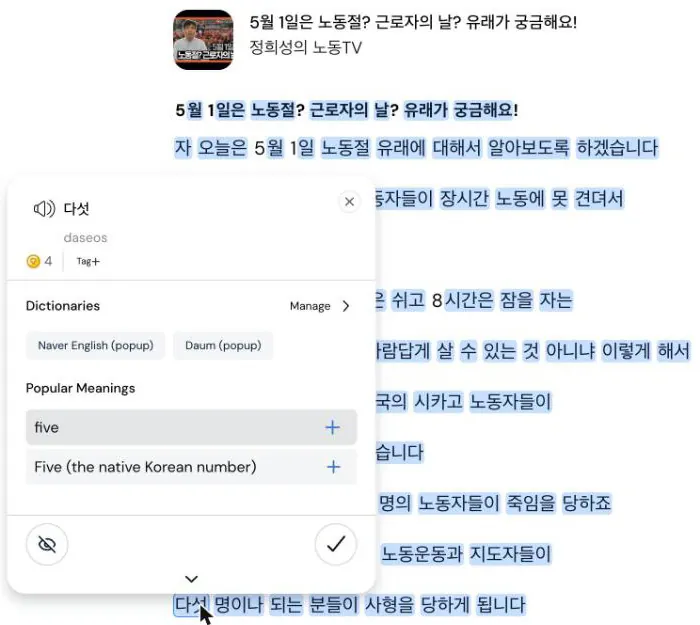
That’s exactly what LingQ is built for:
- Start with Korean Mini Stories, short stories with native audio that repeat everyday numbers, times and counters.
- Tap any number or phrase to see what it means, like 다섯 (“five, the native Korean number”) in the lesson above, and save it.
- See it again everywhere. LingQ highlights every word you save in all your other lessons, so 세 시 and 만 원 keep coming back until you know them.
- Learn from real Korean. Import Korean YouTube videos, dramas and podcasts and hear numbers the way Koreans actually say them.
Start learning Korean with LingQ for free →
For a bigger-picture plan, see how to learn Korean and the best app to learn Korean. Learning Japanese too? Compare these systems with Japanese numbers.
Korean numbers FAQs
What are the numbers 1 to 10 in Korean?
In Sino-Korean: 일, 이, 삼, 사, 오, 육, 칠, 팔, 구, 십 (il, i, sam, sa, o, yuk, chil, pal, gu, sip). In native Korean: 하나, 둘, 셋, 넷, 다섯, 여섯, 일곱, 여덟, 아홉, 열 (hana, dul, set, net, daseot, yeoseot, ilgop, yeodeol, ahop, yeol).
Why does Korean have two number systems?
Native Korean numbers are original Korean words. Sino-Korean numbers came from Chinese, along with many other words. Over time each system took on different jobs: native numbers for counting, hours and age; Sino-Korean for dates, money, minutes and large numbers.
Which Korean number system should I learn first?
Learn Sino-Korean 1–10 first. They’re simple and let you build every number up to the hundred millions. Then learn native 1–10 and the counter forms (한, 두, 세, 네, 스무) for counting, time and age.
When do you use native Korean numbers?
For counting things and people with a counter word (커피 두 잔, two coffees), for hours (세 시, 3 o’clock), for age in conversation (스물다섯 살, 25) and for how many times (두 번, twice). Native numbers only go up to 99.
How do you say zero in Korean?
영 (yeong) in most contexts, such as math and temperatures. In phone numbers, Koreans usually say 공 (gong).
How do you tell the time in Korean?
Use native numbers for the hour with 시 and Sino-Korean numbers for minutes with 분: 두 시 십오 분 (du si sibo bun) is 2:15. Half past is 반: 세 시 반 is 3:30.
Why is the number 4 unlucky in Korea?
The Sino-Korean 사 (sa) sounds like the Chinese-origin word for death. Some buildings label the fourth floor “F” instead of “4” in elevators.
What's the best way to learn Korean numbers?
Memorize both 1–10 charts, then hear numbers in real Korean as often as you can. LingQ lets you learn from Korean stories, YouTube and dramas with one-tap translations, so you meet numbers, times and counters in context until choosing the right system becomes automatic.
Start learning Korean with LingQ
Korean numbers stop feeling like two separate puzzles once you’ve heard them enough times in real sentences. LingQ’s Korean library gives you that exposure from day one, with Mini Stories for beginners, word tracking across everything you read, and the option to import the Korean content you already love. LingQ is free to start.
Try LingQ’s Korean lessons free →
Keep reading: Korean alphabet guide · How to learn Korean · Best app to learn Korean · Learn Korean from Teach You a Lesson
 Learning Korean?