





Russian has a reputation as a hard language, and it’s earned some of it. There’s a new alphabet, six cases and many verbs that come in aspect pairs. But more than 250 million people speak it, it opens up some of the world’s great literature and film, and you can learn to sound out the alphabet in days. The US Foreign Service Institute estimates about 1,100 hours of intensive classes for its English-speaking diplomats to reach professional working proficiency, so the app where you spend your hours matters.
We compared the most popular apps for learning Russian on what they teach, what they cost and how far they can take you. A quick disclosure: we make LingQ, one of the apps on this list, so we’re not neutral. We’ve tried to be fair about what each app does best.
What is the best app to learn Russian? The quick answer
The best app to learn Russian is LingQ. You learn from real Russian content (podcasts, YouTube, TV series and books) with one-tap translations, and every word you save is highlighted wherever it appears in the lessons you read and listen to. Russian nouns and adjectives change their endings depending on case, so you need to meet words many times, in many forms, to recognize them.
If you want a structured first month, Babbel explains Russian grammar, including the cases, clearly in English, and Pimsleur gets you speaking from the first lesson. Duolingo is a free way to learn the Cyrillic alphabet and your first words.
| App | Best for | Price (US) | Free option |
|---|---|---|---|
| LingQ | Getting fluent from real content, beginner to advanced | Free; Premium $14.99/month or about $10/month yearly | Yes |
| Duolingo | A free daily habit and the Cyrillic alphabet | Free; Super about $84/year | Yes |
| Babbel | Grammar and cases explained in English | About $17.95/month or $107.40/year (all 14 languages) | Free first lessons |
| Pimsleur | Audio-first speaking practice | About $15 to $21 a month, depending on the plan | 7-day trial |
| RussianPod101 | A big library of graded audio lessons | Low-cost Basic plan; Premium costs more | Free lessons |
| Busuu | Feedback on your writing from native speakers | Premium plans; price varies by platform | Yes (limited) |
| italki (or Preply) | Speaking with a tutor | Per lesson (set by each tutor) | No |
Prices checked November 2026. They vary by country, change with sales and may differ in the app stores.
What makes Russian hard, and what an app needs to do
Beginners run into three challenges right away. A good app should help with all of them.
- The Cyrillic alphabet. It looks intimidating, but it has 33 letters and several match English. With focused practice, you can sound out words within a week or so. See our guide to the Russian alphabet.
- Cases. Russian nouns, adjectives and pronouns change their endings depending on their role in the sentence. Charts help, but you only get comfortable with cases by seeing and hearing them thousands of times.
- Vocabulary. Russian shares fewer words with English than French or Spanish do, so you have more new words to learn, and lots of reading and listening is how most of them stick.
Beginner drills can build a foundation, but getting past the basics in Russian takes hours of longer, more varied Russian you can mostly understand. For a realistic timeline, see how long it takes to learn Russian.
1) LingQ: the best app to learn Russian for real fluency
LingQ turns real Russian content into interactive lessons. You read and listen at the same time, and you can tap any word or phrase to see its meaning, with Russian dictionaries like Yandex built in. Save it, and LingQ highlights it every time it appears again, in every lesson, so new words keep coming back until you know them.
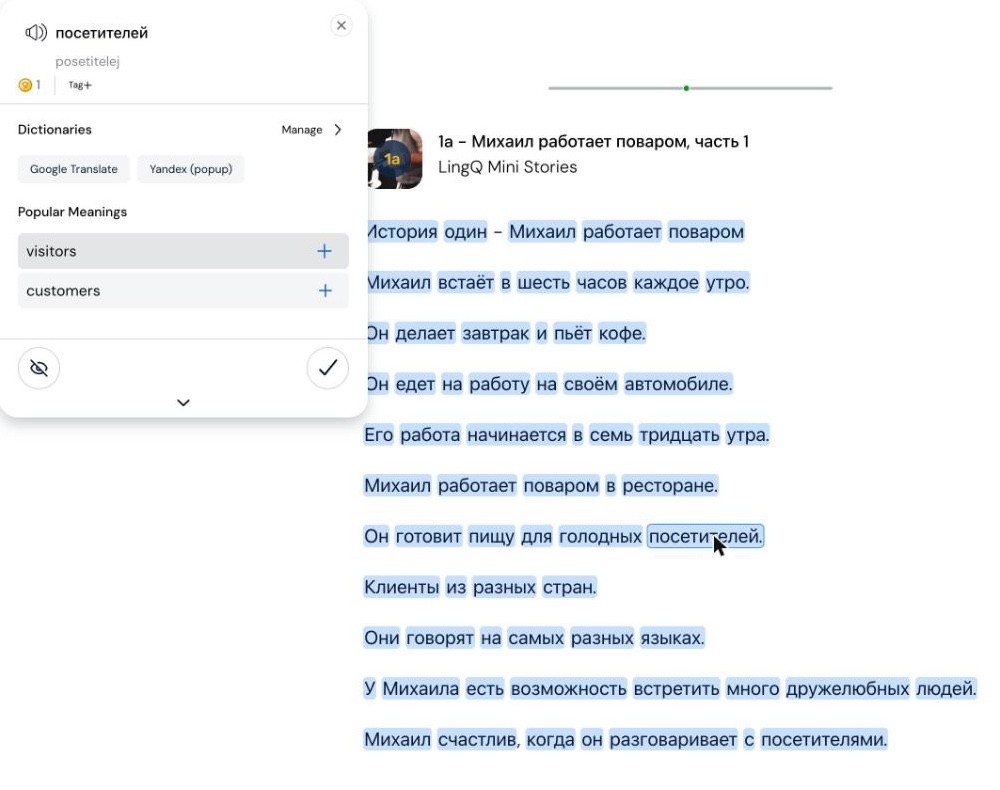
- Start as a beginner. Russian Mini Stories is a 62-lesson beginner course of short, repetitive stories with native audio, so the most common words and case endings come back again and again.
- Hours of real Russian audio. LingQ’s Russian library includes popular podcasts and YouTube channels like In Russian from Afar, Russian with Dasha, Easy Russian and the RealRussianClub Slow Russian Podcast, with matching transcripts.
- Learn from what you love. Import Russian YouTube videos, TV series, podcasts, articles and ebooks, and they become lessons with the same tools. Beginner stories, children’s fairy tales and graded readers are already in the library.
- Track your progress. LingQ counts the words you know, so you can watch your Russian grow lesson by lesson. In Russian, each word form counts separately, so the number runs higher than your true vocabulary.
- One subscription, more than 50 languages, with a free plan to start.
Does it work? LingQ co-founder Steve Kaufmann started learning Russian at about 60, mostly by listening and reading on LingQ. Within a couple of years he was reading Russian literature. He explains his approach in How I Learned Russian.
Price: free to start. Premium costs $14.99 a month or about $10 a month on the yearly plan.
Best for: anyone who wants to understand real spoken and written Russian, from beginner to advanced.
2) Duolingo: a free start with the alphabet
Duolingo’s Russian course teaches the Cyrillic alphabet and basic vocabulary with short, game-like exercises. It’s free, fun and a good way to build a daily habit in your first weeks. It’s slow going, though, and its short practice sentences give you little long-form listening or reading, so you’ll need other content as you progress. Super Duolingo removes ads and costs about $84 a year. See can you become fluent with Duolingo?.
Best for: trying Russian for free and learning to read Cyrillic.
3) Babbel: the best for grammar explanations
Babbel teaches Russian in 10- to 15-minute lessons built around everyday situations, with short English explanations of grammar, including the cases and verb aspect. Speech recognition and spaced-repetition review help new phrases stick. It costs about $17.95 a month or $107.40 a year, and every plan includes all 14 of Babbel’s languages. See our Babbel review.
Best for: beginners who like rules explained. Its Russian course goes to A1, with extra topics up to A2, so you’ll need other material after that.
4) Pimsleur: speaking-first audio lessons
Pimsleur’s Russian course has five levels of 30-minute audio lessons that get you repeating and answering out loud from the first day, which makes it popular with commuters. Premium plans add about 100 reading lessons for Cyrillic. It’s good for pronunciation and confidence, but speaking and listening stay the focus. It costs about $15 to $21 a month, depending on the plan. See the best Pimsleur alternatives.
Best for: getting comfortable speaking basic Russian out loud.
5) RussianPod101: a big library of audio lessons
RussianPod101 has hundreds of short audio and video lessons, sorted by level, each built around a dialogue with a teacher explaining the vocabulary and grammar in English. There’s a lot of material at every level. The English explanation takes up much of each lesson, though, so you hear less Russian per minute than with native content. A low-cost Basic plan unlocks most lessons, and pricier plans add more features. Discounts are frequent.
Best for: learners who like a teacher talking them through each lesson.
6) Busuu: feedback from native speakers
Busuu’s Complete Russian course runs from A1 to B2 with short lessons on vocabulary and grammar. Its standout feature is its community: native and fluent Russian speakers correct your written and spoken exercises, and you can correct learners of your own language in return. Premium unlocks the full course, and prices vary by plan and platform.
Best for: beginners who want a human to check their writing.
7) italki (or Preply): tutors for speaking
When you can understand a fair amount, a tutor gives you real conversation practice and corrects your case endings as you speak. On italki and Preply, each tutor sets their own price per lesson. Tutors are most useful once you have the vocabulary to talk, which comes from lots of listening and reading first. See how to speak Russian.
Which Russian app is best for your level?
| Your level | Best app | Add |
|---|---|---|
| Complete beginner | LingQ (Mini Stories), Babbel or Pimsleur | Duolingo for the alphabet and a free daily habit |
| Beginner (a few hundred words) | LingQ beginner podcasts and stories | Busuu for writing feedback |
| Intermediate | LingQ with imported YouTube, podcasts and series | A tutor for speaking |
| Advanced | LingQ with native TV, books and news | A tutor for polish |
The best way to learn Russian with an app
Whichever apps you use, getting past beginner Russian takes lots of listening and reading in Russian you can mostly understand, ideally every day.
- Learn Cyrillic in your first week, so you can read along with audio from the start.
- Start reading and listening right away with short beginner stories, rereading each one several times.
- Learn cases from exposure, not just charts. Look at a case table when an ending puzzles you, then let real sentences do the rest.
- Save words as you go and let them come back in new content, instead of drilling lists.
- Move to real content early: Russian podcasts, YouTube, TV shows and audiobooks you enjoy.
- Add speaking with a tutor once you understand a fair amount.
For more on this approach, see the best way to learn Russian on your own. For your first words, start with 100 useful Russian phrases.
Best app to learn Russian: FAQs
What is the best app to learn Russian?
LingQ is the best app to learn Russian if you want to get fluent. You learn from real content like podcasts, YouTube and TV series, with one-tap translations and word tracking, which helps with Russian’s many word endings. Babbel and Pimsleur are good structured starters, and Duolingo is a free way to learn the alphabet.
What is the best free app to learn Russian?
For a free start, use LingQ’s free plan for real reading and listening, and Duolingo for a free gamified course that teaches Cyrillic. Duolingo is free but slow, so add real content early.
Can you learn Russian with an app?
Yes, if the app gives you enough real listening and reading. Course apps get you started, but the US Foreign Service Institute estimates about 1,100 class hours of intensive study for English speakers to reach professional proficiency, so you need plenty of practice beyond them. LingQ co-founder Steve Kaufmann learned Russian at about 60, mostly by reading and listening on LingQ.
How long does it take to learn Russian?
The US Foreign Service Institute estimates about 1,100 class hours (44 weeks of full-time study) for its English-speaking diplomats to reach professional working proficiency in Russian. It’s an intensive-classroom benchmark, so with an hour a day expect it to take several years, with everyday conversations becoming easier long before that.
Is Duolingo good for learning Russian?
It’s good for learning the Cyrillic alphabet, building a daily habit and picking up basic vocabulary. It’s slow going, though, and offers little native audio or long-form reading, so add real content like podcasts and YouTube as you progress.
Should I learn the Russian alphabet before using an app?
You don’t need to learn it first, but learn it early. Most apps, including LingQ and Duolingo, teach Cyrillic as you go, and with focused practice you can sound out words within a week or so. Reading along with audio makes it stick fastest.
The bottom line
You might start Russian with a course app like Babbel, Pimsleur or Duolingo. But the app that decides whether you reach fluency is the one where you spend your listening and reading hours.
LingQ gives you hours of real Russian with one-tap translations, lets you import the videos and series you love, and tracks every word you learn, from your first story to your first Russian novel.
Start learning Russian with LingQ for free →
Keep reading: How long does it take to learn Russian? · Russian slang · Russian TV shows for learners · The best language learning apps
Cover photo by Michalis Pafralis on Pexels.


