



Vietnamese is spoken by about 100 million people, and it’s easier to start reading than many Asian languages, because it’s written in the Latin alphabet. But it has tones, lots of accent marks and very different vocabulary from English, and many big language apps don’t teach it at all. The US Foreign Service Institute estimates about 1,100 class hours of intensive training for its English-speaking diplomats to reach professional working proficiency.
We compared the apps that do teach Vietnamese on what they teach, what they cost and how far they can take you. A quick disclosure: we make LingQ, one of the apps on this list, so we’re not neutral. We’ve tried to be fair about what each app does best.
What is the best app to learn Vietnamese? The quick answer
The best app to learn Vietnamese is LingQ. You learn from real Vietnamese content (news, YouTube, stories and podcasts) with one-tap translations. LingQ groups the syllables of multi-syllable words, so you can tap a whole word like nhà hàng (restaurant) instead of one syllable at a time, and every word you save is highlighted wherever it appears again.
If you want a structured start, Pimsleur gets you speaking and hearing the tones from the first lesson, and Duolingo has a free beginner course. Ling has a dedicated Vietnamese course, VietnamesePod101 has a large library of Vietnamese lessons, and Mango Languages is often free through public libraries.
| App | Best for | Price (US) | Free option |
|---|---|---|---|
| LingQ | Learning from real content, beginner to advanced | Free; Premium $14.99/month or about $10/month yearly | Yes (limited) |
| Duolingo | A free beginner course and a daily habit | Free; Super about $84/year | Yes |
| Pimsleur | Speaking and hearing the tones | About $15 to $21 a month, depending on the plan | 7-day free trial |
| Rosetta Stone | Immersion-style lessons without translation | $19.99/month or $159/year (all 25 languages) | 7-day free trial |
| Ling | A structured Vietnamese course with game-like lessons | Paid subscription | Free lessons |
| VietnamesePod101 | Audio and video lessons explained in English | Low-cost Basic plan; Premium costs more | Free lessons |
| Mango Languages | A structured course, often free | $13.99/month or about $10/month yearly | Often, via a library card |
| italki (or Preply) | Speaking with a tutor | Per lesson (set by each tutor) | No |
Prices checked November 2026. They vary by country and change with sales. Babbel and Busuu don’t teach Vietnamese.
What makes Vietnamese hard, and what an app needs to do
Beginners run into three challenges right away. A good app should help with all of them.
- Tones. The standard Northern accent has six tones, and Southern Vietnamese merges two of them, so most descriptions give it five. The tone changes the meaning: ma, má, mà and mã are different words. Lots of listening is how the tones become familiar.
- Accent marks and syllables. Vietnamese uses the Latin alphabet with extra letters and marks for vowels and tones, and it puts spaces between syllables, even when two or more syllables form a single word, as in cà phê (coffee). Knowing which syllables belong together is part of the challenge.
- Vocabulary and accents. Vietnamese shares little core vocabulary with English, and the Northern and Southern accents differ in sounds and some words. It helps to pick one accent to start and hear the other later.
That’s why an app that lets you hear Vietnamese and read along with it, one word at a time, is worth more than one that only drills phrases. For more tips and resources, see how to learn Vietnamese.
1) LingQ: the best app to learn Vietnamese from real content
LingQ turns real Vietnamese content into interactive lessons. You read and listen at the same time, and you can tap any word to see its meaning, with built-in dictionaries. LingQ groups the syllables of words like đầu bếp (chef) and buổi sáng (morning), so you look up whole words. Save a word, and LingQ highlights it every time it appears again, in every lesson, so new words keep coming back until you know them.
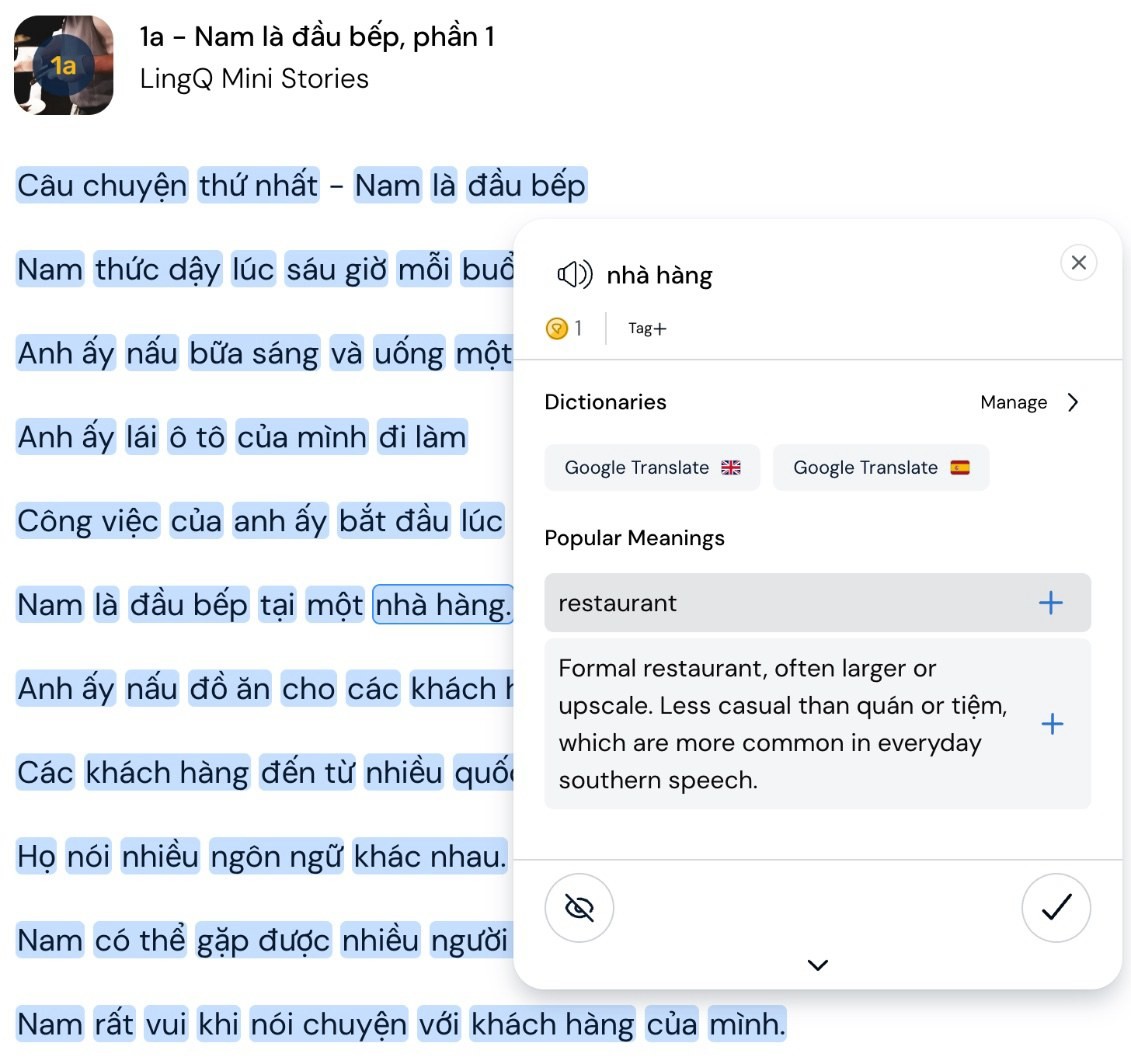
- Start as a beginner. Vietnamese Mini Stories is a 62-lesson beginner course of short, repetitive stories with native audio in a Northern accent, so the most common words come back again and again.
- Lots of real Vietnamese. The library has a daily news feed with stories from outlets such as VTV24, slow Vietnamese stories for beginners, and entertainment with Vietnamese subtitles.
- Learn from what you love. Import Vietnamese YouTube videos, Netflix shows, podcasts, articles and ebooks, and they become lessons with the same tools.
- Listen and read together. Scroll mode keeps the text in step with the audio, so you hear the tones while you see the words.
- One subscription, more than 50 languages, with a free plan to start.
Price: free to start. Premium costs $14.99 a month or about $10 a month on the yearly plan.
Best for: anyone who wants to understand real spoken and written Vietnamese, from beginner to advanced.
2) Duolingo: a free beginner course
Duolingo has a Vietnamese course for English speakers, with its usual short, game-like exercises, streaks and leagues. It’s free, with ads and usage limits, and it’s a fun way to learn your first words and get used to the tone marks. The course is short, though: it covers beginner material up to about A2, so you’ll need other resources to keep going. For a closer look at Duolingo’s limits, read can you become fluent with Duolingo?.
Best for: a free daily habit in your first months.
3) Pimsleur: speaking and tones from day one
Pimsleur’s Vietnamese course is 30 lessons of about 30 minutes of audio that get you repeating and answering out loud from the first day, which is a good way to hear and copy the tones. It’s a solid start, but it’s a single level, in the Northern (Hanoi) accent, and speaking and listening are the focus. Pimsleur costs about $15 to $21 a month, depending on the plan. LingQ co-founder Steve Kaufmann reviews it in his Pimsleur review.
Best for: getting comfortable speaking basic Vietnamese out loud.
4) Rosetta Stone: immersion-style lessons
Rosetta Stone teaches Vietnamese without translation: you match words and phrases with pictures and repeat them, with speech recognition to check your pronunciation. A subscription costs $19.99 a month or $159 a year and includes all 25 of its languages. It’s polished, but some learners find the no-translation approach slow. It relies mainly on learning through context rather than explanations in English, so if you want tones and grammar explained, you may want another resource alongside it.
Best for: learners who like a picture-based course and want access to other languages too.
5) Ling: game-like lessons built for Vietnamese
Ling is a language app that teaches more than 70 languages, including many less commonly taught ones, and has a dedicated Vietnamese course. Its short, game-like lessons cover vocabulary, grammar and pronunciation, with dialogue practice. Some lessons are free, and a subscription gives you the full course. It’s a guided course rather than a way to learn from real Vietnamese content.
Best for: learners who want a guided, game-like Vietnamese course.
6) VietnamesePod101: lessons explained in English
VietnamesePod101 has a large library of short audio and video lessons, from absolute beginner to advanced, many built around a dialogue with a teacher explaining the vocabulary and grammar in English. If you want mostly uninterrupted native Vietnamese, though, you’ll want native content as well. A low-cost Basic plan gives you most lessons, and pricier plans add more features.
Best for: learners who like a teacher talking them through each lesson.
7) Mango Languages: a structured course, often free
Mango has a Vietnamese course built around everyday conversations, with notes on grammar and culture. It costs $13.99 a month or about $10 a month yearly, but many public libraries in the US and elsewhere give members free access, so check yours before paying.
Best for: beginners who want a free, structured course through their library.
8) italki (or Preply): tutors for speaking
A tutor gives you real conversation practice and corrects your tones as you speak. Beginners can use one for pronunciation and guided speaking, and more advanced learners for free conversation. On italki and Preply, each tutor sets their own price per lesson, and you can choose a tutor with the accent you want to learn. Pair lessons with lots of listening and reading, so you have more to say each time.
Best for: speaking practice and feedback on your tones.
Which Vietnamese app is best for your level?
| Your level | Best app | Add |
|---|---|---|
| Complete beginner | LingQ (Mini Stories), Pimsleur or Duolingo | Ling or Mango for a guided course |
| Beginner (a few hundred words) | LingQ Mini Stories and slow Vietnamese stories | VietnamesePod101 for explanations |
| Intermediate | LingQ with imported YouTube, podcasts and series | A tutor for speaking |
| Advanced | LingQ with Vietnamese news, books and TV | A tutor for polish |
The best way to learn Vietnamese with an app
Whichever apps you use, getting past beginner Vietnamese takes lots of listening and reading in Vietnamese you can mostly understand, ideally every day.
- Start listening from day one, so the tones become familiar before you try to produce them.
- Pick one accent to start. Northern (Hanoi) Vietnamese is widely used in formal media and many learning materials; Southern is common in the US. Either is fine.
- Read and listen to the same short stories several times, paying attention to the tone marks.
- Save words as you go and let them come back in new content, instead of drilling lists.
- Move to real content early: Vietnamese YouTube, music, news and series you enjoy.
- Add speaking with a tutor once you understand a fair amount.
Best app to learn Vietnamese: FAQs
What is the best app to learn Vietnamese?
LingQ is the best app to learn Vietnamese if you want to understand real Vietnamese. You learn from news, YouTube, stories and podcasts with one-tap translations, and LingQ groups multi-syllable words so you can look up whole words. Pimsleur is good for speaking and tones and Duolingo for a free start. Ling has a dedicated Vietnamese course, and VietnamesePod101 has a large library of Vietnamese lessons explained in English.
Does Duolingo teach Vietnamese?
Yes. Duolingo has a free Vietnamese course for English speakers, but it’s short and covers beginner material up to about A2. Babbel and Busuu don’t teach Vietnamese at all.
What is the best free app to learn Vietnamese?
For a free start, use Duolingo’s beginner course, LingQ’s free plan for real reading and listening, the free lessons on Ling and VietnamesePod101, and Mango Languages if your public library offers it.
Is Vietnamese hard to learn for English speakers?
It’s a challenge mainly because of the tones and the new vocabulary. The US Foreign Service Institute estimates about 1,100 class hours of intensive training for its English-speaking diplomats to reach professional working proficiency. But the Latin alphabet makes reading easier to start than Chinese, Japanese or Thai, and the grammar is fairly simple: verbs don’t change for tense or person.
Should I learn Northern or Southern Vietnamese?
Either is fine. Northern (Hanoi) Vietnamese is widely used in formal media and many learning materials, while Southern Vietnamese is common in Ho Chi Minh City and among Vietnamese communities in the US. Pick the one you’ll hear most, and get used to the other through listening later.
How long does it take to learn Vietnamese with an app?
It varies a lot by learner, method and how much you speak. Apps get you started, but conversational Vietnamese takes a lot of listening and reading. Expect several months of daily listening and reading before you can follow simple conversations.
The bottom line
Babbel and Busuu skip Vietnamese, and Duolingo’s course is short, so your choice is narrower than for Spanish or French. Pimsleur, Ling, VietnamesePod101 and Mango are good structured starters. But the app that decides how far you get is the one where you spend your listening and reading hours.
LingQ gives you hours of real Vietnamese with one-tap translations, beginner Mini Stories and daily news, and lets you import the videos and series you love, from your first story to your first Vietnamese novel.
Start learning Vietnamese with LingQ for free →
Keep reading: How to learn Vietnamese · Best app to learn Thai · The best Pimsleur alternatives · The best language learning apps
Cover photo by Son Tung Tran on Pexels.


