




TL;DR: The easiest languages to learn for English speakers are Spanish, Italian, Portuguese, Dutch, Norwegian and Swedish. They share thousands of words with English and have friendly grammar. French and Romanian are close behind. But “easy” only gets you started. What decides how fast you actually learn is how much of the language you read and listen to. That’s exactly what LingQ is built for.
Ask Steve Kaufmann, LingQ’s co-founder, who speaks over 20 languages, what the easiest language to learn is, and he’ll tell you two things. For an English speaker, it’s probably Spanish. And the “easiest” language is really the one you’re most motivated to learn, because motivation is what keeps you coming back to the language day after day.
Both answers are true, and this guide covers both. You’ll see which languages give English speakers a genuine head start, why, and how long they take according to the US government’s own estimates. Then you’ll see how to learn whichever one you pick much faster than most people do.
The Quick Answer: Easiest Languages Compared
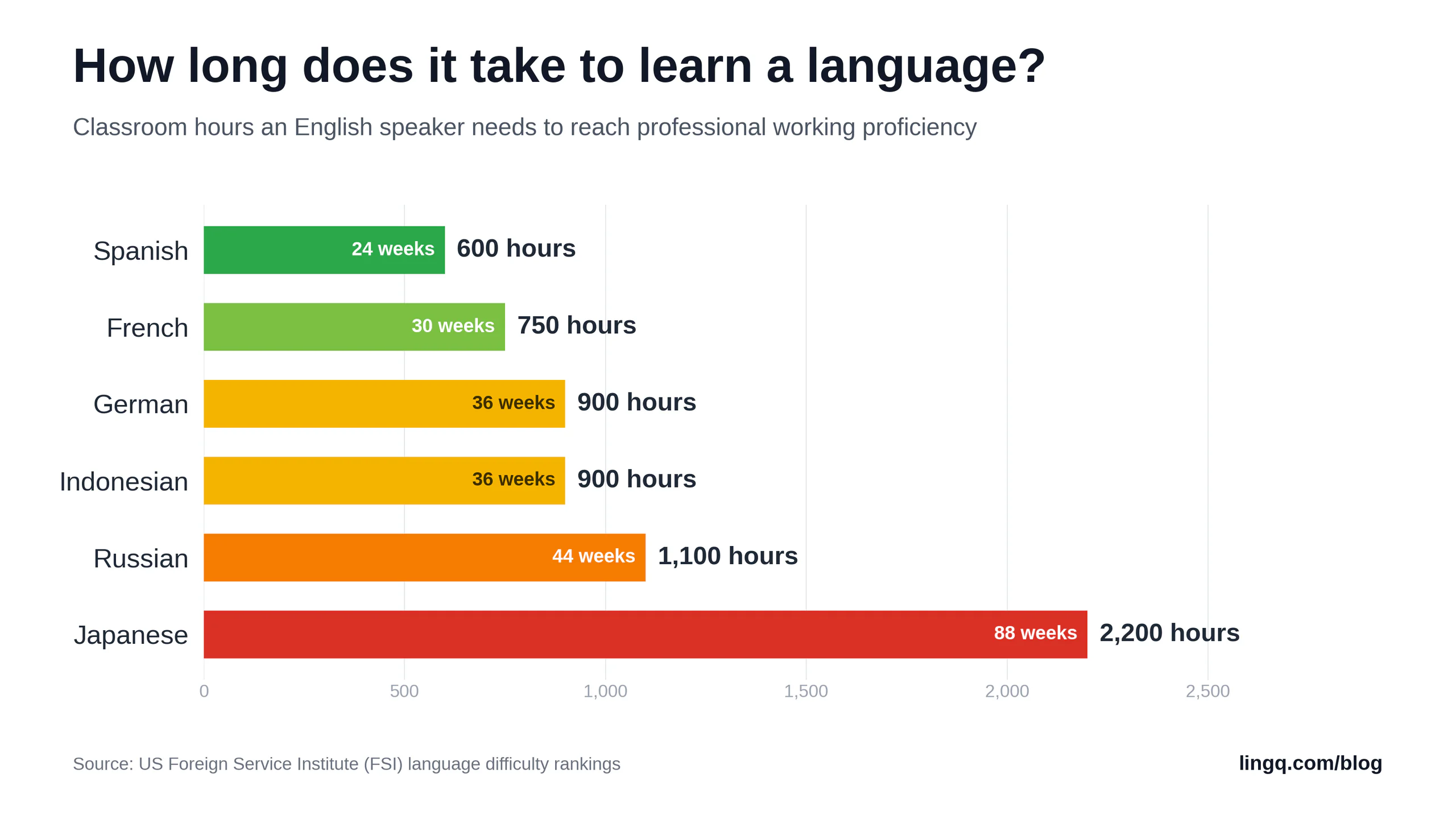
The US Foreign Service Institute (FSI) trains American diplomats and publishes how long its students take to reach professional working proficiency. Its easiest group, Category I, takes 24 to 30 weeks of full-time study. Here’s how the easiest languages compare:
| Language | FSI estimate | Why it’s easy for English speakers | Start learning |
|---|---|---|---|
| Spanish | 24 weeks (~600 hrs) | Thousands of shared words, phonetic spelling | Spanish on LingQ |
| Italian | 24 weeks (~600 hrs) | Familiar vocabulary, pronounced as written | Italian on LingQ |
| Portuguese | 24 weeks (~600 hrs) | Close to Spanish, huge amount of content | Portuguese on LingQ |
| Dutch | 24 weeks (~600 hrs) | English’s closest major relative | Dutch on LingQ |
| Norwegian | 24 weeks (~600 hrs) | Simple verbs, English-like word order | Norwegian on LingQ |
| Swedish | 24 weeks (~600 hrs) | Germanic vocabulary, easy grammar | Swedish on LingQ |
| French | 30 weeks (~750 hrs) | About a third of English words come from French | French on LingQ |
| Romanian | 24 weeks (~600 hrs) | Romance vocabulary, phonetic spelling | Romanian on LingQ |
| Danish | 24 weeks (~600 hrs) | Germanic grammar, but tricky pronunciation | Danish on LingQ |
| Indonesian | 36 weeks (~900 hrs) | No tenses, no gender, Latin alphabet | Indonesian on LingQ |
Remember that these are hours of full-time classroom study for professional proficiency. Most self-taught learners won’t follow a classroom schedule, and you don’t need professional proficiency to enjoy a book or a conversation. The table is most useful for comparison: Spanish takes roughly a third of the time Japanese or Arabic does.
Takeaway: If you want the shortest path to real conversations, pick from the top of this table.
What Actually Makes a Language Easy?
Why is Spanish easy and Hungarian hard? It comes down to five things.
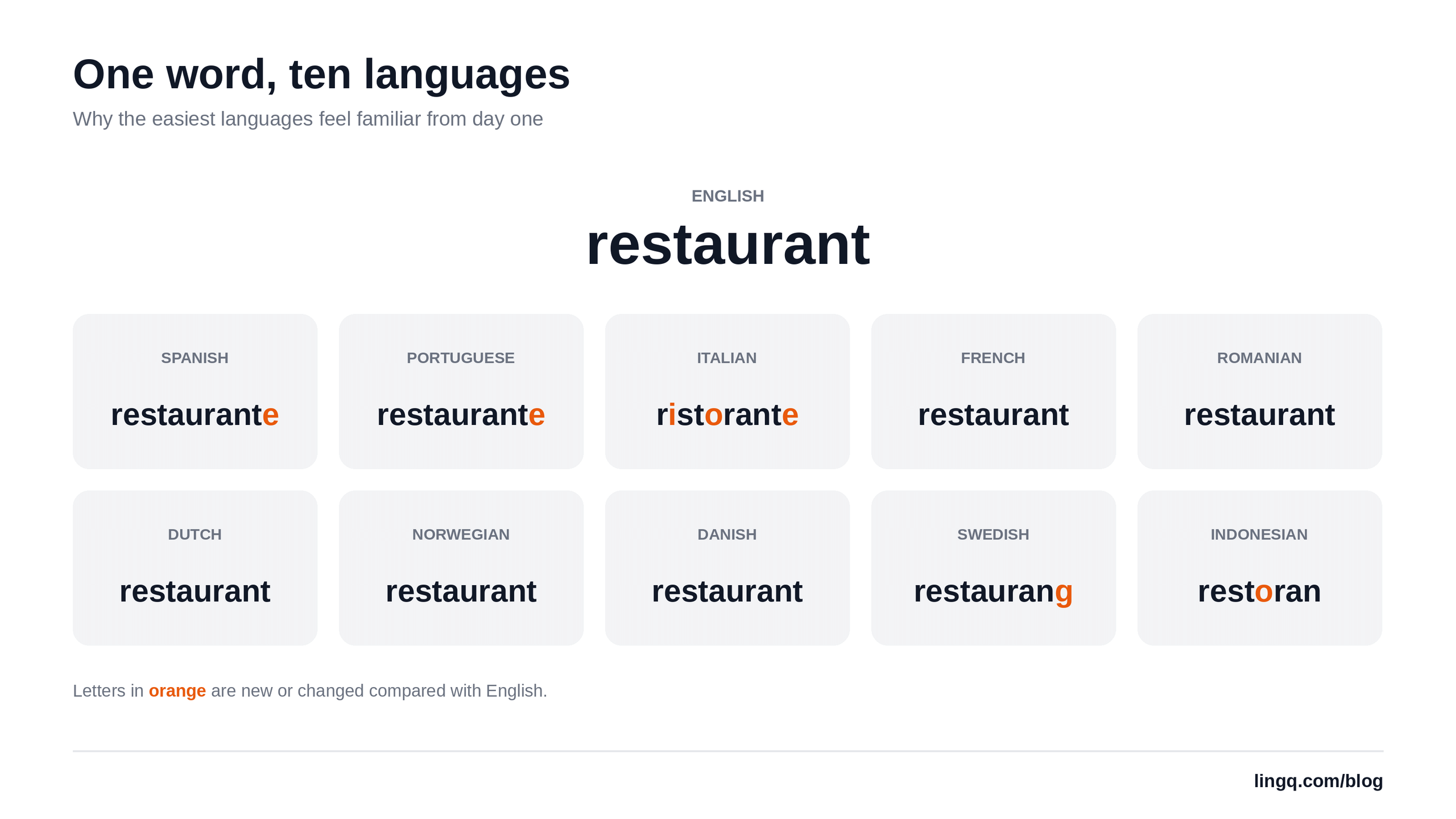
1. Shared vocabulary. This is the biggest factor by far. Language learning is mostly learning words, and every word you already half-know is one you don’t have to learn from scratch. English borrowed heavily from French and Latin, so Romance languages are full of words you’ll recognize on day one: restaurante, problema, importante.
2. Familiar grammar. Languages that put words in a similar order to English (subject, verb, object) feel natural sooner. Fewer noun cases and simpler verb endings help too.
3. Pronunciation and spelling. Spanish and Italian are written almost exactly as they sound. Danish and French are not, which slows down listening.
4. The alphabet. A language in the Latin alphabet lets you start reading immediately. A new script adds months.
5. How much content you can find. This one gets overlooked. The more podcasts, shows, books and articles exist in a language, the easier it is to get the huge amount of listening and reading that real fluency requires. Spanish and Portuguese have an almost unlimited supply. Smaller languages take more digging.
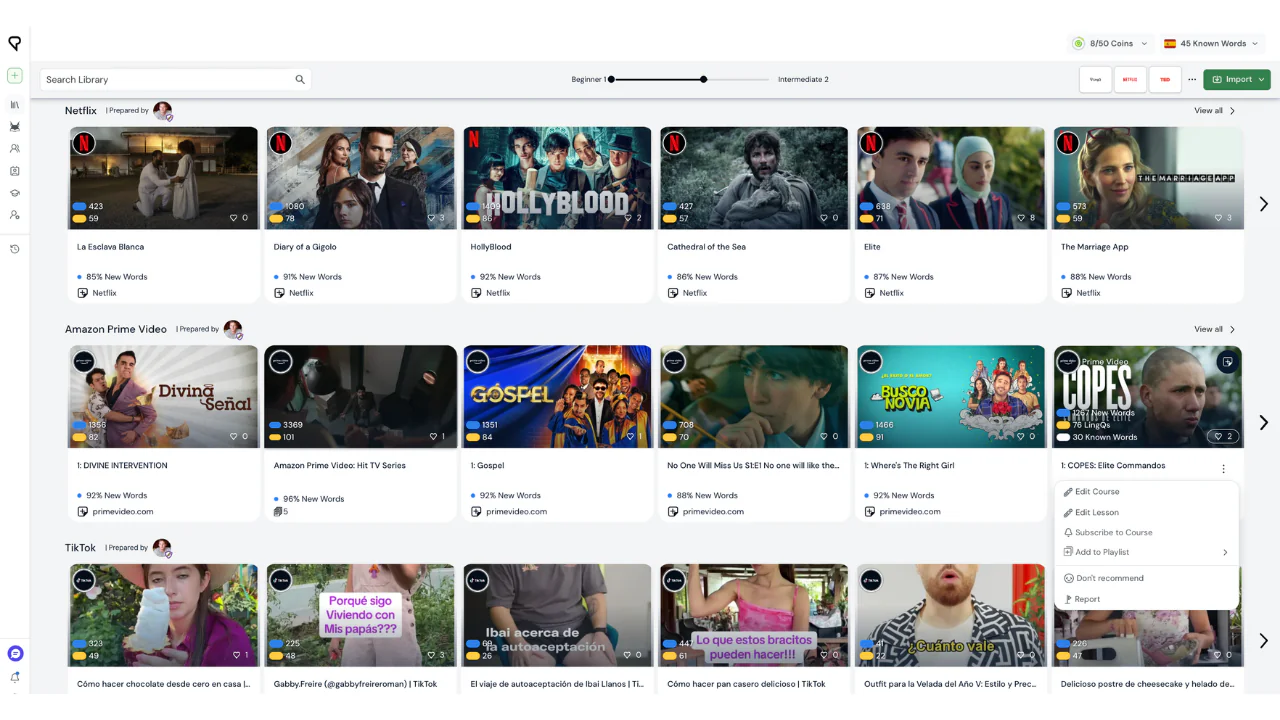
That last point is where your choice of tools matters most. On LingQ, you can turn almost any piece of content into a lesson: a YouTube video, a podcast episode, a news article, an ebook, even Netflix subtitles. Every word is clickable for an instant translation, and LingQ tracks every word you learn. So even for a smaller language like Danish or Romanian, you’re never short of things to read and listen to.
Takeaway: When you compare languages, look at shared vocabulary first and available content second.
The 10 Easiest Languages to Learn
1. Spanish
Spanish is the classic answer, and Steve agrees: for English speakers, it’s the easiest. You’ll recognize thousands of words right away. Spelling is phonetic, so once you know the rules you can pronounce almost anything you read. And with over 500 million speakers, you’ll find people to talk to, and content to enjoy, everywhere.
El restaurante tiene una terraza fantástica. The restaurant has a fantastic terrace.
Watch out for: verb conjugations and the Spanish subjunctive, which take time. You get used to them through exposure far faster than through drills.
On LingQ: Spanish has one of LingQ’s biggest libraries, from beginner Mini Stories to podcasts, audiobooks and news. Want to learn from TV? Start with our list of the best Spanish shows on Netflix and import the episodes. Start learning Spanish on LingQ →
2. Italian
Italian shares much of Spanish’s appeal: Latin-based vocabulary, clear vowels and spelling that matches pronunciation. Many learners find it slightly easier to pronounce than Spanish, and the culture (food, music, film, art) gives you endless reasons to keep going.
La musica è importante per me. Music is important to me.
Watch out for: double consonants (nono vs. nonno) and a richer set of verb tenses than English.
On LingQ: build your ear with Italian podcasts and audiobooks, read along with the transcript, and save new words with a tap. Start learning Italian on LingQ →
3. Portuguese
If you can read Spanish, you can already guess much of written Portuguese. Grammar and vocabulary are close to Spanish, and Brazil produces a huge amount of music, TV and YouTube content.
O hotel fica perto da praia. The hotel is near the beach.
Watch out for: nasal vowels and the differences between Brazilian and European Portuguese. Pick one variety and listen to it a lot.
On LingQ: choose Brazilian or European content and stick with it. Lots of listening is what makes the nasal sounds click. Start learning Portuguese on LingQ →
4. Dutch
Dutch is often described as somewhere between English and German, and you’ll see why the first time you read it. Many basic words are nearly identical, and you’ll start following simple texts surprisingly early.
Mijn broer drinkt koffie met melk. My brother drinks coffee with milk.
Watch out for: the guttural g sound, and the fact that many Dutch speakers will switch to English when they hear your accent. Content you choose yourself won’t switch on you.
On LingQ: since Dutch speakers switch to English so quickly, reading and listening is the most reliable way to get lots of Dutch. Import Dutch YouTube channels and news, or learn from Netflix with our guide to learning Dutch with The Perfect Lie. Start learning Dutch on LingQ →
5. Norwegian
Norwegian may be the most underrated language on this list. Word order is close to English, and verbs don’t change for different people: jeg er, du er, han er (I am, you are, he is). Learning to conjugate a verb basically means learning one form per tense.
Jeg har en hund og en katt. I have a dog and a cat.
Watch out for: regional dialects and two written standards (Bokmål and Nynorsk). Most learners start with Bokmål.
On LingQ: read and listen to Norwegian lessons with audio, and build up the words you need for real conversations. Start learning Norwegian on LingQ →

6. Swedish
Swedish shares Norwegian’s simple verbs and English-like word order, along with lots of Germanic vocabulary you’ll recognize. Sweden’s music, crime fiction and TV give you plenty of content to learn from.
Jag kommer från Kanada. I come from Canada.
Watch out for: pitch accent, the melody that can change a word’s meaning. You absorb it through listening, not rules.
On LingQ: pair Swedish audio with the text so you hear the melody while you read. Start learning Swedish on LingQ →
7. French
French gets a 30-week FSI estimate rather than 24, but English speakers have a hidden advantage: roughly a third of English vocabulary comes from French. You already know restaurant, gouvernement and important. You just pronounce them differently.
Le gouvernement a une nouvelle politique. The government has a new policy.
Watch out for: spelling that doesn’t match pronunciation, and fast spoken French. Listening is the skill to invest in most.
On LingQ: listening while reading the transcript is the fastest way to connect French spelling to French sounds, and it’s exactly how LingQ lessons work. Start learning French on LingQ →
8. Romanian
Romanian surprises people. It’s a Romance language, so most of its vocabulary is related to Italian, French and Spanish. Steve points out that this shared vocabulary makes Romanian quite easy despite its more complex grammar, especially if you already know another Romance language.
Familia mea locuiește în București. My family lives in Bucharest.
Watch out for: noun cases and Slavic loanwords. Less content is available than for Spanish, so you’ll need to look for it.
On LingQ: import Romanian news and YouTube, and let LingQ track the words you learn. Start learning Romanian on LingQ →
9. Danish
On paper, Danish is as easy as Norwegian: similar grammar, similar vocabulary, simple verbs. Written Danish and Norwegian are close enough that readers of one can often follow the other. The challenge is the sound. Spoken Danish swallows many of its consonants, so listening takes real practice.
Jeg kan godt lide musik. I like music.
Watch out for: a big gap between how Danish is written and how it sounds.
On LingQ: this is where reading along with audio pays off most. Seeing the text while you listen trains your ear to hear words Danes barely pronounce. Start learning Danish on LingQ →
10. Indonesian
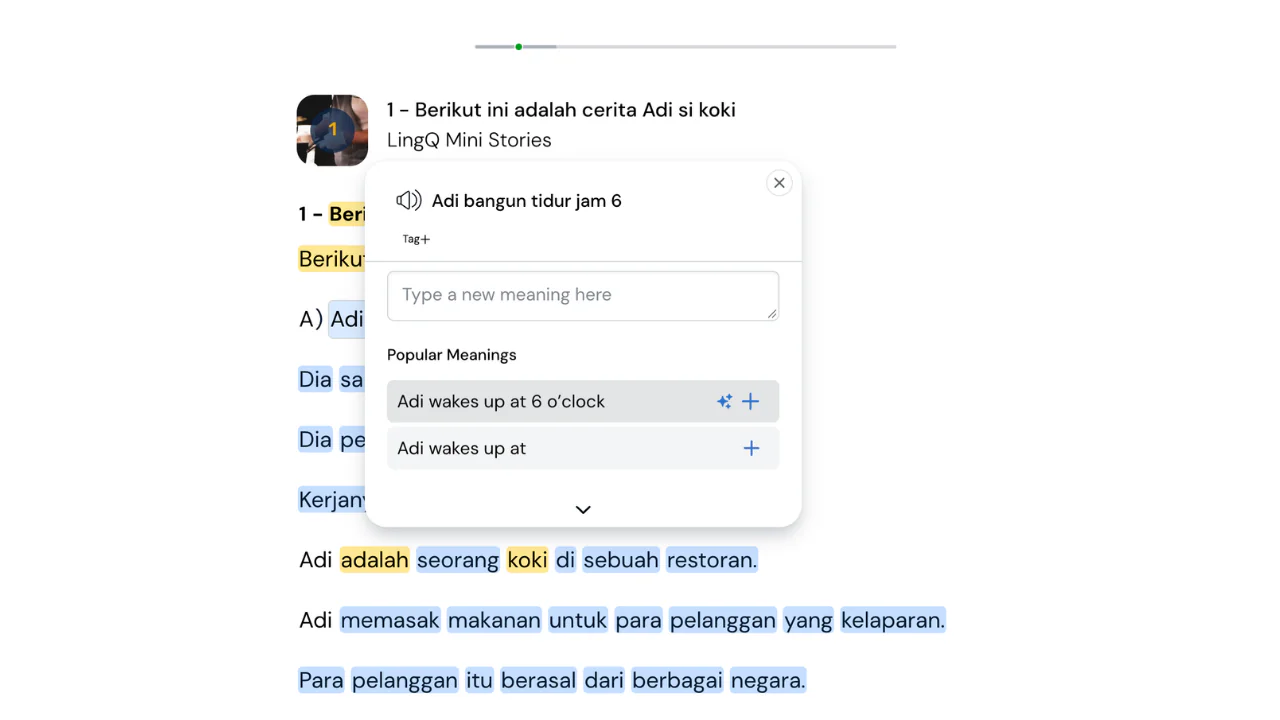
Indonesian is the easiest major Asian language for English speakers. FSI puts it at 36 weeks. There are no verb conjugations, no grammatical gender and no tenses (time is shown with words like sudah, “already”), and it uses the Latin alphabet.
Saya mau makan nasi goreng. I want to eat fried rice.
Watch out for: formal and informal registers, and many regional languages mixed into everyday speech.
On LingQ: start with short, simple lessons and work your way up to real Indonesian content. Start learning Indonesian on LingQ →
Also worth considering
German takes FSI’s 36 weeks, thanks to its cases and three genders, but it shares a huge amount of basic vocabulary with English. Afrikaans is one of the simplest grammars of any Germanic language. Malay is very close to Indonesian, and Swahili uses the Latin alphabet with very regular pronunciation. All of them are available on LingQ.
Takeaway: Choose the language you’ll actually enjoy spending time with. Any of these ten gives you a real head start.
Steve Kaufmann explains why motivation and shared vocabulary matter more than any ranking.
Easy to Start Isn’t the Same as Easy to Finish
Here’s what the rankings leave out. Even “easy” languages take hundreds of hours. Six hundred classroom hours is a lot of Spanish. Nobody gets fluent in a few weeks, whatever the ads say.
What separates people who make it from people who quit isn’t which language they chose. It’s how much time they spend with the language, and whether that time is enjoyable enough to keep going.
That’s the idea LingQ is built on. Instead of drilling isolated phrases, you learn the way Steve learned his 20+ languages: by reading and listening to lots of content you actually care about. Here’s what that looks like in practice:
- Pick content you like. Choose from LingQ’s library, from beginner Mini Stories to podcasts and audiobooks, or import your own: a YouTube video, a podcast, an article, an ebook, or Netflix subtitles with the browser extension.
- Read while you listen. Every lesson pairs text with audio, so you connect spelling and sound from day one.
- Tap any word you don’t know. You get an instant translation and save the word. When it appears again in other content, LingQ highlights it, so you see it in new contexts.
- Watch your known words grow. LingQ counts every word you learn. Seeing that number climb is one of the most motivating things in language learning.
- Review with spaced repetition. Your saved words become flashcards automatically when you want extra review.
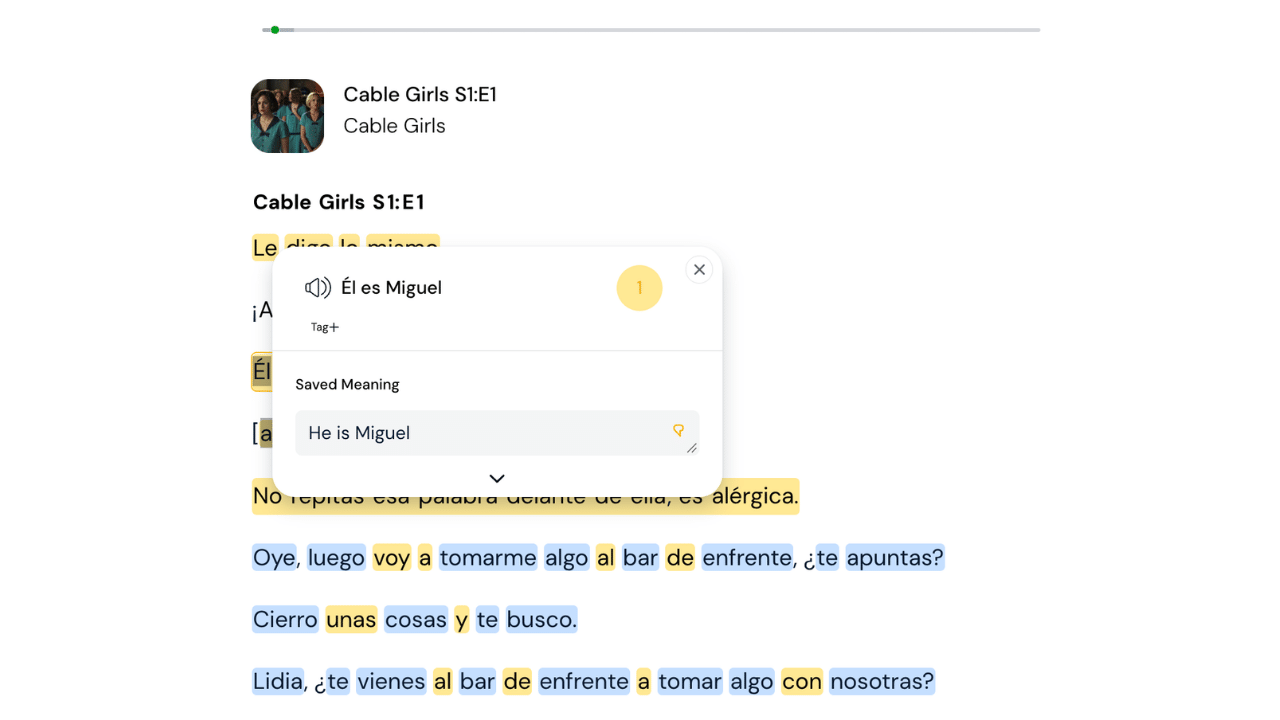
Reading a Spanish lesson on LingQ: tap any blue word for an instant translation.
Thirty minutes a day like this adds up to around 180 hours a year, and those hours are enjoyable instead of a chore. That’s how an “easy” language actually becomes a language you speak.
If you’re coming from an app like Duolingo and feel stuck, our guide to the best Duolingo alternatives explains what to do next.
Takeaway: The easiest language to learn is the one you spend the most enjoyable hours with. Choose your language, then make the hours easy.
How to Choose Your Language
Still deciding? Use these questions:
- Want the fastest path to conversations? Spanish. It’s easy, widely spoken, and has endless content.
- Love food, art or opera? Italian.
- Planning to travel in Brazil, or love its music? Portuguese.
- Living in or moving to the Netherlands or Scandinavia? Dutch, Norwegian, Swedish or Danish.
- Already know a Romance language? Romanian or Portuguese will feel like a bonus language.
- Want an Asian language without a new script? Indonesian.
- Up for a challenge? Read Steve’s take on the hardest languages to learn. Plenty of people learn those too.
Can’t decide between two? Try both on LingQ for a week. Read and listen to a few beginner lessons in each and notice which one you look forward to opening. That’s your answer.
FAQs
What is the easiest language to learn for English speakers?
Spanish is the most common answer, and it’s Steve Kaufmann’s pick too. It shares thousands of words with English, is spelled the way it sounds, and has more learning content than almost any other language.
What is the easiest language to learn in the world?
There’s no single answer, because it depends on the languages you already speak. For English speakers, Spanish, Italian, Portuguese, Dutch, Norwegian and Swedish are easiest. For a Spanish speaker, Italian or Portuguese would be easier still.
How long does it take to learn an easy language?
The FSI estimates around 600 classroom hours for professional working proficiency in languages like Spanish and Italian. With 30 to 60 minutes a day, you can follow simple conversations and podcasts within months, and fluency takes a few years of steady effort.
Is French harder than Spanish?
A little. FSI puts French at 30 weeks versus 24 for Spanish, mainly because French spelling and pronunciation don’t match as neatly. But English speakers already know many French words, so reading French comes quickly.
What is the easiest Asian language to learn?
Indonesian. It uses the Latin alphabet and has no verb conjugations, genders or tenses. FSI estimates around 900 hours.
What's the best way to learn an easy language quickly?
Spend as many hours as you can reading and listening to content you enjoy. LingQ lets you learn from podcasts, YouTube, books and Netflix in all of these languages, with instant translations and vocabulary tracking.
Start Learning the Easiest Language for You
Every language on this list gives you a head start. Now make it count. Pick the one you’re most curious about, open LingQ, and start with a short lesson today. Read along, listen, tap the words you don’t know, and watch your known word count grow from day one.
It’s free to start, and every language in this guide is waiting for you.