


“Every sentence was like a math equation”
Dave’s first two attempts at a foreign language went the way they go for a lot of people. He took Spanish in high school in 2001 and German in college in 2011. Both times, he came out the other end remembering almost nothing.
“I hated grammar,” he says. “Every sentence was like a math equation we were trying to solve, and I loathe math.” He gave up on languages after college, even though he’d always dreamed of being the kind of person he saw in the movies he grew up with: the spy or the Indiana Jones type who arrives in a new country and just speaks the language.
In 2020, his girlfriend at the time wanted them to move to a Spanish-speaking country, and she was using Duolingo. Dave tried it for a month and couldn’t stand it. “I hate being tested,” he says. The constant right-or-wrong answers and the gamification put him off rather than motivating him.
So he went looking for how people actually learn languages. He found Olly Richards’ storybooks, Steve Kaufmann’s videos and the idea of comprehensible input: that you acquire a language by spending time with content you can mostly understand. That’s how he found LingQ.
The first two years: liking LingQ, but using it badly
Dave is honest that his start wasn’t efficient. He liked LingQ, but for about a year and a half he didn’t really know how to use it. He mostly skipped the beginner Mini Stories and jumped straight into transcripts of TV shows while he was still a beginner. He also flip-flopped, stopping LingQ for a few months at a time to try Anki instead.
What changed things was a simple principle he took from the Refold method: do a controlled amount of intensive study every day, then spend the rest of your time immersed in the language at whatever level you’re at. Around the winter of 2022, he started using LingQ as his intensive study tool, and that’s when it clicked.
One sentence, one puzzle
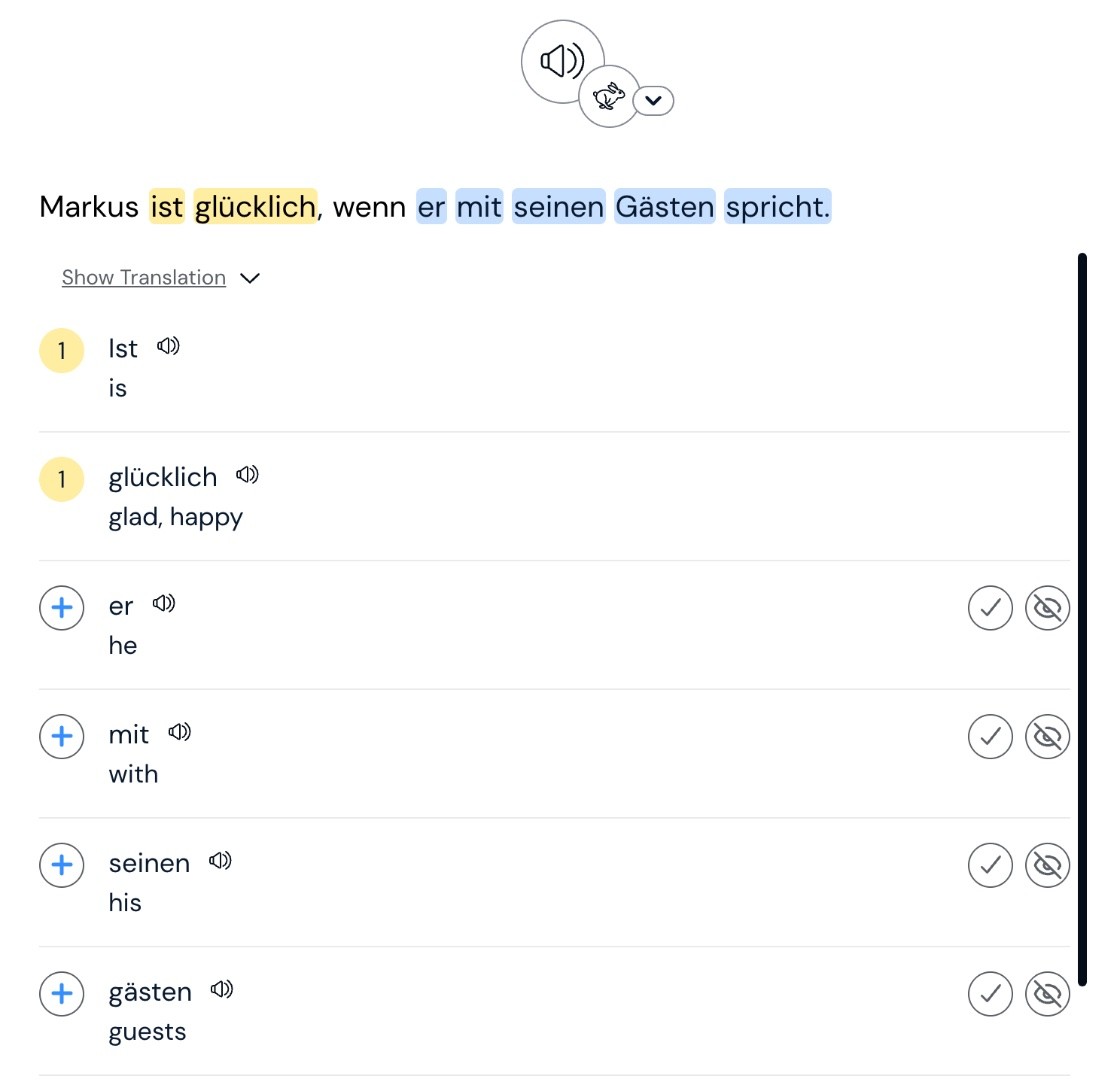
Dave almost never uses LingQ’s page view. He studies in sentence mode, with one sentence on the screen at a time.
“One sentence in front of me is one puzzle,” he explains. He reads it, listens to it, looks up the words he doesn’t know, and rereads it until the meaning comes through, using the sentence translation only as a last resort. He believes this is what taught him Spanish grammar: “It’s not just knowing the words. It’s how these words fit together to create meaning.”
A few other habits make it work for him:
- TV show transcripts over textbooks. Reading the transcript of an episode he’s just watched is more fun, because he already knows the story. He says it also helps his speaking, because shows and podcasts are closer to how people really talk.
- Listening until he “hears” the language. When audio synced with the text became available on LingQ, he called it a game changer. For years he’d play a sentence, close his eyes and listen, until he started hearing the accent in his head. Only then did he move on to reading without audio.
- Rating words by feel. He sets every word’s status himself, moving it through statuses 1 to 4 and eventually to Known, and never lets it change automatically. Words he understands but hasn’t fully acquired stay in what he calls “level 4 purgatory” for a long time, so he knows which ones still need attention.
- Physical books for extensive reading. For Dave, LingQ is for intensive study, not a general e-reader. Extensive reading happens in printed books.
Where his Spanish is now
Today Dave is around C1 in Spanish “on a good day”. He’s read about 30 books in Spanish and now reads them without looking anything up. LingQ counts almost 27,000 known words, but he thinks the real number is closer to 30,000, because a lot of his reading happened outside the app.
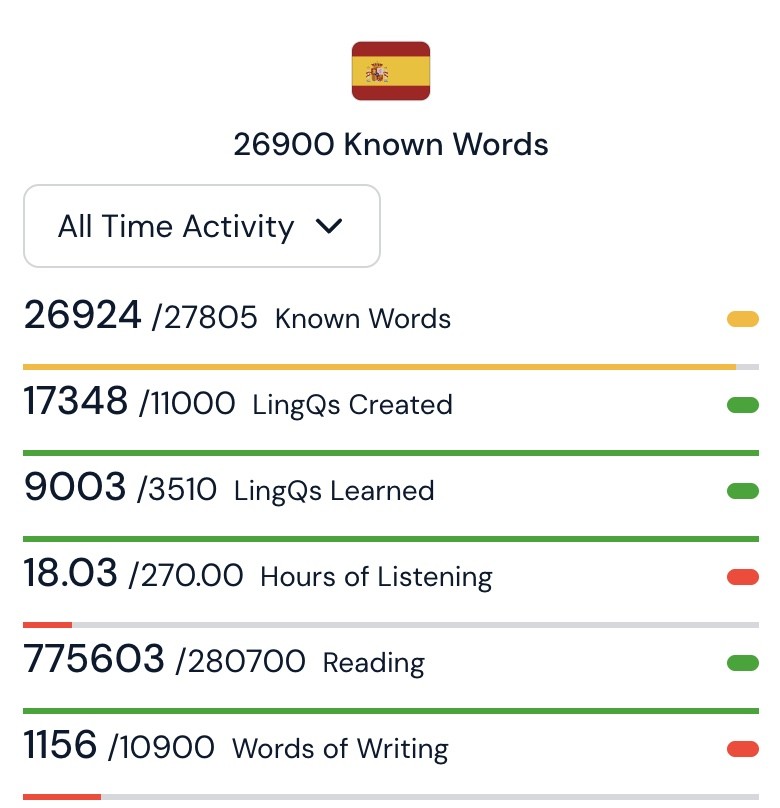
The numbers matter less to him than what he can do. “Can I read a page of a book without having to look up words and get 100% of the meaning?” That’s the test he uses.
He still reads Spanish transcripts in LingQ for 5 to 15 minutes a day, and he practises speaking at Spanish meetup groups.
The one thing he’d change: speaking
There’s one part of his Spanish journey Dave would do differently. He avoided speaking for about a year and a half, assuming it would come on its own after enough input. It didn’t. “You don’t just come out of thousands of hours of comprehensible input being able to speak fluently,” he says. He took lessons with an online tutor to get going, and now speaks easily.
So with German, he started speaking from the moment he committed to it, even if only a word or a phrase at a time. For him, speaking is the skill of turning passive vocabulary into active vocabulary and letting sentences form on their own, and it takes practice.
Round two: German, and doing it right from the start
Dave had started and stopped German several times over the years. In the winter of 2025, he committed to it, and this time he already knew exactly how to use LingQ. Almost all of his intensive German study happens there.
He began with LingQ’s Mini Stories and guided beginner courses, plus short dialogues from Olly Richards that he uploaded himself, and repeated them over and over, the way Steve Kaufmann recommends. Then he moved on to longer lessons: Easy German videos from YouTube, One Piece in German, and his favourite show, Mord mit Aussicht. He’s also reading the Rubinrot trilogy in LingQ, line by line, and is now on the second book, Saphirblau.
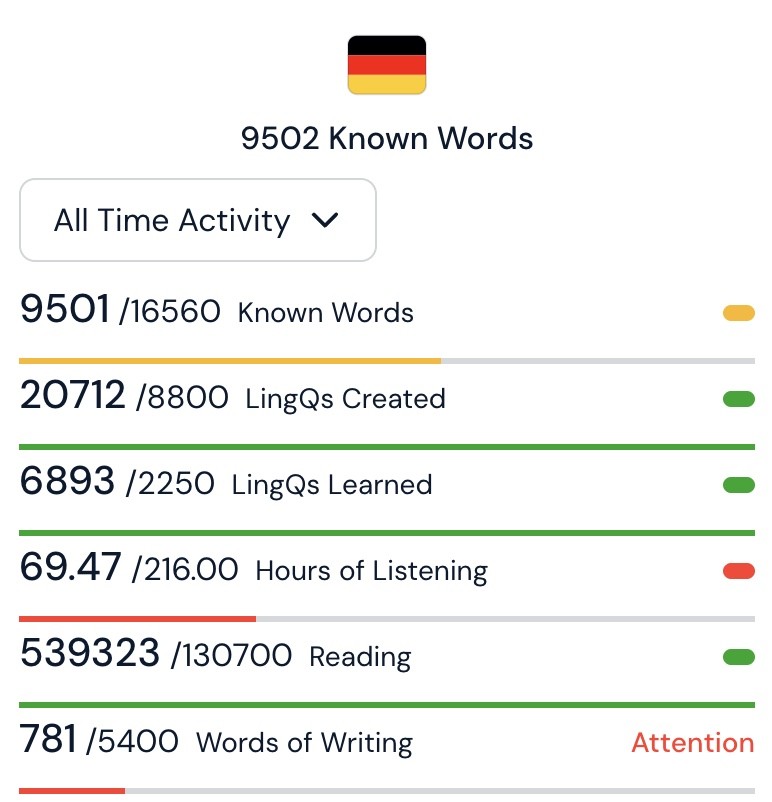
About a year and a half into serious study, he’s at a solid B1 and close to B2, with about 9,500 known words in LingQ. He says that number is accurate, because nearly all of his German has been learned in the app.
Dave’s daily routine
German:
- 5 to 10 minutes of flashcards on the words from his last lesson. He uses a “laid-back” Anki deck with five new cards a day as well.
- 15 to 40 minutes of intensive study in LingQ sentence mode, about 50 to 100 sentences a day.
Spanish:
- 5 to 15 minutes of reading TV show or podcast transcripts in LingQ, with no flashcards any more.
On top of that, he watches, listens, reads and tries to “live the language” as much as he can. What he likes about LingQ is that he controls the dose: “I can control how many sentences I go over.” He used to do 200 to 350 Spanish sentences a day when he had more time.
Dave’s advice for new learners
If he started another language tomorrow, Dave would go through every one of LingQ’s beginner Mini Stories and guided courses, such as “Who is she?”, “Greetings and goodbyes” and “Eating out”, and repeat them again and again. “These basic guided lessons give the perfect foundation in any language,” he says. After each lesson, he’d do a quick round of flashcards.
His other advice comes from experience: learn how the app works, learn to judge whether content is at the right level for you, and start speaking earlier than he did. Over six years, he estimates that about 80% of his time in language apps has been on LingQ, and 90 to 95% for German. “I can’t wait to get through my sentences in Spanish and German every day,” he says. “It really works for me.”
For a very different route to fluency, read Kevin’s 10,000-hour Mandarin story.
FAQ
Does comprehensible input work for Spanish?
For Dave, yes. He went from remembering almost nothing of high school Spanish to around C1, mostly through reading and listening to content he could follow. He also needed speaking practice, which input alone didn’t give him.
What is sentence mode on LingQ?
It shows one sentence of a lesson at a time, with its audio when the lesson has audio, so you can focus on understanding it fully before moving on. Dave uses it for all his intensive study.
Should you start speaking early?
Dave waited a year and a half with Spanish and found speaking hard afterwards. With German he started speaking from the start and found it much easier.
How many words do you need for C1?
There’s no fixed number, and LingQ’s known-word count is a personal progress measure, not a CEFR threshold. Dave has almost 27,000 known words in LingQ for Spanish and estimates his real vocabulary at about 30,000.
Start learning the way Dave does
Try LingQ’s German or Spanish Mini Stories for free, then move on to the shows and books you enjoy.
Start learning German on LingQ →
Start learning Spanish on LingQ →
Cover photo by Yuri Félix on Pexels.


