

How to Learn French Fast: What Actually Works
 Tyler Tolman
16 Sep 2026
Tyler Tolman
16 Sep 2026
TL;DR
The fastest way to learn French isn’t more grammar drills, it’s comprehensible input from the very beginning. Reading and listening to French content that you mostly understand, paired with a realistic daily routine, leads you to fluency. Most plateaus happen because learners stop consuming content at the appropriate level or opt for study without exposure.
If you’re searching for the best way to learn French, you’ve probably already tried a few things: an app, a textbook, maybe even a few classes. And you’ve probably noticed the same thing most learners do: steady initial progress, followed by the infamous intermediate plateau. That plateau isn’t a sign you’re bad at languages. It’s usually just a sign that your method needs to change.
This guide covers how to break through the plateau, achieve a more advanced level in French, and structure a sustainable daily routine.
Why Most People Plateau, and What Breaks Through It
For language learners, the plateau almost always shows up at the same point: you’ve learned the basics, a decent amount of common vocabulary, and simple sentence structures. This is great progress, but real French, spoken at normal speed or written for native readers, still feels like a wall. Most novice materials are built around simplified, controlled language. Once you’ve progressed past the beginner-friendly material, it starts to offer diminishing returns. However, you’re still not prepared for real French.
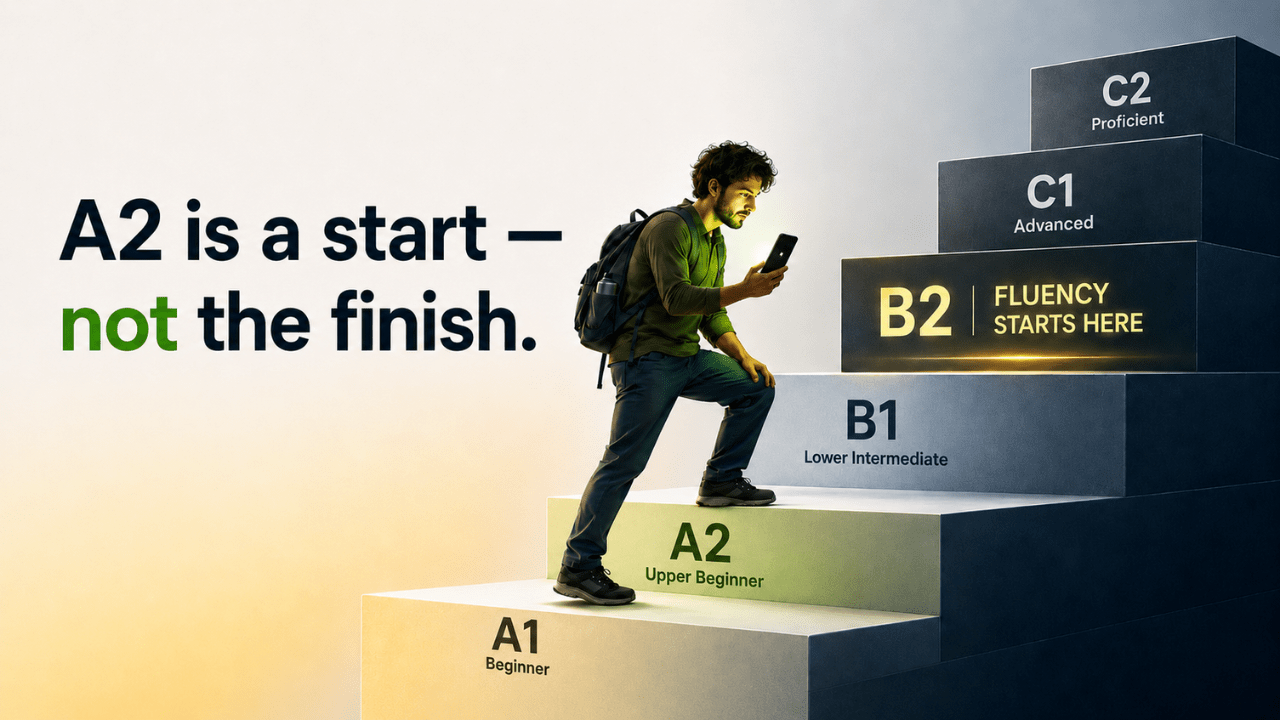
Overcoming the intermediate plateau requires integrating real content into your daily routine. You won’t understand everything, but the difficulty is more appropriate. If the content is not challenging enough, you’ll rarely encounter new vocabulary and more complex grammar patterns. When it comes to learning French, sticking with what feels comfortable hinders progress.
Here’s a typical profile of a French learner who has hit the intermediate plateau:
- You can conjugate regular -er verbs correctly
- You know a few hundred common words
- You can follow a slow, carefully enunciated learner podcast without much trouble
These aren’t small victories, but you still feel discouraged watching an actual French film or reading a real news article. When interacting with native-level content, it may feel like you’ve learned nothing at all! This gap is completely normal, and it’s not a sign your foundation is weak. You simply need to move past the beginner textbooks and start consuming more difficult content. Instead of opting for familiar, simplified material, make the deliberate (but also gradual) jump into richer, more challenging content.
You should be reading and listening to French that feels a level just above what feels easy.
The Fastest Path: Comprehensible Input From Day One
Comprehensible input is the best way to learn French naturally and to an advanced level. However, your range of what’s comprehensible is constantly growing. You should be consistently pushing yourself towards slightly more difficult material, with native-level content as the ultimate goal. This has to be a gradual transition. You cannot master the basics and suddenly approach advanced material with ease.
In other words, don’t throw yourself into a French novel on day one. But stay on the lookout for material at the right level: simple enough that you can follow the gist, challenging enough that you’re still encountering new words and structures. As your ability grows, so does the complexity of what counts as “comprehensible” for you.
The mechanism behind this is straightforward. When you read or listen to something you mostly understand, your brain fills in gaps using context, the same way you infer the meaning of an unfamiliar word from how it’s used in a sentence in your native language. Do this consistently, and you’ll absorb vocabulary and grammar patterns without explicit memorization. This is a fundamentally different process than studying a grammar rule and trying to apply it.
For most learners, a comprehensible-input-based approach is more engaging and produces stronger, more durable results. The best way to learn French is to spend more time reading and listening than doing traditional exercises. Grammar study still has a role, but it works best as a quick reference, not the main activity you build your routine around. This is exactly the method LingQ was built around. Rather than asking you to guess which podcast or article sits at the right difficulty, LingQ tracks every word you’ve encountered and shows you, at a glance, whether a piece of content is genuinely comprehensible for you right now, or still a stretch. That removes the guesswork that trips up most self-directed learners trying to apply comprehensible input on their own.
French-Specific Tips: Pronunciation, Liaisons, and Register
French has a few specific features that often trip up English speakers. It’s worth briefly explaining these to avoid unnecessary trial and error.
Nasal vowels don’t exist in English.
In nasal vowels such as those in bon and vin, air flows through both the mouth and the nose. There’s no substitute for hearing and repeating these sounds extensively. No amount of reading about the mechanics replaces actual listening practice.
Liaison changes how French actually sounds compared to how it’s written.
Liaison is when a normally silent final consonant gets pronounced because the next word starts with a vowel sound. French speakers also link words together into continuous phrases rather than pronouncing each word with a clear pause, a process called enchaînement. As a result, spoken French often sounds noticeably different from the same sentence read silently. For this reason, it’s best to listen and read in French simultaneously if possible.
Register matters more in French than in English.
French distinguishes between formal and informal speech more explicitly than English does. This entails different vocabulary, different pronoun choices (tu versus vous), and even different grammatical constructions depending on the situation. Paying attention to which register a piece of content is using, and why, helps you navigate tone and formality more accurately.
Grammatical gender is arbitrary, and that’s fine.
Every French noun is either masculine or feminine, and the word’s gender often has nothing to do with logic. “Une table” is feminine and “un livre” is masculine, with no reliable, underlying rule to explain why. It can be hard to keep track of which words are feminine and which words are masculine, but everything sticks better through repeated exposure. After enough time, “la table” simply sounds right and “le table” sounds wrong. This is the same instinctive judgment a native speaker relies on.
Resources: Podcasts, Shows, Books, and the LingQ Library
Once you’re past the novice stage, you don’t need to hunt for material built specifically for learners. Here are a few starting points for engaging with authentic French content.
- Podcasts aimed at intermediate French learners are good initially, since the pacing tends to be slower and clearer than native-speed content. When listening to podcasts made for native French speakers, ensure that the topic is of interest and listen to it more passively.
- French shows and films, watched with French subtitles, expose you to natural spoken French at real speed, including the liaisons and register shifts mentioned above.
- Books require reading stamina. Graded readers are a good place to start, then move into native-level French books through more approachable genres (personal growth, YA, non-fiction) once you’re more comfortable with sustained reading.
- LingQ’s French library, which includes content across every level, from complete-beginner Mini Stories to advanced podcasts and articles, all with word tracking built in so you’re not stopping to check a dictionary every few seconds.
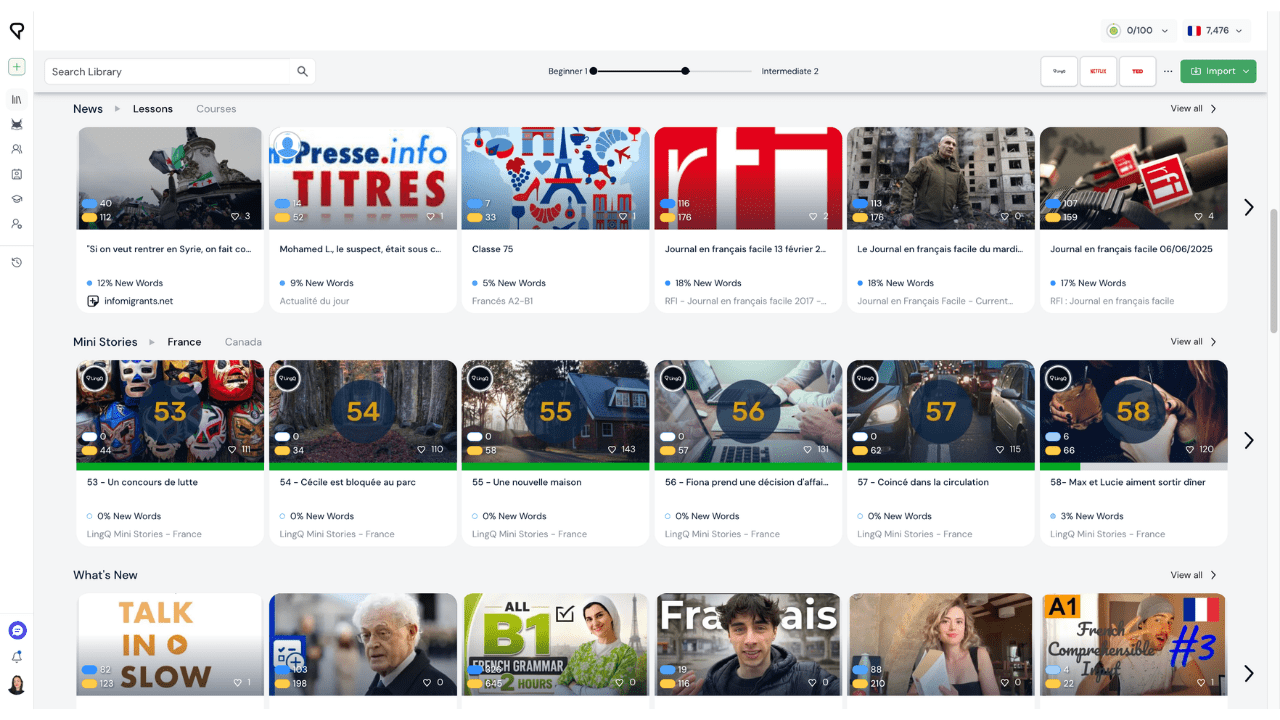
None of these resources need to be used in isolation. A common approach is to mix media for variety, but use a select amount of tools and resources to enhance your learning. LingQ’s import feature, for example, transforms articles, YouTube videos, podcasts, etc. into interactive language lessons. Read and listen to your content simultaneously, and use one-click translation for deeper comprehension. LingQ is built to unlock exactly this kind of content: it tracks every word you’ve seen, saves new vocabulary for review automatically, and lets you read and listen at the same time so you’re never stuck guessing at pronunciation or meaning.
Tip: If you want to build up specific grammar knowledge alongside your reading and listening, our guide to French conjugations is a useful reference to check back against as you notice patterns in real content.
How to Structure a Realistic Daily Routine
Consistency matters more than intensity. A realistic routine looks something like this:
- Start with 20-30 minutes of reading or listening daily. This is more sustainable long-term than occasional multi-hour sessions.
- Combine reading and listening whenever possible. Following text while you listen reinforces both skills simultaneously, and helps connect the sounds you’re hearing to the words on the page, particularly useful for French learners.
- Track your vocabulary as you go, rather than trying to memorize word lists separately from your reading and listening. Just keep listening and reading. LingQ color codes your texts to distinguish new words, unknown words, and words you’re learning.
- Increase difficulty gradually. As content starts feeling too easy, move to something slightly more challenging. This keeps you in the comprehensible-input zone where real learning happens, not too easy to teach you anything new, not so hard that you’re lost.
- Expect plateaus, and push through them with more input, not more grammar study. When progress stalls, the instinct is often to go back to formal study. In most cases, the better move is improving consistency or increasing the difficulty.
- Weekdays and weekends don’t have to look the same. A sustainable routine accounts for real life. On busy weekdays, 15-20 minutes of listening during a commute or while doing chores keeps the habit alive without demanding focused study time you don’t have. On weekends or lighter days, a longer session, reading a chapter of a book, watching a full episode with subtitles, working through a longer podcast, lets you go deeper. The goal isn’t a rigid, identical routine every single day, it’s making sure French shows up in your week consistently.
- Track progress by comprehension, not just time spent. It’s easy to measure a routine purely by minutes logged, but the more useful signal is noticing when content that used to feel difficult starts feeling manageable. If you’re using a tool that tracks known words and vocabulary growth, that running count becomes a concrete, motivating way to see progress that isn’t always obvious.
FAQs
Comprehensible input, reading and listening to real French you mostly understand, from the earliest stage of your learning, combined with a consistent daily routine. This produces faster, more durable results than grammar drills and vocabulary memorization alone. LingQ is built specifically to support this approach, tracking which words and content are actually at your level.
The U.S. Foreign Service Institute estimates around 600-750 hours of study for English speakers to reach professional working proficiency in French, one of the more accessible languages for English speakers. Conversational comfort can come well before that with consistent daily input.
Plateaus usually happen when learners exhaust what simplified, controlled learning material can teach them but haven’t yet transitioned to real, native-level content. The fix is switching to real French, at an appropriately challenging level, earlier than feels comfortable. LingQ’s library makes that transition easier to find the right next step, since it’s organized by level across everything from beginner stories to native podcasts.
Not as your primary activity. Consistent exposure to real French through reading and listening naturally teaches grammar patterns in context. Formal grammar study works best as an occasional reference, not the main method. LingQ’s one-click translations and word tracking let you notice these patterns without constantly stopping to look things up.
Start with material specifically designed for learners, simplified stories, slower-paced podcasts, then move into real French content, shows, podcasts, books, as your comprehension improves. LingQ’s Mini Stories course is built specifically for this early stage.
Start Learning French the Fast Way
The fastest path to real French ability isn’t more studying, it’s more exposure to real French, at the right level, consistently over time. Whether that’s a podcast, a show, or a book, the method that actually works is the same: read and listen to content you’re genuinely interested in, and let your vocabulary and grammar sense build from there.
Start learning French on LingQ →
Writer Bio

Tyler is an American language teacher and language learner. He’s taught Spanish, French and Latin in the K-12 system since 2018. Tyler also speaks Thai and Italian. Currently, he’s learning German and Polish on LingQ!
Twenty minutes a day beats a weekend of drilling.
Read and listen to things you’d have read anyway — LingQ counts every word you pick up along the way.
- 5M+ learners
- 4.7★
- Free to start


You might also like