


Reading is one of the most effective ways to learn German. Books give you thousands of words in context, show you how German word order and cases work in real sentences, and let you learn at your own pace.
The best books to learn German depend on your level. A beginner can start with a course book or a very easy reader; an intermediate learner needs stories that are interesting enough to finish. This guide covers German books for beginners, graded readers written for learners, and real German books you can read as you improve, with the level each one suits.
The Best Books to Learn German at a Glance
| Book | Type | Suggested level | Best for |
|---|---|---|---|
| Complete German (Teach Yourself) | Course with audio | Beginner to intermediate | A full self-study course |
| Easy German Step-by-Step | Course book | Beginner | Learning grammar in a clear order |
| Practice Makes Perfect: Complete German Grammar | Grammar workbook | Beginner to intermediate | Grammar exercises with answers |
| Schritte international Neu | Course book in German | A1 to B1 | A classroom-style course |
| Hammer’s German Grammar and Usage | Grammar reference | Intermediate to advanced | Looking up any grammar question |
| Dino lernt Deutsch | Graded stories with audio | A1/A2, rising to intermediate | Easy stories set in German-speaking cities |
| Klara & Theo | Graded readers with audio | A1 to B1 | Short, easy crime stories |
| Short Stories in German for Beginners | Graded stories | A2 to B1 | Varied genres with vocabulary help |
| Der kleine Prinz | Translated classic | Intermediate | A short, familiar story |
| Emil und die Detektive | Children’s novel | Intermediate | A classic adventure set in Berlin |
| Harry Potter und der Stein der Weisen | Translated novel | Intermediate | A long read you already know |
| Tschick | Young adult novel | Upper intermediate | Modern, colloquial German |
| Der Richter und sein Henker | Crime novel | Upper intermediate | A short book by a Swiss author |
| Schachnovelle | Novella | Advanced | A short classic by an Austrian author |
| Die Verwandlung | Novella | Advanced | A very short classic |
How to Choose a German Book at Your Level
- Pick the right type. Course books teach the basics step by step. Graded readers are stories written with a limited vocabulary for each level. Real books are written for native speakers, so try them after a few graded readers.
- Check how many words you know. Reading is most enjoyable when you know most of the words on the page. If you need a dictionary in every line, choose something easier for now.
- Watch out for the written past tense. German novels usually tell the story in the simple past (ging, sagte, war), which is less common in everyday speech. Learn to recognize it early, because you’ll see it throughout most novels.
- Get the audio if you can. Listening while you read helps you connect spelling and pronunciation, and many learner books come with audio.
Best German Textbooks for Beginners
If you’re starting from zero and like structure, a course book can give you a foundation in basic grammar and vocabulary. Choose one, work through it, and start reading easy stories as soon as you can.
Complete German (Teach Yourself)
A full self-study course with dialogues, grammar explanations, exercises and audio, taking you from beginner to intermediate level. It’s the closest thing here to a classroom course you can do on your own.
Best for: independent learners who want one structured course
Easy German Step-by-Step (Ed Swick)
This book introduces German grammar in a careful order, one structure at a time, with readings and exercises along the way. It helps you understand how sentences are built instead of memorizing phrases.
Best for: beginners who like to understand the rules
Practice Makes Perfect: Complete German Grammar (Ed Swick)
A grammar workbook with clear explanations, plenty of exercises and an answer key. Use it alongside your reading when you want to practise a specific point, like cases or adjective endings.
Best for: drilling grammar you keep getting wrong
Schritte international Neu (Hueber)
A popular course for adults, written in German, that runs from A1 to B1. It’s designed mainly for classes, with course book, workbook and audio, but it’s also a good choice if you want to study the way German courses do.
Best for: learners who want a classroom-style course
Hammer’s German Grammar and Usage (Martin Durrell)
A thorough grammar reference rather than a course. When you wonder why a sentence is built a certain way, this is where you’ll find the answer.
Best for: intermediate and advanced learners with grammar questions
Easy German Books for Beginners
Once you know some basic German, start reading stories. Graded readers use a limited vocabulary and simple grammar, so you can follow the plot and pick up new words from context.
Dino lernt Deutsch (André Klein)
A series of short stories about Dino, an Italian who travels around the German-speaking world, from Café in Berlin to Walzer in Wien and Zurück in Zürich. Each book has about ten short stories with vocabulary help, the series gets gradually harder, and audiobook versions are available.
Best for: beginners who want easy stories with some travel and culture
Klara & Theo (Klett)
Short crime stories for young and adult learners, graded in three levels from A1, with audio. At around 40 pages, each book is easy to finish.
Best for: beginners who like mysteries
Short Stories in German for Beginners (Olly Richards and Alex Rawlings)
Eight stories in different genres, written for high beginners to intermediate learners (A2 to B1). Each chapter has a summary, a vocabulary list and comprehension questions.
Best for: high beginners who want variety
LingQ has its own graded readers too. LingQ’s German Mini Stories are 62 short lessons with audio, written to teach the most common words and grammar. For more free reading, see our guide to German short stories.
German Books for Intermediate Learners
These books were written for native speakers, but they’re short, clear or familiar enough for learners. Try them once graded readers feel comfortable. Native-speaker books don’t have official learner levels, so treat the levels here as a rough guide.
Der kleine Prinz (Antoine de Saint-Exupéry)
The German translation of The Little Prince is short, and its sentences are simple. Knowing the story already makes it easier to follow, so you can focus on the language.
Best for: your first real book in German
Emil und die Detektive (Erich Kästner)
A classic 1929 children’s novel about a boy who chases a thief through Berlin with a gang of local kids. The German is lively and clear, and it’s still read in German schools.
Best for: a fun, classic first novel
Harry Potter und der Stein der Weisen (J.K. Rowling)
If you’ve read Harry Potter in English, the German translation is a long book you can follow from memory. Some names are translated: Hogwarts is still Hogwarts, but Sorting Hat is der Sprechende Hut.
Best for: learners who want a long book they’ll finish
German Books for Upper-Intermediate and Advanced Learners
When you can read for pleasure without stopping too often, try these. They’re all short, which makes them good first books by well-known German-language authors.
Tschick (Wolfgang Herrndorf)
A funny, moving road novel about two teenage boys who take a stolen car across eastern Germany. It’s told in colloquial teenage language and is widely read in German schools.
Best for: modern, informal German
Der Richter und sein Henker (Friedrich Dürrenmatt)
A short crime novel by the Swiss author Friedrich Dürrenmatt, set in Bern and the Lake Biel region. It’s a gripping read and a good introduction to German-language literature from Switzerland.
Best for: crime fans ready for literature
Schachnovelle (Stefan Zweig)
One of the Austrian writer Stefan Zweig’s best-known works and his final novella, about a chess match on an ocean liner. It’s short but rich, so expect to look up more words than in the other books here.
Best for: advanced learners who want a classic
Die Verwandlung (Franz Kafka)
Kafka’s story of a man who wakes up transformed into a monstrous insect-like creature (ungeheures Ungeziefer). Its sentences are long, but the book itself is short, and it’s one of the most famous works in German.
Best for: advanced learners ready for a challenge
How to Learn German From Books
Reading in German is most effective when you read a lot and don’t stop too often. Here’s a simple routine:
- Choose a book slightly below your level. You should be able to follow the story without a dictionary for most of each page.
- Read for meaning first. Look up the words that keep coming back, or that you need to follow the plot, and skip the rest.
- Listen while you read. Use the audiobook or audio recording if there is one. It supports your listening and pronunciation.
- Review your new words. Save the words you look up and review them so you recognize them next time.
- Reread. A chapter is much easier the second time, and rereading helps new words stick.
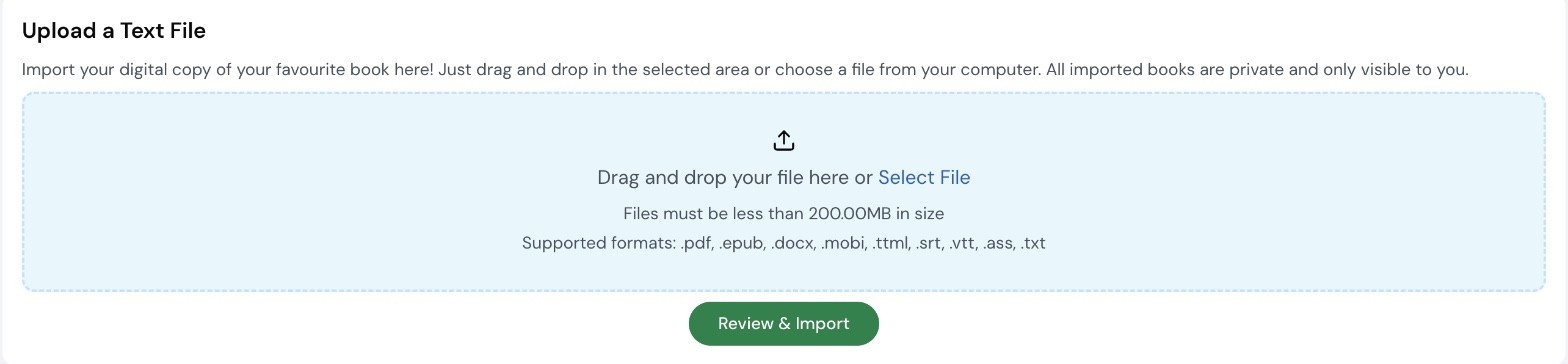
This is how LingQ works. Import a German ebook as a PDF, EPUB, MOBI, DOCX or TXT file (DRM-protected files usually won’t import), and LingQ turns it into lessons. Tap any word to see its meaning and save it, and LingQ tracks the words you know, so every book gets easier. Each lesson shows how many words are new to you, so you can tell whether a book is at your level.
LingQ co-founder Steve Kaufmann, who speaks 20 languages, has learned most of them this way: by reading and listening to lots of content he finds interesting.
Start reading German on LingQ for free →
Pair Books With Other German Content
Books build your vocabulary, but you also need to hear German spoken. Mix your reading with listening:
- German audiobooks, so you can listen to the books you read.
- German Netflix shows for learning German.
- The best app to learn German, if you want structured practice too.
Best Books to Learn German FAQs
What is the best book to learn German for beginners?
For complete beginners, a course book like Complete German (Teach Yourself) or Easy German Step-by-Step is a good start. Once you know the basics, graded readers like Dino lernt Deutsch, Klara & Theo or LingQ’s German Mini Stories are good first stories.
What is a good first book to read in German?
Der kleine Prinz and Emil und die Detektive are popular first books: both are short and clear. If you know Harry Potter well in English, the German translation is also a good choice.
Can you learn German just by reading?
Reading can take you a long way, especially for vocabulary and grammar, but you also need to listen to spoken German to understand conversations and speak well. Reading while listening to the audio is a good way to do both.
Are graded readers worth it for German?
Yes. Graded readers use a limited vocabulary for each level, so you can read whole stories early on and get used to German cases and word order in context. They’re the easiest bridge between a course book and real books.
How do I read German books without looking up every word?
Choose books where you already know most of the words, and look up only the words you need to follow the story. On LingQ you can tap a word to see its meaning without leaving the page.
Start Reading German Today
The best German book for you is one at your level that you want to keep reading. Start with a course book if you’re brand new, move to graded readers as soon as you can, and work up to real German books.
When you’re ready, import your German books into LingQ, or start with its free Mini Stories, and learn every new word as you read.
Try LingQ free and start reading in German →
Cover photo by Christina & Peter on Pexels.