The Lost City of Chan Chan | Lost Cities with Albert Lin
[music playing]
ALBERT LIN: I'm headed to the lost city
of Chan Chan, once the beating heart
of the mighty Chimu empire.
Is that a pyramid?
I think that's a pyramid.
A pyramid at Chan Chan.
Can I find the answers inside the city walls
as to why the children had to die?
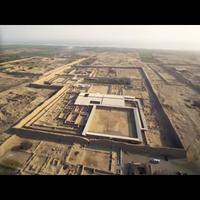
Built over a thousand years ago, amazingly much of the city
has survived.
And I've been told to expect something spectacular.
Look at these walls.
They stretch as far as the eye can see.
I got my drone up, taking a closer look right now.
Looks like a labyrinth of walls.
I'm using photogrammetry data with graphic modeling
to rebuild the city and these extraordinary walls.
Here they are restored to their full glory, a truly awe
inspiring sight rising out of the desert
like something out of a fable.
At its dazzling peak in the 15th century,
the city was a bustling home to 60,000 people,
about the size of London at the time,
and covering 14 square miles.
This is one of the greatest cities of human history.
So why did it collapse so suddenly?
I'm here to meet Peruvian archaeologist,
Arturo Paredes Nunez, who's been working here for years.
Ironically his last name means wall.
[speaking spanish]
This is Chan Chan.
Look at all these carvings here.
It's-- it looks like digital fish.
The Chimu covered the city with carvings of the ocean.
Wow.
Look at these.
They're everywhere.
But among all these artworks is one Arturo
really thinks I need to see.
An entire wall in the central palace
is devoted to a giant mural over 170 feet long.
Wow.
Wow.
Look at this.
What is this?
ARTURO PAREDES NUNEZ: [speaking spanish]
ALBERT LIN: Fish.
Yes.
[speaking spanish]
And each one of these is actually a wave moving
down towards the coastline.
Are these currents?
[speaking spanish]
ALBERT LIN: All these fish, they're going in a direction.
They're traveling from south to north.
They're actually following the course of a current,
the Peruvian current.
But a closer look reveals that the mural also depicts a moment
of great change, another current coming back
in the other direction, fish swimming in the opposite way,
north to south.
Incredible.
Is this right?
Did I get this?
Did I get this right?
It looks like the Chimu are recording a dramatic shift
in the ocean currents.
And when that happens, something else dramatic happens, too.
A violent shift in the climate.
Were the Chimu recording a huge natural disaster
on those walls?
Were they chiseling a premonition
of their own destruction?
I need to check the data to see if they were right.
This is a dry, arid desert.
But a sudden switch in the Pacific Ocean current
can trigger violent change and devastating rain.
Look at this.
Everything flips.
Because the ocean currents are tied to the weather currents.
Everything's tied together.
I know this kind of thing.
I live on the Pacific coast myself, just in North America.
This climate shift is called an El Nino.
These days, it happens about once every five years.
But once in a generation, you get a really
big or long lasting event.
That's called a Super El Nino.
And the impact can be catastrophic.
Wait a minute.
Look at this, the data right here, this rainfall data.
Every year for the last decade, less than half an inch of rain.
And then boom, 2017, one big spike,
four inches of rain in a single year
completely out of the blue.
It happened as recently as 2017, destructive floods in Peru
caused by torrential rains triggered by a severe El Nino.
Maybe there's clues in the experiences in that El Nino
that'll tell me what might have happened to the Chimu.
I'm gonna go try to meet some people.
In 2017, the city of Trujillo, just three miles from Chan Chan
and also sandwiched between the sea and the mountains,
was one of the worst hit.
[dog barking]
I'm here to meet some people who almost lost everything.
One local family filmed the flood
as it tore through their home.
Never seen anything like this before,
this much moving material, water just rushing
down through the streets.
This whole thing would have been a river.
You can actually see the storm in the background.
[inaudible]
The more I talked to people in Trujillo,
the more I hear this word, [inaudible]..
It doesn't sound like Spanish to me.
[inaudible] is Quechua or is--
Quechua.
It is?
Quechua is an ancient language of Peru, predating the Spanish.
Wow, that's incredible.
This has happened so many times for so long
that there's an ancient word.
It's something that's embedded in the memory.
[inaudible]
[speaking spanish]
An avalanche.
This term, [inaudible],, is used to describe a combination
of water, mud, stone, debris.
Coming not from the ocean in the west,
but from the east in the mountains behind the city.
Is it possible that the same type
of event happened to the Chimu?
If it did, then there must be some way
of finding evidence that an El Nino
event happened in their time.
And the answers may be up in those mountains.
[soft music]
