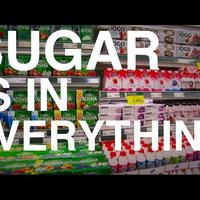
Food Industry's Secret Weapon (WHY Sugar is addictive & in 80% of Food)
Sugar, do do do do do do🎵 Aw honey honey, do do do do🎵
You might have read something lately about Sugar being 8 times as addictive as cocaine.
This piece of information probably didn't do too much for you unless you are already
anti sugar. Considering everyone has eaten sugar at some point, how could this be alarming?
I mean, logically if Sugar was 8 times as addictive as cocaine, this statement would
feel either entirely obvious or totally unrealistic. That is- for most of us it sounds unrealistic,
but If you've stabbed someone in the past 6 months for a piece of cake, then the information
comes with little surprise.
And what does that mean 8 times as addictive? Do you get hooked 8 times faster? Are the
withdrawal symptoms 8 times worse? Would you kill 8 people to get some sugar, but only
kill 1 person to get cocaine?
Well, a study from 2007 presented rats with the chance to choose either a sweetened water
solution or a cocaine water solution 8 times a day. They almost always picked the sweetened
water. Other studies have shown that Rats, even when already addicted to cocaine, will
quickly forget about the cocaine and work much harder to get sugar, even when it means
walking over a panel that will repeatedly shock them.
But what are the implications for humans? And should you even care? If you were experiencing
sugar addiction, you'd surely know it by now, right?
“Hey, I got that for my birthday!”
Several recreational substances exist in nature without needing much processing, like dried
tobacco leaves, beer from fermented barley, or even the sap from the opium poppy plant.
The closer you remain to the natural state of these things, the less dangerous and problematic
they are. While smoking tobacco in any form is of course harmful to your health, it usually
takes continuous use over a long period of time for it to truly damage you. It's very
rare that someone would drink beer or wine to the point that they get alcohol poisoning
or become seriously addicted to alcohol. You could even argue that opium was never a problem
in human populations until it was conceived of as a problem by british colonial policy
makers. Italian aristocrat and actor Dado Ruspoli had supposedly smoked opium for over
45 years without it having severe repercussions on his life.
Substances like this only become truly hazardous to your health and terribly addictive when
you extensively refine them. Around 1810, morphine was derived from opium and was available
in the US from the mid 1850's to be used as a painkiller by doctors. Due to injuries
sustained during the Civil War, many soldiers were exposed to morphine, and suddenly you
had tens of thousands of morphine addicts. Then in 1874, Heroin which is derived from
morphine, was marketed as morphine's non addictive substitute and since then, the heroin
addict has been ever present in American culture.
Another example is the very dangerous and very addictive cocaine, which is also a product
of refinement. The refinement of coca leaves. These leaves had been chewed by farmers in
the Andes for hundreds of years for a boost in energy, and the worst they got from constant
chewing of the leaves was maybe bad teeth.
Alcohol too doesn't get that bad until you refine it, or distill it. People who have
become alcoholics will skip the weaker fermented alcohols like beer, wine or cider and stick
to the hard distilled stuff like Whiskey, Gin and Vodka. Have a couple beers and you
might be kind of a jerk, but for most people it's not until they start doing shots that
they'll make a real ass of themselves, black out or end up in the hospital.
In each of these examples, the result of refinement is a higher concentration of a particular
ingredient that will have an effect on your brain's reward system. What happens is the
substance either occupies your dopamine receptors or causes dopamine to be released and it makes
you feel good. That is- you get more bang for your buck. Distilled alcohol means you
get drunker for a lot less liquid, and cocaine and heroin give you way more of the feel good
effects from just a tiny bit of the substance.
This brings us to sugar, another substance which also affects your brain's dopamine
system, and is also the result of a refining process. With sugar, you're getting more
sweet for your buck. And compared to other tastes, sweet activates your reward center
even more- that is, evolution programmed us to seek sweet foods in particular. One of
the reasons is that sweet foods in nature are very rarely poisonous.
Another fun thing about sugar is that it actually has a small opiate like effect. When newborns
are to be circumcised, they are given a pacifier dipped in something called “sweet ease”-
which is just a concentrated sugar solution. The sugar activates the endogenous opioid
system, providing enough analgesia for the baby that the procedure can be completed without
too much fuss.
And then, how much something is refined should give you an idea of how intense you can expect
the effects to be. For example, 100 kilograms of coca leaves will get you about 300 - 1200
grams of cocaine. That is - the resulting material is about 100 times stronger than
what you started with. When it comes to sugar, for a good yielding sugarcane, about half
the weight of one stalk is juice, and 20% of that juice is actual sugar. So the result
of the refinement process is a material that's around 10 times sweeter than what you started
with.
The average American consumes about 82 grams of sugar per day. To naturally consume this
much sugar, they would have to chew through about 2 lbs of sugarcane. This is 2 lbs of
fiber rich plant material that our bodies would normally expect to come along with all
that sweetness. The fiber in there slows the rate at which the sugar is released into your
system, so without the fiber the sugar is absorbed very rapidly. This is another parallel
to cocaine. Your body could probably handle chewing through
a 100 grams of coca leaves because the active ingredient is released very slowly into your
system... However if you slam that amount of active ingredient instantaneously via your
right nostril then it's gonna be a shock to your body.
OK, so sugar has some parallels to narcotics, but how is it actually addictive? In animals
at least, sugar addiction has been thoroughly proven. However, establishing addiction in
people is a little different. According to the APA Diagnostic and Statistical Manual,
3 of the following 7 criteria need to be met.
5 of these criteria are considered psychological and they are: Bingeing on the substance, a
desire to quit using the substance, craving or seeking the substance, the substance interfering
with your daily life, and continued use of the substance despite negative consequences.
The other two criteria are considered physiological, which makes them the most important in establishing
addiction. They are Tolerance and Withdrawal.
Tolerance is easier to establish objectively since you can use neuro imaging to actually
see it. What's happening in the brain when you become tolerant to something is that the
dopamine receptors in your brain get downregulated, so more dopamine is necessary to get the same
effect - essentially you need more of the substance to get the same amount of pleasure.
If you take a look at a cocaine addicts brain, you can see that the cocaine has clearly downregulated
their dopamine receptors. Then, if you look at the brain of someone who frequently over
consumes sugar, you see the exact same thing in their brain. This is tolerance.
And what about withdrawal? People who try to quit sugar consistently report symptoms
like lightheadedness, headaches, anxiety, mood swings, muscle aches, general fatigue,
and physical tremors or “the shakes”. If you've seen Morgan Spurlock's “Supersize
me!” you may remember this scene: “I was feeling bad, in the car. Feeling like shit.
Started eating - feel great. Feel really good now. I feel so good it's crazy.” So what's
happening here is he's having withdrawal symptoms until he gets the food again. And
what is almost every one of McDonald's products loaded with? Sugar, or High fructose corn
syrup which is chemically almost identical to sugar. In this documentary “That Sugar
Film” Australian filmmaker Damon Gameau goes on an experimental high sugar diet for
30 days. Despite consuming the same amount of calories and just upping his sugar intake,
in these 30 days alone he gained 8.5 kilograms (19 lbs) And by the 18th day he already had
developed fatty liver disease. When he finally goes off the diet, he talks about his withdrawal
symptoms: “Frankly, it didn't feel that different from giving up cigarettes. I had
headaches, I was moody, and my sleep patterns were terrible. Woke up, very early, and as
soon as I was awake I kind of.. I'm craving sugar.”
As paracelsus said, “the dose makes the poison.” So if you're not someone who's
eating candy or drinking soda on a regular basis, you might not be worried about all
of this. However, the real issue is that a lot of people could be over dosing on sugar
without even realizing it. Ever since the low fat craze, our food supply has become
more and more overrun with added sugars and now 80% of our food has sugar added to it.
One of the reasons is that if you take the fat out of something, it tastes like garbage.
If you're a food company looking to maximize your profit, your product needs to appeal
health conscious consumers and it needs to taste good. So, you take the fat out of the
product so you can market it as low fat and then you put sugar in where the fat was so
it still tastes good.
In fact, food companies found out that you can make almost anything taste better by putting
some sugar in it. The “Bliss Point” is a term the food industry uses to describe
the point at which a product is most likeable for the majority of consumers. And the majority
of consumers like more sugar than less. So the Bliss Point is going to be the point at
which the maximum amount of sugar has been added before the product becomes too sweet.
This includes anything from bread to pizza sauce to salad dressing.
Sugar used to be way more expensive than it is nowadays - way back in 1319 it sold for
about 50 dollars a pound, but as sugar cane and sugar beet cultivation improved and the
refinement process became more advanced, sugar became significantly cheaper. Then things
got really cheap with the advent of high fructose corn syrup, which again is almost identical
to sugar. Because of the way subsidies are managed in the United States, we end up with
a massive amount of corn. In 2010, 32 percent of the world's corn supply, 63.9 billion
dollars worth, came from US farmers. That's a lot of corn. No wonder this corn derived
sweetener is in almost everything.
High fructose corn syrup and sugar have built up a bad reputation over time, but there's
54 other names for sugar that the food industry can use to have us feeling better about their
products while keeping the sugar in.
This is how even the more health conscious people can end up consuming more than twice
the daily recommended intake of sugar without even knowing it.
And now we have the question: are you addicted to sugar? If you're like most people, you're
fulfilling your cravings at almost every meal without even knowing it, so how could you
tell? With something like caffeine, you can take a pretty good guess about whether or
not you have some dependence on it. You can just go without a coffee for a while and see
how you feel. However, with sugar, it will take some deliberation and careful label reading
to properly cut it out from your diet.
But I really recommend you do trying cutting it out so you can know how you feel without
it. It's important to know whether or not you are dependent on this stuff, because as
I'll discuss in my next video, sugar has some particularly negative effects on your
health.
“Disease doesn't happen with one meal, but it happens with a thousand. But that's
what we have because now sugar is with EVERY meal.”
If you liked this, make sure to check out these other two videos on health and maybe
even consider supporting me on Patreon.
