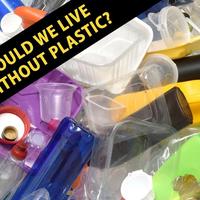
Curbing our plastic addiction - 6 Minute English - YouTube
Neil: Hello, and welcome to 6 Minute
English. I'm Neil.
Rob: And hello, I'm Rob.
Neil: Today we're talking about plastic.
Rob: Yes, it's our addiction to plastic that's
of concern because this material doesn't
decay very quickly, so once we've used it,
it hangs around for a very long time.
Neil: It is a problem - and decay, by the
way, describes the natural process of
something being destroyed or breaking
down into small particles. We hear so
much about the consequences of
having too much waste plastic around,
don't we?
Rob: Indeed. Not only does it cause a
mess - wildlife, particularly marine
animals, are at risk when they become
entangled in plastic waste, or ingest it.
It's an issue that needs tackling -
or dealing with. And that's what we'll
be discussing today and finding out what
could be done to solve this plastic crisis.
Neil: OK, first, let's challenge you to
answer a question about plastic, Rob.
The first synthetic plastic - that's plastic
made entirely from man-made materials -
was created over 100 years ago. Do you
know what its brand name was? Was it...
a) Bakelite, b) Lucite or c) Formica?
Rob: I'm no expert, so I'll say c) Formica.
Neil: Well, we'll reveal the answer at the
end of the programme. Now let's talk more
about plastic. This man-mad substance
is everywhere - from clothing to crisp
packets, and bottles to buckets.
Rob: But the problem is that most of it isn't
biodegradable - that's a word that
describes something that can decay
naturally without harming anything. Each
year, 400 million tonnes of plastic is
produced and 40% of that is single-use.
So why don't we stop using it?
Neil: It's not that easy, Rob, and it's
something Lucy Siegle, a BBC reporter
and author, has been talking about.
She was speaking in a discussion on the
Costing the Earth programme on BBC
Radio 4, and explained the issue we
have with quitting plastic but also how our
attitude is changing...
Lucy Siegle: We have this weird
psychological attachment to this material
that's been around and it's like a push and pull.
At the one time, we're so horrified by what
we're seeing - the whales dying, the
oceans vomiting plastic, beaming in from
all over the world, and at the same time
we're being told we can't live without it, so
that creates a psychological dissonance -
which I think is the barrier to behavioural
change but I'm finding now
awareness has peaked and it's going over
into activism.
Rob: She mentioned the word
psychological - that's something that
affects or involves our mind - so here,
psychological attachment means that in
our mind we feel we have to
use plastic - we're addicted.
Neil: But we also see the negative impact
of plastic - like whales dying - and in our
mind we're also thinking we must stop!
This has created what Lucy says is a
'psychological dissonance' - dissonance
means a disagreement between two
opposing ideas - so we're having
an argument in our head about the right
thing to do - this is the 'push and pull' of
thoughts she referred to.
Rob: And this dissonance has been the
barrier to us trying to solve the plastic
issue - but now we're starting to do
something about it - we're taking action to
reduce our plastic waste - we're turning to
activism. That's taking action to change
something - it could be social or political
change, or a change in our
behaviour or attitude.
Neil: Of course there has been a big push
- that means people have been strongly
encouraged - to recycle.
Rob: Maybe in an ideal world the best
thing to do is go plastic-free - but that isn't
easy, is it?
Neil: No, it isn't, and it's something Lucy
Siegle spoke about. Getting rid of plastic
in our lives is a gradual process. But
where does she think we can make
the biggest difference?
Lucy Siegle: I really think that to
concentrate on stopping the flow of
plastics into your life is easier and more
effective in the long term, than trying to
go plastic-free from the outset.
We are in the UK, a supermarket
culture, so a lot of the tips and tricks to
decreasing the flow of plastic are getting
round supermarket culture.
Rob: She says we have a supermarket
culture in the UK. Culture here describes a
way of life - or a way that we generally
behave - and in terms of food shopping,
we tend to do that in supermarkets.
Neil: So, for example, customers can
make a big difference by putting pressure
on supermarkets to use less plastic
packaging. It does seem that the future of
plastic is in our hands - we need to be
more careful about how and when we use
it - and use our collective power
to force change if it's needed.
Rob: But there's no doubt plastic is useful
for many things so it will be a long time
before it disappears altogether.
Neil: And earlier I asked you what was the
name of the first synthetic plastic,
invented over a 100 years ago. Was it...
a) Bakelite, b) Lucite or c) Formica?
Rob: And I said c) Formica. Was I right?
Neil: Formica is a type of hard plastic
used for covering tables and working
areas in kitchens - but it's not the oldest
type. That was Bakelite.
Rob: I may have got that wrong but
hopefully I'll have more success
recapping some of today's vocabulary -
starting with decay, which describes
the natural process of something being
destroyed or breaking down into small
particles - which plastic takes a long
time to do.
Neil: Next we had biodegradable - that's a
word to describe something that can
decay naturally without harming anything.
Rob: Then we had psychological - that's
something that affects or involves your mind.
Neil: Next up, we had dissonance, which
describes a disagreement between
two opposing ideas.
Rob: And then we mentioned activism -
that's taking action to change something.
We also mentioned the phrase 'a big
push' which means people are strongly
encouraged or persuaded
to do something, usefully by force.
Neil: And finally we had culture. In our
context of supermarket culture, it
describes a way of life - or a
way that we generally behave.
Rob: Thanks, Neil. Now, remember you
can find more learning English
programmes and materials on our
website at bbclearningenglish.com. That's
it for now but please join us next time for
6 Minute English. Goodbye.
Neil: Goodbye.