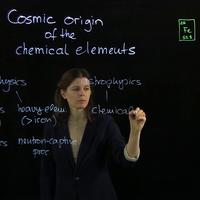
Ep. 1: Introduction and Overview
Have you ever wondered how all the chemical elements are made? Then join me
as we are lifting all the star dust secrets to understand the cosmic origin of the
chemical elements. We want to talk about the cosmic origin of the chemical
elements today. In order to understand where the elements come from, we need to
consider two different components. One is nuclear physics and one is astrophysics
they nicely combine when we want to understand where the chemical elements
come from. So let's look at that in more detail. We have the nuclear physics part
and we have astrophysics.
and on the nuclear physics side we have two things that we want to consider or learn
about it namely how the light elements are formed. Light elements up to iron and
they are formed in fusion processes in stars. Fusion processes. This is one and then
we have also lots and lots of elements in the periodic table that are heavier
than iron. So how are the heavy element formed? That would be heavier than
iron and they are made in what's called neutron capture processes and
that's a really neat way of making big heavy nuclei and so these two parts here
together really explain how most of the elements in the periodic table are made. There
are few extra processes that we will not consider but this gets us almost
there. Then we have the astrophysics because this is basically a lot of
theory and we need to put this to the test. And one test that the universe
offers us is investigating chemical evolution.
Chemical evolution is the successive buildup of heavy elements in the
universe with time, with cosmic time, over last 13.8 billion years and we can
observe stars at different times and thus trace the signatures of these
nucleosynthsis processes here and reconstruct how the nuclear physics
operated. That works particularly well at early times when the universe was a much
less messy place and it's now and so the second portion here is going to be the
oldest stars because they are a tool for us to really figure out how the elements
were made first in the universe. That allows us to again get clean
signatures of these processes there. That's very exciting and timely avenue
for us to study. Together with the oldest stars comes the concept of stellar
archaeology. That encompasses how we use stars that still available in
shining today to study the early universe when everything got started.
And in order to study chemical evolution with old stars, we actually need to use a
scientific method called spectroscopy so we're also going to look at spectroscopy
and how that works, observing of the little stellar
rainbows and because we do that with big telescopes who also going to look at
what it's like to use big telescopes and observing because all of this work is
based on astronomical observations with the largest telescopes, mostly in
Chile and I will explain all these different parts, one by one, and then in
the end, we're going to put it all together to understand the origin of the
elements.
