The Most Powerful Way to Remember What You Study
Hey, what is going on, guys?
So I think we can all agree that studying takes
far, far too much time so what I wanna do in this
video is show you guys how you can remember more
of what you learn, even if you're spending fewer
actual hours studying, and the way to do that
is by spacing out that study time.
This is a technique called spaced repetition
and to do it you add progressively longer
and longer time intervals in between each
of your study sessions.
So in this video I wanna show you exactly how
you can do that, both with your paper flash cards
and with apps both for smartphones and computers.
But first I wanted to get into why this technique
is so powerful and also talk to you a little bit
about the history behind it and how it relates
to our memories in general.
Spaced repetition leverages a memory phenomenon
known as the spacing effect, which describes how
our brains make better connections and overall
remember things more effectively when we space
out our learning over time.
How's how Pierce J. Howard, the author of my
least favorite book to haul into coffee shops,
puts it: "Work involving higher mental functions,
"such as analysis and synthesis, needs to be
"spaced out in order to allow new neural
"connections to solidify.
"New learning drives out old learning when
"insufficient time intervenes."
And we've actually known about this effect
for quite a long time.
Back in the late-1800s a psychologist named
Hermann Ebbinghaus basically launched the field
of memory science itself by embarking upon
an intense study where he made himself memorize
long, long lists of nonsense syllables.
And through that research he eventually came
to develop what's called The Forgetting Curve,
which describes how memories decay over time.
But what he also learned was that by spacing out
his efforts to memorize these lists,
he could put in less actual study time to get
them memorized perfectly.
For example, for one list of 12 syllables he found
out it took him 68 repetitions on one day and then
seven repetitions the next day to memorize
it perfectly, but by spacing out his studying
over the course of three days he found he could
achieve his same level of perfection in only
38 repetitions.
Over the past 130 years since he published his
findings, lots of other studies have been able
to replicate this same positive results, which leads
us to the question, "Why does the spacing effect work?"
Well to put it in simple terms, it turns out that one
of the most important parts of learning process
is actually forgetting.
Now what forgetting truly is is a subject for another
video that I'll publish in the future, but the most
important thing to note here is that the more we've
forgotten something, that is the harder we have
to work to retrieve it since we last learned it
or studied it, the greater the increase
in learning will be.
To make this a bit more clear, here's how the author
Benedict Carey, who wrote the book "How We Learn,"
explains it: "Some amount of breakdown must occur
"for us to strengthen learning when we revisit
the material.
"Without a little forgetting, you get no benefit
"from further study.
"It is what allows learning to build,
"like an exercised muscle."
And that's the main reason why Carey calls
spaced repetition one of the most powerful methods
for remembering what you've learned in his book.
And I would add to that the fact that you can do
this with basically any other learning technique.
It's entirely complementary because it's all about
just modifying the time periods in which you study.
You can do anything within those time periods,
you're just using the time periods
as intelligently as possible.
With that being said, now I wanna get into how you
can put spaced repetition into action and implement
it into your own study systems.
And we're gonna talk about apps and computer programs
that you can use in a minute here but first I want
to talk about a system that you can use with your
paper flash cards, which is called the Leitner
System, and here's how it works.
The first step is to decide on the number
of boxes that you're gonna use to hold the cards
in your system.
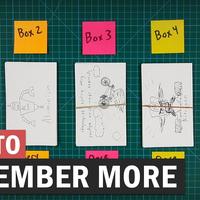
Now I don't actually own little boxes so I've just
substituted rubber bands and sticky notes that say
"Box," but that actually works just as well
and actually makes the system more portable,
so that's pretty cool, and from there each
individual box is going to represent a different
study time interval.
So Box 1 might be studying every day, Box 2 might
be studied every other day, and so on.
And when you're studying the cards in the boxes,
every time you get a card right it's gonna graduate
to the next box, so you're gonna see it less
and less often.
But if you get a card wrong, it's gonna go all
the way to box number 1, no matter where it was.
And by using this system you get two main benefits.
Number one, you're maximizing your learning through
the spacing effect, but number two, you're also
studying more efficiently because you're spending
more time on the cards that need the most attention
and less time on the ones you know really well
rather than studying every single card equally.
Now this paper system works really well for both
of those goals but if you wanna take advantage
of more advanced scheduling algorithms and other
features, you're gonna need to find yourself
a space repetition app and there are a lot
of contenders in this area but I wanna focus
first on what is probably the most popular one
right now and that is called Anki.
Anki has a huge community, it's insanely customizable,
and best of all, it has apps for almost every
platform out there and almost all of them are free
with the exception of the iPhone app, which oddly
costs a whopping $25.
Now I think the price is that high because it's their
way of basically letting people support the app since
it's free everywhere else but if you're on an iPhone
and you don't wanna pay that much, fear not because
Anki also has a companion web app called AnkiWeb,
which is accessible from mobile Safari.
So you can use that free if you want.
Now with Anki, creating cards is really, really
easy and I really like the fact that you can add
basically any kind of media you want to your cards,
including pictures, which is awesome because adding
pictures to your flash cards can really help
increase retention.
However, the killer feature of Anki is the ability
to rate cards based on difficulty when you're
studying them.
So essentially, when you turn a card over, you can
tell the program how hard it was for you to dredge
the answer up from the depths of your memory
and it will use that data to decide how long it's
gonna be before you see that card again.
And that's really the main strength of space
repetition apps versus a paper system.
Each individual card can be tracked, can have
a difficulty rating, and can be adjusted
in the algorithm so you're getting the most
benefit of the spacing effect.
Anki is definitely not the only space repetition
app out there, though, so if you're looking for
alternatives, I've got a few things in mind
for you to take a look at, number one being an app
called TinyCards, which I showed off in my previous
video on how to make better flash cards.
Now TinyCards is only for the iPhone, unfortunately,
but there should be an Android version coming soon,
and honestly, when compared to Anki I think it's
a lot more simple, a lot prettier, and the process
of making cards is more fun and faster because
they have an excellent system for adding images
to your cards.
Aside from TinyCards there are also apps like
Flashcards Deluxe, Memrise, SuperMemo, Mnemosyne,
Eidetic, Quizlet, and probably a bunch of others
that I don't even know about right now but I'm
sure you will let me know about down in the Comments.
So before I wrap this video up I have a couple
more things I wanna mention, number one being
the script I wrote for this video is actually
about half the length of the blog post I wrote
so if you want a lot more detail, especially
pertaining to the memory bits and how the spacing
effect works, you can click the blog post link
in the description down below or on the card
on screen right now and read to your heart's content.
Also, and I have been really excited to announce
this for quite a long time now, there's now
an official College Info Geek t-shirt on
DFTBA.com and I'm super, super stoked about this.
I've already ordered mine and there's gonna be
a link down in the description, also a card so
if you would like to get your very own shirt,
which may or may not grant superpowers, you can
click either of those links and order one.
Now one cool thing about these shirts' design
is it was actually created by the College Info
Geek community.
My good friend Ashley did the hand-lettered design
itself but the mantra or saying on the shirt was
actually decided upon by people in the College Info
Geek community over on Reddit, which I think is
really, really cool, and I would love to continue
to play up this community aspect so if you get
a shirt I would love to see you tweeting awesome
pictures of you wearing it to send to me over
on @TomFrankly and I will probably retweet them.
You can also put them in the Reddit as well if
you like and other than that, that's all I have
for this video, guys, so thanks so much for watching.
And if you found it useful, give it a Like
to support this channel and you can also Subscribe
with that button right down there if you wanna
get new videos on being a more effective student
every single week.
You can also get a copy of my book on earning
better grades by going to the picture of the book
right there and clicking your mouse button.
You can find the previous video right over there
which was about how to use flash cards more
effectively and if you wanna find that awesome
article which is way more detailed than this
video was, go to the Full Article thing right there.
If you'd like to connect with me you can use
the social media links down below but there's
also a non-zero probability that you can connect
with me by yelling into a conch shell,
so maybe give that a try too.
