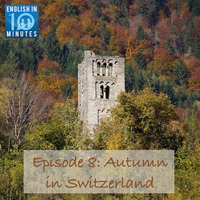
Nick: Well, the days are getting colder and they're getting darker so that must mean that it's autumn in Switzerland, umm, and before we get into autumn, which is going to be the topic of our conversation today, Wendy one of the things that you often talk about is that in Switzerland you have all four seasons.
Wendy: Yeah, that's true. Uhh, I grew up in a very different climate in the deep south of the United States in Alabama, and it's very hot there. I mean, it does get cold in the winter and in fact it's even snowed a few times - I can count on one hand probably the number of times that it's snowed in my lifetime - but it does happen. But for the most part it's hot, uhh, for most of the year and so growing up I didn't really experience the changes of the seasons in the same way that we do here in Switzerland.
Nick: Yeah, and it's a similar story for me as well. I mean, Australia is hot, umm, and so the winters are not that cold, they're quite mild, and so you don't have the extremes at either end - I guess you maybe have the extreme heat sometimes. Umm, I don't think it's ever snowed in Sydney in my lifetime. And so basically what that means is, yeah you don't have the extremes of winters and so it means that the shoulder seasons which are spring and autumn are also not exactly the same as they in some other places such as Switzerland.
Wendy: Yeah, uhh, and it is one thing that I really love about living here. I know it's not just Switzerland, I know there are probably lots of people, uhh, listening who do live in a place where there are four distinct seasons and probably kind of take that for granted as just being the norm and perhaps thinking that it's like that everywhere, but it's not. And it's a really special feeling when you can feel the seasons start to change, so that's happening now. Definitely in October you start to see all of the leaves change colours on the trees, and, uhh, it gets a little bit chillier but it's not too cold, you know, and it's refreshing in that way and, uhh, the air just feels very crisp and fresh and, uhh, I really love the season.
Nick: And once the leaves obviously change colour and then after that they begin to fall off the trees and so, in fact, in American English you say fall…
Wendy: Yes.
Nick: …for the season rather than autumn.
Wendy: Yeah, I mean we also know the word autumn and some people use the word autumn. Autumn and fall are interchangeable in American English, but yeah, we do say fall a lot.
Nick: And so as we said, here in Switzerland you can see that. Umm, in Geneva we live near the lake and there are some parks near the lake, including a small botanical gardens, and so you can go for walks there and see the different colours and the oranges and the reds and the yellows and things like that.
Wendy: Yeah.
Nick: And I remember my parents came once during that time, during October, uhh, to visit, and we took them there and we were taking photos of red leaves and having fun with that because it was also a little bit of a novelty, perhaps, for them as well.
Wendy: Mmm.
Nick: Umm, but also outside Geneva, in other places in Switzerland, there's some really interesting, uhh, trips that you can make to really make the most of autumn, ‘cause of course Switzerland is, you know, it's a winter country. I guess most of the cultures and customs are built on winter, and obviously in summer it's really great as well because you can go hiking, and it's an outdoors country. And so you might not think there's much to offer in fall because it's kind of too late to hike, too early to ski, right? But there's still lots of great scenery that you can see all around the country. And it's one of the things that I like to say is that people know Switzerland for being … you know, it's famous for its mountains and for these dramatic, snowy landscapes and things like that, but it really is a beautiful country, just in the ‘everydayness' of it, you know, just in all different rural areas when you're going … when you're travelling by train or you're travelling however you're doing it, umm, you always just see these beautiful scenes and in autumn I think you can see that as well. Wendy: Yeah, umm, and I think the autumn really highlights some of those scenes that perhaps don't have the spectacular, majestic mountains, you know, even if you're not way up in the Alps and seeing, you know, this gorgeous, really spectacular scenery, uhh, when you're, you know, down at lower elevations and you're just passing by old farmhouses or just nice scenes like that, then the autumn colours really, you know, make it much more special than it is in other seasons.
Nick: And so there's a couple of places or a couple of trips in particular that we've taken, umm, that I remember well. One is that there's this place still on Lake Geneva, uhh, kind of at the other end of Lake Geneva called the Lavaux Vineyards, so it's a set of terraced vineyards which is really beautiful, it's a world heritage site, and these vineyards come up from the lake because there's a hill that rises quite steeply coming up from the lake, and so you have these different, uhh, terraces and then you have all these areas where they grow (grapes to make) wine, and there's little walking paths and you can walk through it, so obviously throughout the summer the grapevines are all green and that's very nice, and then once it turns to autumn, they start to turn to yellow and then brown and this is the time obviously when they harvest the grapes. Umm, and so we've been a couple of times during autumn to walk through and just to look at the colours and it's really spectacular.
Wendy: Yeah, there are some great hikes that you can do of different lengths, you know, if you just want to take a short walk, uhh, through a little bit of the vineyards you can do that, or if you want to walk for hours through several different villages, then there's plenty of room to do that too. And there are lots of, umm, celebrations at this time because this is the harvest time so, uhh,many villages or even many, umm, vineyard, you know, operations, they will have their own kind of festival, uhh, autumn harvest festival, where you can come and taste the wine and, uhh, you know, really enjoy the scenery and also enjoy the wine.
Nick: Yeah, for sure. Uhh, and another thing we did once is that we got very cheap or even almost free tickets to take boat rides anywhere we wanted for one day in Switzerland, and so we basically looked at the map and chose, uhh, a trip that would basically allow us to spend the most time on the boat, and so it was around the area of Interlaken, which is in the German speaking part of Switzerland, and it's called Interlaken because it's between two lakes, and you can travel by boat from … across one of the lakes, and then you can kind of have the liaison by train or you can even go perhaps up the river and that joins onto the other lake as well.
Wendy: Yeah I think maybe it's a canal.
Nick: Right.
Wendy: A man-made canal between the two.
Nick: And so we spent virtually all day one day on these boats, on these two lakes, and it was in … during autumn, and so the scenery was really amazing, again because you could … you just see on the shores of the lakes there's just trees in all directions and again they go up, you know, on hills, on the slopes of hills, and you just see all the different colours, umm, and that was really great as well.
Wendy: Yeah, that's also my best memory of autumn, I would say, is the images of the trees and all the scenery that we saw from the boat when we were travelling on the lakes that day.
Nick: And the other thing that you have in autumn which again is something that is a little bit foreign to us but really great is that you have seasonal, umm, produce, or seasonal vegetables. Umm, and so in autumn it's obviously famous for pumpkins and other, kind of, squashes and things from that same family. Umm, and so, you know, in Switzerland you can't really get stuff that's out of season, and so it's always exciting when it comes in season and you're in the supermarket or you go to the markets and you see it and then you realise that you can start cooking with this now.
Wendy: Yeah, yeah, and growing up in the U.S., I really had no concept of seasons, because you can always buy anything. Every grocery store is open 24 hours for the most part and there's … it's always stocked with any kind of produce. Of course they ship it in from all over the world or they grow it in greenhouses, so, you know, it's a very artificial thing. But I just took it for granted that I could just always buy anything that I wanted to. And that's not the case, and now I know, you know, that berries are in season in the summer, and that persimmons are in season, uhh, in the autumn and the winter. I'd never even had a persimmon before, until we moved to Switzerland. And now it's one of my favourite fruits and I really look forward to the autumn when the persimmons start showing up in the produce aisle.
Nick: Right, and so my, uhh, favourite thing probably in terms of the pumpkin family is the butternut squash, and so we bought a … I bought a big one last week and we made several meals centred around butternut squash. Yeah, and so it's always fun to do it. Sometimes when it's in spring and you see a nice recipe that has butternut squash or something in it and you know that you can't do it, you have to wait until autumn, but then once autumn comes, you have to make the most of it and, uhh, and get out there and buy it and eat it.
Wendy: Yeah, and I do think that it makes those foods all that more special, you know, because you do have to wait for them, and so you appreciate them a lot more. And then, you know, you have all these associations with them, and so it's all of these, umm, memories and smells and tastes and sights all coming together, you know, you taste the taste of pumpkin or the taste of butternut squash and it tastes like autumn and you can almost, you know, see the trees and all of it comes together to make it that much more of a big impression.
Nick: Alright, so that's it for autumn and the next stop is winter.
Wendy: Yep.