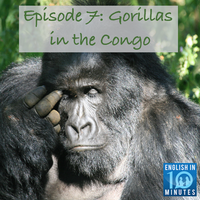
Nick: Today Wendy and I are talking about the time that we saw mountain gorillas in the wild in Africa, and that's one of the best experiences that we've had while travelling, right?
Wendy: Yeah, definitely. Uhh, it really made a big impression on me at the time. We've had quite a few experiences with wildlife, with different species of animals, uhh, but the gorillas were one that I really connected with and it was a very special moment.
Nick: So basically there are only a few places where you can do this. Uhh, I think there are three countries where you can see these gorillas which are Rwanda, Uganda and the DRC, which is the Democratic Republic of the Congo. And most people go to Rwanda and Uganda, uhh, because they're safer. My brother Mark actually went to Rwanda to do it about 10 years before we did, umm, and so we tried to book one of these two places because we were going to those countries anyway as part of a longer trip in East Africa, but they were booked out, uhh, because they only allow a very small number of people to do it. I think it's, you know, a maximum of six, uhh, tourists per family and it's only I think once a day, and so you really have to book, I guess, three, four, maybe more, months before you go.
Wendy: Umm-hmm.
Nick: And we were kind of backpacking around and we didn't have fixed dates exactly, and so we didn't, uhh, book in time, and so basically the only chance that we had was to go to the DRC. And that was a bit, uhh, I don't know, it's a bit, umm, you know, there's often safety concerns and sometimes regarding the gorillas, sometimes you can't do it. They stop the tourists from going there when it's unsafe, and so we took a bit of a risk, uhh, because we had to pay in advance.
Wendy: Umm-hmm. Nick: And it's not cheap. Wendy: No it's not.
Nick: Umm, so we paid four hundred dollars per person (in 2010), and in Rwanda and Uganda you pay about five hundred per person, so it's a bit more. So we paid that in advance and then we just had to hope that everything would be OK. And so we came into the DRC from Rwanda and we were actually really lucky, because there was some problems, I think even while we were there, and they closed the border that we entered, uhh, through, just a couple of days after we went in.
Wendy: Umm-hmm. Nick: And so I'm not sure what would have happened to our eight hundred dollars but in any case we were lucky to get in. And so you stay in this town called Goma which is in the far east of the Congo, umm, and, that's basically the base, uhh, from where you can go and see the gorillas.
Wendy: Umm-hmm. Nick: And so the gorillas are in a national park called Virunga(s) which is the oldest national park in all of Africa and I think it's the second oldest in the whole world or the third oldest in the world, umm, so it's been a national park for about 100 years and that's actually one of the things that makes it really sad that even despite that long heritage of protected land, that there are so many problems there and there are rebels in the area and all sorts of things, and actually three years before we went, uhh, some rebels executed, uhh, some gorillas. Wendy: Yeah, umm, yeah they were shot in the back of the head and, you know, gorillas are killed, uhh, pretty regularly in the park, uhh, usually for meat, for their flesh, uhh, but in this case the bodies were left there, uhh, and it was understand to be a sign, you know, a threat to the rangers basically. Umm, with, you know, these rebels who did it trying to show off their power and show that, uhh, they had the ability to do this.
Nick: Right, and that's why they use the term execute which is not usually what you think of when talking about hunting or killing animals, umm, but the way that they did it … and I think they hung up the bodies and put them on display, and it was really awful. So after that they stopped doing the gorilla tours in Congo but by the time we went there they had restarted them.
Wendy: Yeah, and so we were lucky enough to be on a tour and we were actually the only people on the tour so we had the real privilege of being alone with the gorillas, apart from the guards, the rangers, who were accompanying us.
Nick: Yeah, because usually you can have, as I said, up to six people but because of the situation, the security situation, at that time, yeah we were lucky to be the only ones there. Umm, and so from Goma you have to travel for about two hours to get to the park, umm, and that was also even an experience in itself because you go past - you know, on this road, it's quite a bad road, it gets worse and worse as you go along - there are these villages or settlements alongside both sides of the road, umm, and it's a very poor area, uhh, and a lot of the people are refugees because it's very close to the Rwanda border and that situation with refugees, uhh, and counter-refugees from the Rwandan genocide still hasn't been resolved and so we saw a lot of houses which were … which had … barely had roofs, for example, they would just have … there would be kind of like a tent or they would have a tarpaulin with one of the UN agencies' names on it, especially UNHCR which is the United Nations High Commission for Refugees, so we saw a lot of that and that was really sad to see.
Wendy: Yeah, umm, I mean I'm glad that we ended up going to DRC instead of Rwanda or U … I mean, we did also visit Rwanda and Uganda but I'm glad we went to the DRC for the gorilla experience. Umm, I mean we mainly did it, as you said, because it was cheaper and it was actually the only option that was still available, but, you know, it had the added benefit of us being able to experience DRC and really understand better the situation there which is just heartbreaking. Umm, but it was something that I was glad that I had been exposed to and knew a bit more about, having been there for a few days.
Nick: Yeah, and so then once we got to the park, what they do is they send out a couple of advanced scouts or advanced trackers who go out before you to try to find the general location of where the gorillas are. They don't … I don't believe they tempt them in any kind of way, umm, it was a very authentic experience and the gorillas are truly wild, but the trackers go and find them, you set off a little bit after that, and I think we had a guide and then also a ranger and then another guy, a kind of machete-hacker guy who creates a path for you if you can't go on one of the paths that might already be there . So it's quite a big operation, and I mean they did it quite well and to be honest, the rangers and the guys who work there, you know, it's a very dangerous job for them given the situation and the rebels and all of that, so, you know, they're really doing something worthwhile and doing something, you know, that benefits people and, you know, I look up to them for what they do to risk their lives to come and show people gorillas because it's more than just about seeing gorillas. ¶ You know, there's a lot more to it than that, you know, about … there's a lot of lessons to be learned about nature and about the world and things like that. And you often find - I'm not sure if it's true in this case, but you often find that some people who used to be poachers or used to be hunters of animals end up later working to protect the same animals, umm, and so I think these guys realise that it's not just showing tourists gorillas but it's also about the protection and about standing up, uhh, for their country and against the war that's kind of engulfed it. ¶ Wendy: Umm-hmm. And actually protecting the gorillas and the other animals that live in the park, uhh, in addition to, you know, protecting the people who live around there as well. >¶ And a lot of rangers have lost their lives doing this, uhh, and there are now some programs to help the widows of these rangers. ¶ I saw on the website recently for the national park, there's a sewing workshop that's been created. You know, this group of widows, the wives of the rangers who have died, they're now helping them to, you know, sew dresses and other materials that they can then sell on and make a living for themselves.
Nick: And so these guys took us through the jungle and we had to walk quite a while through the jungle, it's not a kind of easy, you know, path that's just laid out in front of you. You're really walking through a huge jungle. And finally we got to see the gorillas and it was just incredible.
Wendy: Yeah.
Nick: We spent about an hour with them. Uhh, the family that we saw had three silverbacks, which are the adult males, umm, and you just, you just kind of watch them and you watch the way that they go about what they're doing and you're just kind of transfixed by it. It's really fascinating.
Wendy: Yeah, uhh, I think what is so striking is to see how much they are like us, how similar humans and gorillas and other primates really are, how much we have in common. You can really see the emotion on their faces. Uhh, the one that I remember the most was the baby, uhh, there was a little baby who was, you know, doing what babies do. He was very hyper and playing and jumping around and making big wide-eyed expressions and, uhh, it was just beautiful to see.
Nick: Yeah, so if you ever have a chance to go and do it, umm, we highly recommend it.
Wendy: Yeah definitely.
