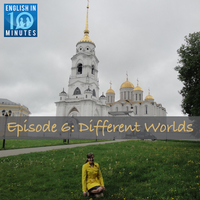
Nick: Today I'm talking to my friend Lena about her experiences in Russia, which is her home country. Thank you for talking to me.
Lena: You're very welcome.
Nick: So, you have a really interesting background and a really interesting, sort of, experience, because you were born in Russia, is that right?
Lena: Yes.
Nick: But then you moved to Canada when you were young.
Lena: Yes, I was born in, uhh, Nizhny Novgorod, which was back then, it was the Soviet Union, it was known as Gorky, uhh, named after a very communist writer, and then I moved to Canada when I was 10 years old. And in Canada I lived in Winnipeg, then Vancouver, then Ottawa and then back to Vancouver.
Nick: Wow, so you moved around quite a lot.
Lena: Quite a bit, yeah.
Nick: OK, and so do you remember what it was like to move to Canada at age 10 from Russia? It must have been very different.
Lena: Uhh, I definitely remember it. I think everybody remembers their childhood really vividly, because it's the best time of their life, or hopefully it is. Uhh, so definitely I remember my move to Canada. It was my very first flight. It was my very first time out of my home region, umm, because in Russia you don't have that many opportunities to travel, not just outside the country but within the country as well. It's a very big country, so you need a lot of, umm, patience and a lot of, I guess, resources in order to take the trains or the planes. So, yeah, it was, uhh, the first time I had ever been on a plane, the first time I went outside the country and it was … I had no idea where I was going, because I didn't know Canada existed at that point.
Nick: And did you speak any English at that time?
Lena: I thought I did, but I did not. Umm, I studied English in, uhh, since grade 1. It was a secondary language in, uhh, Russia, but, umm, when I reached grade 3, uhh, they divided us into two groups, our class. So the first group who was people who showed some potential, and those were the people who were expected, maybe, in the future at some point, to speak English somewhat decently, and then there was the second group, which was just hopeless and you just do it for the school credit. I was part of the second group, so when I arrived in Canada, umm, basically someone asked me my name and I couldn't understand what they said, so it was at that level, yeah.
Nick: OK, and so how did you improve your English even, uhh, at this stage?
Lena: I came at the end of April and I went to Canadian school for the first time in May, umm, and I was only there a month before summer vacation, and, uhh, I remember kids not making fun of me, but the only thing they could so that I would understand is, ‘Do you like me?' or, ‘Do you like me not?' And I would say ‘Yes' or ‘No'. For a month, that's all I said, and then in grade 6, umm, I had a special … uhh, the vice principal of the school would come and study English with me with a colour, with a picture book, while everybody else in my class had French class, because it was, it's Canada, so French is the second language. And after one year of, uhh, studying with her, I started … they put me in a French class as well so I had to know English and French and everything.
Nick: OK, and you also told me a really interesting story about another way that you helped learn English by yourself, uhh,on the weekends.
Lena: Yes, we had, umm, my parents, uhh, got a VCR player, uhh, when we came and we bought three cassettes, so it was Back to the Future, Home Alone and Titanic, and Titanic was by far my favourite one. And, umm, I didn't understand what it was, I just saw the lovely pictures of the ship sinking, and, umm, I would watch it every single weekend, every single Sunday, in the morning, while my parents were usually out for a walk. And, umm, I would listen to it every … I loved it so much, I cried, I was … I knew that he died at the end and it was very sad, and, uhh, I remember the first phrase that I learned fully in English was, ‘Women and children first'. It wasn't very useful, but that came from my Titanic knowledge. And I still … I think, I haven't watched it in a while, but I think I can still remember the script identically as it was, including all the sounds, yeah.
Nick: That's great. And so how long did you stay in Canada?
Lena: I was in Canada since I … from the age of 10 to the time I finished university, so that was 2012, so it was by that point, I'm not very good at math, but I was around 25, yeah. And then I moved, my last degree in Canada was in journalism, and the really good job I was offered was in Moscow at an English-language newspaper. So I went back to Moscow for two years and I've been sort of ‘commuting' between the two countries ever since. Nick: OK, and so when people ask you where you're from, uhh, do you have a direct answer or is it difficult to say?
Lena: It's complicated, yes, because, umm, I think my family when they moved from Russia, it was a very difficult situation. Uhh, it took a lot of effort. Nobody in my family - not just my parents, but no one in my family - has been outside the Soviet block. And, umm, my parents definitely don't have a very good memory of Russia. Umm, when we moved it was the 90s, umm, they didn't have enough money, they had to borrow money from all their friends, we had to sell everything we owned. Uhh, we had to, we didn't have an apartment, so we just … it was really nothing we could sell, so it was really hard to collect the money and to make the move. My parents' salary was delayed. My father's salary - he's a university professor - uhh, it was delayed by six months, and when he did get it, it was very small. Uhh, my mother worked at a factory, also a very small salary. So when I told them, ‘I'm going back to Russia,' after having been given all these opportunities in Canada, they really didn't understand me. They still don't understand me. They're very much against the idea, umm, but whenever I go back to Russia I just feel very much at home, because the rest of my family - umm, my grandparents were there until recently, my aunts, my cousins - so it's very, it feels like home. But Canada also feels like home because my family is there, my immediate family is there.
Nick: So do you think you have a kind of different perspective on Russia having lived in the west? Can you look at it differently from other Russians, or how does it feel to be back there again?
Lena: Definitely it feels … I notice things that Russians might not notice. A prime example would be things like recycling that you just … umm, in Canada you pretty much take for granted that this is the case, and then in Russia you walk around trying to find a recycling container and realise there is no recycling containers everywhere. It's things about freedom of speech, about the way the government should respond to the people's needs. Umm, in Russia people don't question that, because they've never lived outside a system that hasn't been a very, sort of, autocratic system. So, but in the same way when I go to Russia I get a different perspective on Canada than I would if I lived my whole life in Canada, so I think it … I take the best from every place that I live and I try to go from there.
Nick: No, that's a really good way to think about it. And so being in journalism in Russia, that must also be a challenge.
Lena: Umm, well I haven't written many stories about politics at all in Russia. I was, when I was working in Moscow, I was writing for business, uhh, for the business section. I was writing for the arts section, so I didn't get, umm, the experience of what it might be like to write about controversial political issues, but my friends definitely, umm, who are foreign journalists in Moscow, they have experienced some pressure on them to write a specific kind of way and things that they should mention. And even the editors sort of encouraging them to stay away from certain topics because they don't want to create problems for the newspaper, so yes.
Nick: Another thing is that you're a vegetarian.
Lena: Yes.
Nick: Is that more difficult in Russia than it is in Canada?
Lena: Ooh yes, ooh yes. Umm, I think, well my parents are still trying to put meat in all my food and hope that I don't discover it, umm, but my grandma I think, that was the most difficult. Umm, when I visited her in the last couple of years, umm, she was starting to develop dementia, and for her it was very hard to remember that I didn't eat meat. And it was a very hard concept for her to understand that I didn't eat meat. So every five minutes, she would say, ‘Oh, I have soup in the fridge.' I'd say, ‘What kind of soup is it?' ‘Oh, it's a chicken soup.' I say, ‘Grandmother, I don't eat chicken, I don't eat … I told you already, I don't eat meat, I don't eat chicken.' And she told me, ‘Chicken, it's not meat, it's chicken.' I'm like, ‘No no no, chicken is considered meat, In my world, it's considered meat.' And she said, ‘But it doesn't matter, it's already dead, I already cooked it.' And then we closed that conversation somehow, and then five minutes later, the same thing happened, so whenever I would stay at my grandmother's, she would constantly keep asking me about my meat situation. And, umm, I went to, umm, a psychologist in Moscow, for work-related issues, I wanted to figure out how to deal with the work-life balance and things like that, because Moscow's a very stressful place to live. And, uhh, I was asking her about how to manage my time better and things like that, and the only recommendation I got from her for six months in a row, was that my problems could all be solved if I started eating meat, umm, which I didn't, but I went to the market, and she did convince me to start eating fish, which I did for one winter. Uhh, she thought that would be the solution to everything and it wasn't. Russians don't really … they're not really on board with vegetarianism. They think it's something that weak people do, and it's just a silly whim.
Nick: OK, so Lena thank you very much for talking to us.
Lena: You're very welcome.
Nick: And good luck.
Lena: Thanks.
