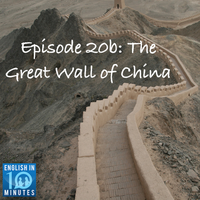
Episode 20b: The Great Wall of China (Part 2)
Nick: This is part two of our episode on the Great Wall of China. And in part one we talked about Badaling which is this famous section of the Wall near Beijing, umm, but there are also many other sections of the Wall and, in fact, there's another section also quite close to Beijing. And it's … what you can do is you can walk along the Wall from one section to the other. You can probably say the names of the two sections a little bit better than I can…
Wendy: Uhh, the first one is Simatai and the second one is Jinshanling.
Nick: And so what you can do is … and there are a lot of, now, tour agencies in Beijing who will do this, is that they will take you in a minivan, a small group of people, to one of these points, and then you can walk along the Wall for about three hours, and then they pick you up at the other point and then take you back to Beijing. I think it's also possible to do it with public transport as well. Umm, but even though you're still quite close to Beijing, this gives you a completely different experience of the Wall, uhh, firstly because there's almost no one there.
Wendy: Yeah.
Nick: And you'll be there maybe with a small group of people, and that's it. Umm, the mainstream tour groups, package groups and the Chinese domestic tourists don't really go to that area. Uhh, and secondly the Wall itself is very different, because it's unrestored and so the whole thing is … I think it's sometimes promoted as the wild side of the Wall because the Wall itself is quite wild in that way, it's unrestored, it's not as neat and perfect as it is in Badaling, but it's more interesting, perhaps, because of that. And also the nature around it is quite wild as well, umm, and as you're walking, sometimes you have to scramble a little bit up and down the sections of it. It's not, you know, it's not as perfect in terms of the steps and things like that as it is at Badaling.
Wendy: Umm-hmm. Yeah, sometimes, you know, some of the bricks are kind of falling apart a little bit and, uhh, like we talked about the crenellations that you see that are perfectly restored in Badaling - that's not the case in Simatai and Jinshanling and on the walk in between the two, so, uhh, yeah, it definitely looks more dilapidated, more rundown, but also more authentic in that way. Because it is a wall that was built hundreds of years ago so it's normal that it wouldn't be in perfect condition.
Nick: Yeah and so I think more people, uhh, who go to Beijing should try to visit this section of the Wall as well but it's just, people get a little bit overwhelmed because there's so many other things to do in Beijing and if they see the section at Badaling they think that, you know, that's probably enough. But it's really worth it to make this extra trip if you can. And the other thing that's good about it is that you also get a hike out of it as well, and so it's one of these places, and, you know, there are a few, umm, in the world, but it's quite rare to have, you know, a great natural scenic area where you can hike but then also a historic monument as well that's part of it.
Wendy: Right.
Nick: And so it's a really great half day or full day out if you can do it.
Wendy: Yeah and to be able to hike on the Wall itself I think is really special, you know, to know the whole time that your feet are walking on, you know, the same bricks that Chinese soldiers walked on hundreds of years ago when they were defending, uhh, the Wall. Umm, so that adds I think something special to the hike, is the historical nature and that you really are walking on this historical monument.
Nick: And so, when you go to one section of the Wall, you know, it's great to visit the Wall, but you don't … you can't … it's impossible to really get a true understanding and picture of how huge this wall is…
Wendy: Right.Nick: …from its start point to its end point. And so we've been lucky enough, actually, to go to the start point and the end point. And so the eastern-most point is near a city called Dondang.
Wendy: Dandong.
Nick: Dandong. And it's very, very, very close to North Korea, and so you can walk on the Wall at this section and you can look over the river and you can see North Korea. And that was … I just thought that was a kind of amazing experience, because you see these tiny little villages, and not so much from the Wall itself - you can see villages from the Wall itself - but the city is also just this enormous Chinese city that's risen out of nothing in the last 40 years, let's say. And so probably at one point it was quite … there was quite a similar level of development on either side of the river, the Chinese side and the North Korean side. But then the North Korean side has remained this rural area and suddenly this huge Chinese city with skyscrapers has appeared out of nowhere on that side of the river. Umm, but the scenery around the Wall at this area is very … it's like a jungle, it's almost like rainforest. And so it's quite interesting because you see forest in other areas but this was very … almost a tropical section of the Wall, so that was interesting to see that part as well.
Wendy: Yeah, it was very green and, uhh, there was a small river running next to the Wall, as I remember.
Nick: Yeah, and it's also some … a place where not that many people go, certainly foreign tourists don't really go to that area. And there weren't really … there were hardly any people on the Wall, uhh, when we were there. We went there because we were staying for a period in Harbin at the time and it was … it's a city in the north of China and it was somewhat close to go there for the weekend so we happened to be in the right place in the right time, I guess. And at the other end of the scale, at the other end of the Wall, all the way in central China, central-western China, umm, you have a fortress at the end of the Wall. And the fortress is called…
Wendy: Jiayuguan.
Nick: And so this is completely different again. So you have this huge fortress but even the Wall that you can see is in this kind of desert area. It's a very barren landscape, it's very desolate, there's no trees, it's just black rock, uhh, and just dark coloured rock. It's just almost like nothing is growing there at all. And it's just the complete opposite that you can imagine from the jungle area at the eastern end of the Wall.
Wendy: Yeah, that's true.
Nick: And so that was really fascinating as well. We got to walk along a small section of the Wall there, and just to look out, and just to see hardly any sign of life at all was really crazy, because all … more or less all of the other experiences that we'd had at the Wall, there were, there was a lot of trees and a lot of interesting nature. And this was interesting in its own way. And you can also see snowcapped mountains from that area but on the day that we were there, there was a lot of pollution I guess or it was a cloudy day, and, umm, we couldn't see that. But it was so fascinating to see the … to see this part of the Wall compared with other parts. And so really, when you see the Wall in all of these different places, it's … a journey along the Wall like this is like a journey through China itself.
Wendy: Yeah, yeah, and through the history of China. Umm, and from what I remember, at the time that that Wall … that, you know, final section of the Wall was built in Jiayuguan, uhh, that really was considered by the Chinese to be, kind of, the end of the world, you know, and that's why they stopped building the Wall at that point, because there was just nothing left, there was no one to defend China from at that point, there was no one and nothing out there in the middle of nowhere, and, uhh, of course, now it's kind of in the middle of China, really. China extends much further west into Xinjiang, umm, but at that time that was the end of China and so in Chinese terms it was kind of the end of the world.
Nick: Right, and even today Chinese people, uhh, often consider that their cultural concept of China kind of ends at around that point. That they'll describe places that are in central China on a map of the nation-state of China as being in the far west of China.
Wendy: Yeah, yeah, that's true.
Nick: And so one other place that we've seen the Wall was in Shanxi province and this was a very basic form of the Wall. It has made out of earth and mud. And it was, again, really fascinating to compare it with these other different sections. And so, some people, sometimes I get the feeling that people are a little bit disappointed when they learn that the Wall wasn't all built as part of one project with a finite beginning and end. It was kind of added to and built upon over many decades and centuries. But that for me is part of the fascination of it, that you see that it keeps getting extended and that they do different things in different sections, they use different materials. And so it's this kind of adventure in construction, it wasn't just ordered by one person and then completed within a certain time frame. It was this just enormous project that was a huge part of Chinese history for so many centuries in terms of building it. And now today we can see all these different parts.
Wendy: Yeah, yeah, and it is really quite a contrast between, you know, uhh, Badaling that we talked about last time, that's, uhh, really perfectly preserved, or perfectly restored, umm, and then comparing that to, like you said, this, uhh, earthen, uhh, part of the Wall, that's yeah, really just made out of dirt, out of packed earth, packed dirt. Umm, and there's not much of it standing anymore, you could easily hop over it. It's not, uhh … it doesn't serve much defensive purpose nowadays, uhh, so it's really interesting to see all the different forms that the Wall took.
Nick: Exactly. So, if you have the chance to go to China, my advice is to see the Wall in as many places as you can, and then you get a really great understanding of it.