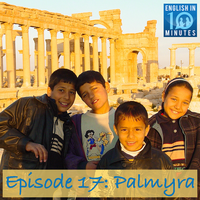
Episode 17: Palmyra
Nick: Today we're talking about the city of Palmyra in Syria, which many people will have heard of because it's been in the news quite a lot in the last few years, umm, as part … uhh, as an unfortunate part of the Syrian civil war, and it's become a kind of symbol of the war in a way, or the symbol of what has been lost and the heritage that's been lost in the Syrian civil war. Umm, but what we want to talk about is our trip to Palmyra, which happened, fortunately for us, uhh, years before this civil war started. So it was all the way back in 2003, umm, and we went to Palmyra, and in fact there was a war in neighbouring Iraq at the time, so it's just one of these unfortunate places. It seems, the Middle East can't really escape war, or it just happens, uhh, so often in that area. Umm, but, Palmyra is famous for being a Roman site, and so it's a large Roman archeological site that you can visit, and it's just a really spectacular historical place to visit, right?
Wendy: Yeah, it is unbelievable. Umm, and it's one of a number of, uhh, historic sites in the region. We saw several other places, umm, that, you know, were similarly impactful, uhh, on that trip. We travelled throughout the Middle East, so there was, for example, a place called Baalbek in Lebanon, there's several sites in Turkey, umm, but Syria, yeah, Palmyra was definitely one of the most memorable places that we visited on that trip in terms of ancient historical sites because it was a whole city, and so you really see, umm, how the city was laid out. You know, you see these long colonnades, uhh, going along the main streets and different temples and things. Umm, so it really gives you - or at least at that time, I'm not sure what's left now, but at that time what was left of the ruins really gave you a great sense of what the ancient Roman city was like.
Nick: Yeah, and I think like you said, we visited so many incredible places - not just Roman places but all sorts of historic sites, uhh, in that area, but Palmyra was one that stood out for me for a few different reasons, but, uhh, firstly because the location is really spectacular. It's an oasis in the desert, and so you're really surrounded by this desert landscape. There are these hills that kind of surround it, it's in this valley, and just the material, umm, and the colours of the stone and the marble, it's very evocative and very romantic when the sun hits it in the late afternoon and you have the desert surrounding it and so it's just really spectacular in that way.
And it's a very, uhh, historically important site as well because it basically served as a kind of a frontier city, or almost at certain times a buffer zone between the Roman Empire to the west and the various incarnations of the Persian Empire to the east. And so when you go now you see what look like classical Roman ruins, it looks like a Roman city, but it did kind of change hands and at certain points it was independent. Umm, and in the third century AD it was exceptionally important as a kind of centre of this Palmyrene Empire, a sort of breakaway empire from the Romans, so it's very interesting that it's not just a small Roman place that wasn't really important at its time. It was really important at its time and then we still get to see a lot of it today, or at least we did before the war.
And the final thing that I really loved about was that entry to the site for local people was free, and we had to pay whatever it was to enter which was fine. And, you know, there's a small town that's around the ruins but there's not really a lot to do, I guess, in the town, and so the local people go to the site because it's free for them, and they … it's like a nice park where they can go and have picnics and, you know, be with family and be with friends. And I think we might have been there on a Friday afternoon after Friday prayers and it seemed like the whole town was just there enjoying themselves, and not doing anything bad, but just, sort of, being amongst the ruins and really appreciating them, I think, in a way that was really nice to see because often you might have something like this in your backyard and not really understand that other people don't have this in their backyards. Umm, and so I think … people would come up to us, they wanted photos with us, and I think, you know, they were curious about us and why we had come to their town, and, you know, I think they could see that they had a special place right there and I found that really nice.
Wendy: Yeah, I remember that too. I remember lots of people, umm, having picnics and, you know, it was just very obvious that they weren't there as a tourist. You know, they weren't, uhh … they didn't have their noses in their guidebooks and they weren't, you know, trying to identify sites. They were just sitting there and relaxing and really taking it all in and enjoying being there. Umm, and I think that's really special. There weren't very many tourists when we were there, uhh, because, as you mentioned, there was the conflict, uhh, in Iraq. Uhh, that war had just recently started or … yeah, it was right around that time, while we were on that trip, that the U.S. began bombing Iraq, and so that scared away a lot of people from the region, even though Syria itself was perfectly safe at that time. But there weren't very many foreign tourists who were going there back then. And so that was nice for us to have most of the sites to ourselves and, uhh, to be one of the few tourists there, but then it was also great to see that the local people were still enjoying it too.
Nick: Yeah, that's an interesting point because at some of the other famous Syrian sites that we went to, we were, in some cases, the only people there. Apamea, which is the next famous Roman site, we were the only people there. Uhh, the Crac des Chevaliers, which is a very famous castle, I think we didn't see anybody there the whole time we were there. Umm, Bosra, which is a Roman theatre surrounded by an Arab, uhh, fortress, there were maybe two other people there. And so, you know we had fun with that when we were the only people there, but at Palmyra we had that different experience.
And, you know, now that there's this terrible war in Syria that, as we're talking now, has been going on for about five years, uhh, you have such a heavy human cost, which is so tragic, and also you have this loss of cultural heritage, umm, and in Palmyra especially because ISIS has had control of the city at various times. Control of the city has been handed back and forth and ISIS has destroyed, uhh, several of the ancient buildings in Palmyra, uhh, the Temple of Bel and also a Roman archway, and that's really sad. It's interesting to think about the human cost and then the cultural cost or the cultural loss as well. And we attended a talk by the director general of UNESCO, Irina Bokova, recently, about two years ago. And she was, sort of saying … you know, because some people think that OK, because the human cost is so great you shouldn't focus on whether a building has been blown up, it doesn't really matter in comparison with the human cost and you can certainly see that point of view. But she was basically saying that it's really inseparable, that the human cost and the cultural heritage cost, uhh, it's one and the same, it all comes together as part of the identity of the people of the region and who they are. And when I think about that I always think about our trip to Palmyra and seeing these people with their picnics and now you think about where they are or what's happened to them, and are they safe? And now they can't go and have their nice picnics in Palmyra anymore, and so for me, that's the kind of vision of the tragedy of the Syrian War, umm, both the human side and the cultural heritage site kind of coming together in this way.
Wendy: Yeah, yeah, I think a lot about the people that we met. Umm, and just casual interactions, you know, we didn't necessarily make lasting friendships in Syria but the people that we met as a whole were just so friendly and so warm and so welcoming and it really struck us. And so I just remember little chance encounters that we had on the streets, umm, with people who would say something to us as we were walking by, that has stuck in my head for all of these years, and now I think about those individuals and wonder where they are and what they're going through.
Nick: Yep, and I mean as we've talked about a couple of times, we saw so many amazing sites, and basically in Syria, all of the world heritage sites have all been damaged, some seriously damaged, and, you know, we have these memories of our trips to all these different places and now we don't know what they're like and I think Palmyra above all is, as I said at the beginning, the kind of symbol, or the physical or visual symbol of this war, and, umm, the terrible things that it's brought.
Wendy: Yep, so it's a very sad situation and, uhh, we hope for a better future for Syria and its people and its cultural heritage very soon.
Nick: Absolutely.
