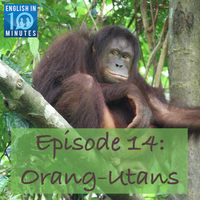
Episode 14: Orang-utans
Nick: In episode 7 of the podcast we talked about the time that we saw gorillas in the Congo. And today we're going to talk about another type of primate that we've seen in its natural setting, and that's the orang-utan.
Wendy: Yes, one of my favourite primates.
Nick: For sure, and the orang-utan is native to only two islands in the world. Uhh, one is Sumatra, which is the biggest island, uhh, in Indonesia, and the other is Borneo, which is, uhh, an island that's shared between three countries. Essentially the northern part is in Malaysia, the southern part is in Indonesia and then there's also a tiny section of the northern part, uhh, which is the country of Brunei.
Wendy: Mmm-hmm.
Nick: And so orang-utans only live on these two islands, uhh, and so their habitat is quite small I guess, and it's also endangered, they're an endangered species.
Wendy: Yes, and that is because their habitat is threatened, umm, largely by, well by man, in general, by logging, deforestation because of logging, because people want, you know, the logs … a lot of them are very valuable, uhh, forms … very valuable trees, different types of wood that people like to use for furniture, so, uhh, the forest is destroyed for logging and then a lot of it is also destroyed, uhh, to make room for palm oil plantations, so you may have heard about, uhh, palm oil being a very problematic, kind of, umm, ingredient that goes into a lot of foods. And, uhh, one of the problems is that it's destroying the habitat of the orang-utans.
Nick: The other thing with orang-utans is, I think, that because they're so human-like, umm, they've also been used as pets, taken as exotic pets, and mistreated and things like that. And so, umm, you know, unfortunately it's not all smooth sailing for them.
Wendy: No.
Nick: Umm, and there are - in these countries - in Indonesia and Malaysia where they live - there are some rehabilitation centres. This is where they take orang-utans that have been used as pets, uhh, and they rehabilitate them, which is to say that they, uhh, get them … they make them become wild orang-utans again. And so they gradually and slowly, uhh, help them to rediscover their natural lives and their natural habitats. And so there are four of these rehabilitation centres, two in Indonesia and two in Malaysia, and we love orang-utans so much that we've been to all four.
Wendy: Yeah we have. Not all on the same trip, but, uhh, we've made a few different trips to that part of the world and, uhh, yeah, over the course of a few different years we managed to visit all different … all four of them.
Nick: And so it's quite interesting because I think the … what you see in these centres is a good reflection of the differences in the two countries.
Wendy: Mmm.
Nick: Because we went to Indonesia first, and we went to these two centres in Indonesia, and later on we went to the two in Malaysia. The ones in Malaysia are much, uhh, better funded, they have better infrastructure, better facilities, more tourists, and things like that. So I think the more magical experiences that we had actually were in the Indonesian, uhh, ones.
Wendy: Yes, umm, that might seem counter intuitive but I think, you know, because there was not so much infrastructure and because there weren't that many tourists, we were able to have a much, uhh, more close-up experience and more, kind of, personal experience with the orang-utans. Umm, particularly at one of the two rehabilitation centres, I have very vivid memories of the one that's called Tanjung Puting, uhh, which we arrived at by boat. That's the only way that you can get there is by boat, there are no roads that go there. And when our boat arrived at the dock we were met at the dock by an orang-utan, who took me by the hand and walked me down the dock to our lodging, to where our accommodation was, which was amazing. Uhh, and, you know, you're not supposed to have that kind of close interaction with the orang-utans, you're not supposed to touch them, because, you know, because humans and orang-utans are so very close in our DNA that it's easy for us to transmit diseases to them or for them to transmit diseases to us, so for their safety, you know, they do tell you to stay a safe distance away from them. And in Malaysia, that's … that is pretty closely enforced. But in Indonesia, much less so. And, you know, in some cases, even though I wasn't trying to come close to the orang-utan, she actually approached me and took my hand. Umm, so, uhh, there wasn't a lot that I could do, and, uhh, it was an incredible experience.
Nick: Yeah, it's also part of the rehabilitation, that what they're trying to do is, sort of, wean the orang-utans off human contact.
Wendy: Right.
Nick: Uhh, and so these are orang-utans in many cases that have been exposed to humans a lot and they're comfortable with humans, but they're trying to turn them wild again. Umm, so like you said, they're happy to play with the visitors who come, umm, but, yeah, you're not really supposed to have that close an interaction with them. And so in the two centres in Malaysia, there are viewing platforms, and you don't get really close to the orang-utans.
Wendy: No.
Nick: Uhh, but in Indonesia, they're right with you, it's really quite incredible at both of the two sites, but this one in particular, uhh, which is the one in Kalimantan, which is the, uhh, Indonesian part of Borneo, where there are very few visitors, I think, there, because it's very hard to get to…
Wendy: Right.
Nick: …umm, and not that many people go, I think, to Kalimantan anyway.
Wendy: No.
Nick: Even when you go there, it's not near, umm, major cities or major airports or anything, so we spent a long time on a lot of buses to get to this place from where we could take this boat to go and see them. But it was incredible, it was absolutely worth it.
Wendy: Oh yeah, no doubt about it.
Nick: Umm, and but … just to watch the orang-utans was really amazing. Because, I remember one of them had a T-shirt on and he had some soap and he was lathering up his arm with soap and it's just like watching a kid or a, you know, like a baby or a kid just kind of fooling around.
Wendy: Yeah.
Nick: But it was just incredibly human-like in everything that they were doing. And I think one of them jumped onto our boat and took something.
Wendy: Yes, yes, one of them took … we had insect repellant, a bottle of insect, like, spray. And, uhh, I didn't know what to do. I was afraid that the orang-utan was going to, you know, spray himself and maybe try to eat it and, you know, that it could be bad for them, so I didn't know what to do. And then our guide came and saw and then, you know, made a noise to scare the orang-utan away so that he would drop the insect repellant. Umm, but yes, we had lots of close contact with them in that way.
Nick: So what they do, especially in the two Indonesian centres, is that, you know, the facilities are very basic. There's some wooden huts and there's a couple of rangers who live there and, you know, they're keeping track of the various orang-utans who they've rehabilitated. And they have a kind of feeding time, especially the new ones that they've just released back into the wild, it's still important for them to come back, or to know that they can get some fruit quite easily. And so they will start calling out, they'll start making sounds like orang-utans, uhh, as they go into the jungle with some fruit, and then they'll find that the ones that have been newly released will come for that, and that's important for them. And then once they're a bit more habituated to their … back into the jungle, then they don't come back as much for those, kind of, feeding sessions because now they can get their own food.
Wendy: Yeah, yeah, they've learned, you know, relearned, uhh, how to fend for themselves and how to find food for themselves, so they're not longer dependent on the rangers. But in the beginning it is important for the rangers to give them that option in case they're not doing so well at finding their own food. They know that they can get some at these certain times.
Nick: But that was a really magical trip that we took on that boat and we had no idea, because you could also see orang-utans sometimes from the boat, uhh, on the side of the river, and you could also see proboscis monkeys, which is another, uhh, very interesting type of monkey that you find in that part of the world as well. They have these very long noses … but the real highlight was the orang-utans.
Wendy: Yes, although I did love the proboscis monkeys too.
Nick: And so that's why when we went to Malaysia we went to see them again, umm, at these other two centres, and it was a little bit less magical, it was a little bit more structured, and, umm, it wasn't quite the same thing.
Wendy: No.
I'm glad that we had the experience in Indonesia, for sure.
Nick: Yeah, and so I think many people only get to have that Malaysian experience which is still very nice, but it is … it's not like a zoo but it's something a little bit close to a zoo, I guess. But in Indonesia you just felt like, uhh, you just felt like you were watching them in their natural setting.
Wendy: Yeah, and we had lots of time to, you know, hang out with them, and, especially in Tanjung Puting, umm, you know, they're just hanging around the rehabilitation centre a lot of times. And we were staying there because, you know, there's no town to go to, so you're right there with them for a long time, which was great.
Nick: So if you ever have a chance to see these amazing animals, umm, go for it.
Wendy: Yeah, definitely.
