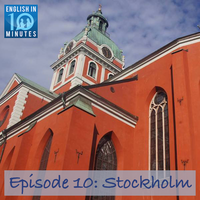
Nick: Last weekend we went to Stockholm for the weekend. Stockholm is the capital of Sweden, and it's about two-and-a-half hours, uhh, by plane from Geneva, but, you know, with EasyJet in Europe it's quite easy just to go places for the weekend, so that's what we did. And, Wendy, it was our first time in Sweden.
Wendy: It was, yes. We don't know Scandinavia very well in general. Uhh, we have been to Copenhagen, umm, and that's about it. We've also travelled around Iceland, umm, but that's, I think, generally not considered to be part of Scandinavia. In any case, we'd never been to Sweden before, so it's a new country, and a pretty new region for us in general.
Nick: Yeah, and so, umm, we only had a weekend. It was just a short trip, umm, but we tried to make the most of it. And, it was the end of September, so you never really know in the northern countries with weather, how you're going to go at that time. But I think we got pretty lucky in the end.
Wendy: Yeah, it never really rained. I mean, it was cloudy for part of the time but I don't think we ever had to put our umbrellas up, did we?
Nick: No, I don't think so. And, you know, I don't know about you but I wasn't really sure what to expect from Stockholm, because we have a friend who lived there for about a year or so while he was doing post-graduate study. He didn't really seem to like it that much.
Wendy: No.
Nick: And I don't know if that was just because he was living there and it's obviously always a different thing when you're living somewhere as opposed to when you're there as a tourist. Umm, but one of the things he used to say to us was that he would ask Swedish people, if he had some time off, he would say, you know, ‘Where should I go? You know, what can I do? What's something good to do, uhh, in Sweden?' And then Swedish people would say, ‘Go to Norway instead.' And he'd be … he'd say, ‘No, I want you to tell me what I can do here in Sweden.' Umm, so I came in not knowing exactly what to expect, but it was really nice.
Wendy: It was, yeah, I really liked it. Umm, I mean, I … you know, I've always heard those same negative stories from that same mutual friend of ours, uhh, so I had that impression before going. But I also had more positive impressions from a good Swedish friend, uhh, who I met a number of years ago, and I remember that she used to tell me about how beautiful it was, especially in the summer. Umm, so I think we were probably a little bit late, getting there in September. I think it probably would have been an even better experience in July or August with better weather and, you know, really long days where it doesn't get dark until very, very late at night. Umm, but even so, I enjoyed it. Umm, I was really glad to, you know, experience a new city and a new culture. Umm, unfortunately, we were both a little bit sick while we were there. Uhh, I think you had a cold first and then you gave it to me and so I came down with the cold while we were in Stockholm, which was unfortunate. But we were able to do some kind of relaxing activities that didn't take too much energy out of us and still allowed us to really enjoy the city. So I think the best example of that is the boat tour that we took, uhh, which I really enjoyed.
Nick: Yeah, I guess, I mean I didn't really realise exactly how much water there is around Stockholm.
Wendy: Yeah.
Nick: I mean, not just the water directly around the city, but you can take a boat in almost any direction and there's all sorts of islands, umm, and all sorts of different waterways. There's both lakes that are freshwater lakes and there's also the Baltic Sea, and so I think, you know, boats and water are a big part of their lives and culture and stuff there too.
Wendy: Yeah, definitely. And in fact even the city itself, you know, the city centre is made up of a number of different islands, and then you have hundreds more islands beyond that that are perhaps not inhabited at all, or in any case they just have a few cottages on them and so if you want to get out into nature, uhh, I think that's what a lot of the inhabitants of Stockholm do, uhh, like I said especially in the summer. They take a boat out to one of the other, more remote islands and have a picnic or a barbecue out there, which would be great.
Nick: Yeah, and we looked at some of the options for boat trips and some of them were really like that, that you could do where you go in an old boat that's about 100 years old, you know, a really beautiful wooden boat. Umm, and you would be on the water for all day, for eleven-and-a-half, twelve hours, and it would include meals, and you go to all of these different islands and everything. And that looked really good, uhh, but we didn't really have the time for it, uhh, so we just did a smaller trip, but it was still really worthwhile. So it was about two-and-a-half hours.
Wendy: Yeah, maybe two hours, fifteen minutes, something like that.
Nick: And so we just went around the city. I mean, to places on the outskirts of the city as well, but mainly focused, you know, within the city area. But we went on lots of different … we went around to lots of different islands, and we also had to go from the Baltic Sea into a lake, so there was a lock that you had to … that we were inside while the water levels rise and fall, so that we could traverse the … uhh, from the sea into the lake. And that was always interesting, it's always cool to be in a lock.
Wendy: Yeah, I mean we've done it, I guess, a couple of times before. The most notable one would be the Panama Canal, uhh, so that's probably the most famous system of locks, uhh, that you can travel through on a boat. Uhh, and I think we've done it before in Paris, I believe I remember we took a boat trip on the Seine and we went through some locks there as well. Umm, but yeah, it's a really interesting experience to see how the engineering works.
Nick: Yeah, and it's quite interesting because the old city of Stockholm is called Gamla Stan and it's … it dates from the 1300s or something like that, it's a medieval city. But then, kind of on the outer ring of this island there are more recent Renaissance buildings and so when you're on the boat looking at it you get a completely different perspective than when you're inside the older part.
Wendy: Yeah.
Nick: Umm, and so that was interesting to have that different view as well.
Wendy: It was. It was a really beautiful view. And you're right, uhh, you just don't get the same impression when you're inside it, you know, it's like you can't see the forest for the trees. You're just surrounded by really tall buildings, whereas if you're out on the water you can step back and look at it from a distance and you can really see all of those façades at once and get a much better impression of what the city as a whole is really like.
Nick: It was also interesting to see as you … as you're on the water and you go past these different areas of the city, that there's different parts that have their own little culture or, you know, their own feeling, their own vibe to it. Because of the geography, it's kind of led to this situation where there are different, I guess you wouldn't call them suburbs, but different parts of the city, umm, you know, that have a different atmosphere to them.
Wendy: Yeah, different neighbourhoods, umm, that, yeah, have their own unique characteristics.
Nick: And then because they've got a lot of water, you know, there's a lot of, umm, a lot of different types of housing that you can have that looks over the water and they're very good at building balconies and terraces and things like that, so we saw a lot of nice places overlooking the water.
Wendy: Yeah, I know that Sweden is quite famous for design, you know, modern kind of sleek design, which to be honest is not something I'm particularly interested in. I much prefer older buildings and, you know, medieval or Renaissance or Baroque architecture as opposed to modern architecture. But I think they are really good at making places that are pleasant to live in and that are, at least, not ugly. You know, umm, there's lots of windows so it's lots of sunlight and open spaces, as opposed to just, you know, really ugly, concrete blocks.
Nick: Right, and then Sweden is the home of IKEA, right?
Wendy: Yes, it is.
Nick: And so that … you know, what you see when you see some of the more modern buildings in Stockholm, it's kind of like IKEA on a grand scale. You see an entire house with the same kind of principles like you talked about for Swedish design.
Wendy: Yeah.
Nick: And so we also did a walking tour, as we like to do, uhh, in Gamla Stan, the old part of Stockholm, which was also quite interesting.
Wendy: Yeah, it was good. Umm, I love doing walking tours, uhh, I mean, at the same time, I hate being on a tour, like a multi-day tour where you're stuck inside of a bus and you're stuck with the same group of people and you don't have any freedom or independence to decide when and where you want to visit. But if it's just a short, one or two-hour walking tour to show you around the city, uhh, I think that's really valuable and you can really learn so much about the city that you would never know just from walking around it on your own. So I really enjoyed doing that.
Nick: Yeah, so we got these little stories about things that you certainly wouldn't have known about otherwise. Umm, and so, in Gamla Stan they have one street, for example, which is very, very narrow. I think at its narrowest point, it's maybe 80 centimetres. Uhh, so you can almost hardly fit into it. And it gets wider and wider, uhh, as you go down it. And so it was fun to find places like that.
Wendy: Yeah, there was a legend, you know, that you're supposed to, uhh, reach out and touch both sides of the wall on either side of this little street, and then keep touching, you know, as you're walking down, and it's getting further and further apart, so your arms are stretching out wider and wider and wider until eventually you can't touch the sides anymore, and then you make a wish and it's supposed to come true. So we did that, uhh, so hopefully our wishes come true.
