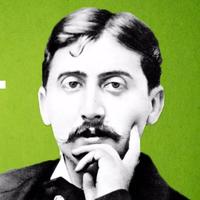
Marcel Proust. LITERATURE. Part 2/2.
This brings us to the third and only successful candidate for the meaning of life: ART.
For Proust, the great artists deserve acclaim because they show us the world in a way that is fresh, appreciative, and alive.
Now the opposite of art for Proust is something he calls habit. For Proust, much of life is ruined for us by a blanket or shroud of familiarity that descends between us and everything that matters. Habits dull our senses and stops us appreciating everything, from the beauty of a sunset to our work and our friends.
Children don't suffer from habit, which is why they get excited by some very key but simple things like puddles, jumping on the bed, sand and fresh bread.
But we adults get spoilt about everything; which is why we seek ever more powerful stimulants like the aforementioned fame and love.
The trick – in Proust's eyes – is to recover the powers of appreciation of a child in adulthood, to strip the veil of habit and therefore to start to appreciate (to look upon) daily life with a new (and more grateful) sensitivity.
This for Proust is what one group in the population does all the time: artists.
Artists are people who know how strip habit away and return life to its true deserved glory, for example, when they show us water lilies or service stations, or buildings in a new light.
Proust's goal isn't that we should necessarily make art or be someone who hangs out in museums all the time. The idea is to get us to look at the world, our world, with some of the same generosity as an artist, which would mean taking pleasure in simple things – like water, the sky or a shaft of light on a piece of paper.
It's no coincidence that Proust's favourite painter was Vermeer: a painter who knew how to bring out the charm and the value of the everyday.
The spirit of Vermeer hangs over his novel: it too is committed to the project of reconciling us to the ordinary circumstances of life – and some of Proust's most compelling pieces of writing describe the charm of the everyday: like reading in a train, driving at night, smelling the flowers in spring time and looking at the changing light of the sun on the sea.
Proust is famous for having written about the dainty little cakes the French call ‘madeleines'. [4]
The reason has to do with his thesis about art and habit. Early on in the novel, the narrator tells us that he had been feeling depressed and sad for a while when one day he had a cup of herbal tea and a madeleine – and suddenly the taste carried him powerfully back (in the way that flavours sometimes can) to years in his childhood when as a small boy he spent his summers in his aunt's house in the French countryside. A stream of memories comes back to him, and fills him with hope and gratitude.
Thanks to the madeleine, Proust's narrator has what has since become known as “A PROUSTIAN MOMENT”: a moment of sudden involuntary and intense remembering, when the past promptly emerges unbidden from a smell, a taste or a texture.
Through its rich evocative power, what the Proustian moment teaches us is that life isn't necessarily dull and without excitement – it's just one forgets to look at it in the right way: we forget what being alive, fully alive, actually feels like.
The moment with the tea is pivotal in the novel because it demonstrates everything Proust wants to teach us about appreciating life with greater intensity. It helps his narrator to realise that it isn't his life which has been mediocre, so much as the image of it he possessed in normal that is voluntary memory. Proust writes:
“The reason why life may be judged to be trivial although at certain moments it seems to us so beautiful is that we form our judgement, ordinarily, not on the evidence of life itself but of those quite different images which preserve nothing of life – and therefore we judge it disparagingly.”
That's why artists are so important. Their works are like long Proustian moments. They remind us that life truly is beautiful, fascinating and complex, and thereby they dispel our boredom and our ingratitude.
Proust's philosophy of art is delivered in a book which is itself exemplary of what he's saying. It is a work of art that brings the beauty and interest of the world back to life.
Reading it, your senses are reawakened, a thousand things you normally forget to notice are brought to your attention, he makes you for a time, as clever and as sensitive as he was – and for this reason alone, we should be sure to read him and the 1.2 million words he assembled for us. And thereby, learn to appreciate existence before it is too late.
