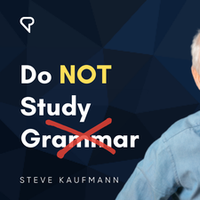
Do NOT Study Grammar
That distracts the learner from the main goal, which is to get lots of exposure to the language.
Steve Kaufmann here and today I want to talk about grammar, how important is grammar? And I'm going to talk about grammar in the context of all of the details of languages that we learned in school. How effective is it to teach these details if the ultimate goal is to become fluent in a language? Now, remember if you enjoy these videos, please subscribe. You can click on the bell for notifications. By the way, you'll notice that I have my LingQ t-shirt on. I just happened to find that in the closet when I was getting dressed this morning. Um, at any rate, so, you know, details, one of the things that struck me in Manfred Spitzer's book, and I often refer to it, is the, when he explains that the brain, our brains and all the brains, the process of learning is the same. There are no people with brains that learn better this way or that way, our brains learn the same, the same way we have our likes and dislikes. But the process of learning is the same and the brains are better...
our brains are better at forming patterns, recognizing patterns and not so good at retaining detail. So that, uh, the details that we learn that we keep somewhere in our short-term memory, we lose them. But over time, the brain starts to recognize that pattern. And that's very much in my view, the process
by which we learn languages. So, you know, if you sort of spell out like grammar, grammar basically describes usage. So since languages evolve over time, sounds in languages evolve over time, uh, you know, usage patterns evolve over time. So the grammar which describes the usage will evolve over time. So how useful is it to attempt to teach people how the language, what the rules of usage are before the learner has had enough experience with the language?
I think it's not that useful. And, at least in our school system in Canada, where they teach French, they teach grammar, they teach grammar because it's something they can easily test the learners on. And some learners got eight out of 10 and some got six out of 10. So learner A with eight out of 10 is better than learner B with six out of 10, but that doesn't necessarily mean that at the end of the day learner A is going to be better at speaking than learner B. It may mean that, but it's not obvious. And there are many cases where learner B who may be exposed more to the language, maybe had comes from a, you know, a country where the language is spoken hears the language at home, but he speaks it incorrectly from a grammatical point of view and so he does poorly on the test, but he understands and he communicates, and there are many things, examples like that. So my feeling on grammar and other details of the language is that they can be introduced at any time. They should be introduced when the learner is interested in them. It's, it's true that many of the patterns in the language, you know, are not noticed when we hear even hearing the language over and over again, we don't notice certain niceties of pronunciation.
We don't notice that certain syllables aren't stressed. We don't notice, you know, the, whatever it might be, third person singular in English, uh, of the present tense, uh, it takes an "s". Whereas the other forms of the verb don't. We don't notice these things. So sometimes it can be useful to point these things out.
Therefore, I think it's useful to have a reference grammar [book] and every language that I have learned, I have tried to get a hold of a grammar [book] as small as possible with no exercises, no drills, just what happens in the language and a bunch of examples. And so I look at that and I see the examples. And it's just helping my brain get used to how the language works.
The patterns in the language and this approach, I think is the same for other details of the language. For example, pronunciation upfront, when it is explained to you using international phonetic, the international phonetic alphabet that this sound is pronounced this way. I don't personally find that very useful, uh, I find that with the availability of audio today, text to speech, I can hear how it's pronounced, but it is possible that three months later having listened to the language many, many times, I still don't notice that a certain vowel is pronounced a certain way, or I don't notice that the stress is a certain way, uh, or in the case of pitch accent that it's this way rather than that way.
And so at that time later on to help us notice things that might've passed us by it's useful to refer to these explanations, but there's far too much emphasis placed, placed on these, these explanations or these details of a language, uh, with the intention of testing people on these details. And the result is normally not very good because it distracts the learner from the main goal, which is to get lots of exposure to the language, lots of listening, lots of reading. And as Krashen says, in an environment that is low stress, that is enjoyable. And if you do that, and if you trust your brain, a lot of these things will be acquired naturally. And therefore you needn't be tested on if the goal is comprehension, they don't even need to test you on your comprehension.
Even if you misunderstand something, the fact that you are putting in the time, listening and reading will eventually enable your brain to get used to the language. So, yeah. In my approach to language learning, I want to sort of, deemphasize the sort of details, the grammar, the other specific explanations, because our brains are not as good at dealing with these explanations and rather encourage people to find ways to enjoy the language.
Listen to the language. Don't worry about what you don't understand. Don't worry about the mistakes that you make. If you continue to expose yourself to the language, you will gradually get better. And when you are interested in, genuinely curious about specific details, you can look them up and it's never been easier to look them up, but, but don't get yourself a thick grammar book like this.
Get yourself a thin as possible grammar book, which explains what's happening in the language with examples, without exercises, without drills and go over it regularly. Don't try and block learn the conjugation table of a specific verb. Just look it over, forget it, look it over and recognize you're going to forget it and go back there.
And eventually over time that activity looking things up, grammar rules, whatever, uh, which are limited unlike the amount of words we have to learn, which is almost unlimited, the grammar rules are actually quite nice. And if you keep on flipping through a sort of a thin grammar book, you will eventually get a very good overview of what happens in the language.
And when you combine that with lots of listening and reading, you're going to get better and better at the language rather than trying to fight the rules of grammar upfront. So that's my take on grammar and I I've covered this subject before and I'll leave a few other videos on the same subject. Bye for now.
