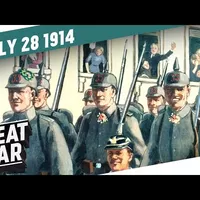
The Outbreak of WWI - From Local Conflict to World War in 1914 I THE GREAT WAR Week 1 - YouTube
My name is Indy Neidell and this channel – The Great War – is going to cover the first world war,
week by week, as it unfolded 100 years later. From today until November 2018,
so you can really get a sense of just what happened as it happened. The active weeks, the passive weeks,
the weeks of carnage and the weeks of hope – we'll follow them all one by one.
And we've made a couple of special episodes about the prelude to war so you can get some
idea of all of the forces in motion. We've also made an episode about the assassination
of the archduke and his wife as it was one of the pivotal
moments in our history. All three of these episodes will come out in the next few days.
100 years ago today, on July 28th, 1914, the empire of Austria-Hungary declared
war on the Kingdom of Serbia. Now, as you are probably aware, this snowballed within days into the
First World War.
Now people often talk of the “blank check” – when Kaiser Wilhelm said on July 5th, 1914
that he would unconditionally support Austria in whatever actions she took against Serbia,
and this is seen as the main argument for Germany's responsibility for the war, but
this is a little too simple.
In the days following the assassination of the Austrian Archduke Franz Ferdinand in Sarajevo
by the Serb Gavrilo Princip, there were anti-Serbian riots and demonstrations in much of Bosnia
and official dispatches to Vienna that there was Serbian complicity in the plot, but general
European reactions to the killings were quite mild. Austria, however, had big ideas, many
of them coming from Army Chief of Staff Conrad von Hötzendorf. And I love that name.
Conrad was a vehement imperialist for Austria and Austrian greatness. He's also
been described as being “the most dangerous kind of officer...both stupid and intensely energetic."
There you have it.
In fact, in the year and a half before today, 1914, he asked his government
to go to war no less than 26 times. And it's very important to note here that his main
counterweight, the man who repeatedly urged emperor Franz Josef against war with Russia
or war with Serbia, not to listen to Conrad, was Archduke Franz Ferdinand, now deceased.
The assassination was, to Conrad, a heaven sent means to curb Serbian power and ambition.
Now to understand the next few weeks we really need to look a bit at both Germany and Russia
In 1912, the Kaiser had told army chief of staff von Moltke and Grand Admiral
von Tirpitz that “Austria had to act vigorously against the foreign Slavs... If Russia were
to support the Serbs war would be inevitable for us.”
Although we think of pre-war Russia today as a backwater,
this was not really the case. Russia had become the world's fourth largest economy by 1914.
Okay! Shortage of money had always meant before that she had never been able to build and
equip her army like the Germans could, but more importantly, her railways. By 1914, though,
Russian currency was on the gold standard and the railroads were booming and Russia
would be able to easily and quickly defend her borders in only a few years.
Now this was a big fear in the German high command – since Russia obviously had the manpower advantage,
once her railways were a match for Germany, well... German Chancellor von Bethman Hollweg's
diary from July 7th tells us these thoughts: that Russia had become a nightmare, and that
the German generals say there must be a war before it was too late. By 1917, Germany
has no hope, so better 1914.
As an aside here – this was the opinion of the generals and some government
leaders but it was not the opinion of the German people at large.
You see Germany had the largest population of socialists in Europe and they and others comprised
a big anti-war segment of society.
So the Kaiser wrote on June 30, “the Serbs must
be disposed of, and right soon!” and he did pledge German support for Austria, and
he did tell the Austrian ambassador on July 5th that should war between Austria-Hungary
and Russia prove unavoidable, Germany would be at Austria's side. HOWEVER, and this
is really important, he also told his chancellor that he did not think there was a real prospect
of war – that Russia was not close to being ready.
The next day, he went on his annual three-week vacation cruise to Norway, which is kind of
not what you'd do if you were basically the most powerful man in the world and you
were about to go to a major war, so in spite of it all, a world war was not on the Kaiser's mind.
So on July 7th, the Austro-Hungarian cabinet met to discuss Serbia, and they were
for a war to reduce Serbia's size and make her dependent on Austria.
On July 13th, a secret report reached Vienna from Sarajevo that there was zero evidence
the Serbian government had anything to do with the assassination. Now, this didn't really
change anything, but THIS did:
Franz Josef finally became convinced that Austria could take action against Serbia
without other powers interfering, so he agreed to issue an ultimatum. The terms of the ultimatum
were finalized on July 19th. It had a total of 15 demands and it linked the Belgrade government
with the assassination, even without evidence.
Now, you can look up the demands yourself, but here are a couple that really stick out:
the Serbian government must condemn anti-Austrian propaganda and punish anyone who made or distributed it,
and the big one – Austrian officials would participate in the judicial process.
In Serbia. Yep, they would be in charge of justice in another country.
Now, as you may guess, this ultimatum was designed to be rejected. It was sent on July
23rd, with 48 hours for Serbia to agree to it. 6 PM on
July 25th, Serbia answered the ultimatum. She agreed that anti-Austrian propagandists
would be punished and subversive movement suppressed, and actually agreed to almost
everything else, but as to Austria participating in the judicial process within Serbia, Serbia
simply asked that this demand be submitted to the tribunal in The Hague.
Now, everybody except Austria thought this response was just fine, but Austria was determined
to go to war. Actually, Russia suggested two days later that negotiations between
her and Vienna should be opened to try and sort things out. This was refused. A British attempt that same
day to talk Germany into having a four-power conference to also try to sort things out
was rejected as well.
And you know what? Here's something that happened then that remained secret until after the war:
on July 28th, 100 years ago today, Kaiser Wilhelm finally read the full
text of the Austrian ultimatum and Serbia's response. And he could see no reason at all
for Austria to declare war. Yep. After all this that had happened, The Kaiser wrote:
“a great moral victory for Vienna, but with it every reason for war is removed...”
And just about an hour after the Kaiser scribbled that in the margins, Emperor Franz Josef signed
a declaration of war on Serbia, confident of German support. And that declaration would
turn out to be the death warrant of his own empire.
We'll see you next week. Click subscribe to get each and every episode as it comes
out, and if you like the show but English isn't your best language, once again, this
show is also available in German and Polish – you can find links to those channels below.
Now I'm sure many of you have comments, ideas, and suggestions; we're happy to hear them.
See you next week!
