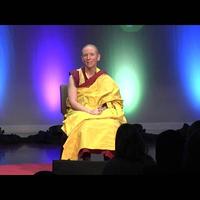
Happiness is all in your mind: Gen Kelsang Nyema at TEDxGreenville 2014
Transcriber: Adrienne Lin Reviewer: Hannah Ximenes
Alright, my friends. Hello.
(Audience) Hello.
So I want to start off with a few questions.
And I know a lot of other presenters
have already asked you questions,
and they've been kind of hard questions.
But the questions I'm going to ask you
are very, very simple.
And I promise you'll be able to answer these.
Alright, are you ready? For your first one?
Okay.
Your first questions is --
you don't have to answer out loud:
Are you having a good day?
Okay, got your answer?
Alright.
My second question for you is:
Why?
If you're having a good day,
why are you having a good day?
Or if you're having a bad day,
why are you having a bad day?
So I have one more question for you.
This should be the easiest one of all.
My last question is:
Tomorrow,
would you rather have a good day,
or would you rather have a bad day?
Do you have your answer for that one?
What about the day after tomorrow?
What about Sunday?
Let's see. Yeah, that's right.
Tomorrow's Saturday. Sunday.
How about Monday?
Would you like to have a good day or a bad day
on Monday?
Tuesday?
Wednesday? Thursday? Friday?
This time next week?
A good day or a bad day?
So that last question,
like I said, is probably the easiest one
for us to answer,
because we know the answer to that, don't we?
We want to have a good day,
everyday.
Did anyone in the room answer,
"Yes, I want to have a bad day on Monday"?
Of course not.
We all want to have a good day everyday.
So this is really speaking to the type of happiness
that we all wish for
in our heart of hearts.
We have a good day when we're happy,
and we want to be happy everyday.
There's never a day
when we don't want to be happy.
But whether or not we have good days or bad days
really depends upon how we answered
the second question.
Do you remember the second question?
What was the second question?
"Why?"
Why am I having a good day?
Why am I having a bad day?
So one thing that my teacher says
-- his name is Geshe Kelsang Gyatso --
and he says that,
"Much of the time
our mind is like
a balloon in the wind,
blown here and there
by external circumstances."
Do you know that feeling?
He says when things are going well,
when they're going our way,
we feel happy.
But then if something goes wrong,
for example, he says,
"If we're forced to work with a colleague that we dislike,"
but I'm sure none of you have colleagues you dislike, right?
(Laughter)
He says if we're forced to work with someone we dislike,
or if something doesn't go our way,
then our happy feeling disappears.
So as long as our answer to the question
"why am I having a good day?", or "why am I having a bad day?"
Because you know, this is a question people ask us
like, maybe when you get home today,
someone will go, "So how was that TED thing?"
"Did you have a good day?"
And we'll say, "Yeah, I did."
"There's this lady, and she talked to us about
how we need to be compassionate towards former inmates,
and there's this performer who did this awesome beat-boxing thing with his mouth,
you know, this person, and that person."
As long as our reasons
for why we had a good day are a list of external conditions,
then we're not going to
have this stable happiness that we all want.
Does that make sense to you?
Because if that's what our happiness depends upon --
because we cannot control
people and circumstances
every single day --
then our happiness will be in the hands of others, won't it?
It'll be at the whim of our circumstances.
So if you really wish
to have a good day everyday,
we've got two things we need to do.
So the first thing that we need to do
is we need to stop
outsourcing our happiness
and outsourcing our unhappiness
on the people and circumstances.
In other words,
we need to stop attributing our happiness
to what's going on externally,
and we need to stop blaming others,
-- especially blaming others --
for our unhappiness.
So for as long as we do that,
as long as we're making it
the job of people and circumstances
to make us happy,
or as long as we're making it their fault when we're unhappy,
our happiness will be very unstable,
and illusive.
Our second job
is to actively cultivate
a source of peace and a source of happiness
coming from inside our own mind.
So here's something I want you to commit to memory.
Are you ready?
This is another line
from one of my teacher's books,
where he says,
"Happiness and unhappiness
are states of mind;
and therefore their real causes
cannot be found outside the mind."
So if we have a peaceful state of mind,
we will be happy
regardless of people and circumstances.
If our mind is unpeaceful or agitated,
then even if we have very good circumstances,
we'll find it impossible to be happy.
So, in other words,
it's not what is happening
that is making us happy or unhappy;
it is how we are responding to those things
that determines whether we're happy or unhappy.
It is what our state of mind is like
that determines our happiness or unhappiness.
So how are we going to do this?
So we can all understand this intellectually.
It's not rocket science, is it?
It's not hard to understand.
And maybe, to a certain extent,
as I tell you these things,
you're like, "Yeah , I knew that already."
"I knew that already."
But how do we actually do it?
How do we actually cultivate
this stable peace of mind
that we can rely upon,
regardless of the external circumstances?
So this is really where meditation comes into play.
And I would say I would need a whole other TED talk
-- hint, hint -- (Laughter)
in order to really do this subject of meditation justice.
But for our purposes today,
we can say that meditation
is a mental action.
It's the mental action of concentrating
on a peaceful positive state of mind.
If we do that, we concentrate
on a peaceful positive state of mind,
then we can say we're meditating,
whether that's like this, right?
See, actually, you don't know if I'm meditating or not,
because I could be thinking about my grocery list.
(Laughter)
It's only meditation
if I'm actually focusing on a positive peaceful state of mind.
But the trick is, I can do it like this.
This is called formal meditation.
But we can also learn to do this all the time
in our daily life.
See, here's a perfect opportunity.
(Laughter)
We concentrate on a mind of patience.
We're not disturbed, not unhappy.
So why don't we try it now?
Are you up for it? Just a short meditation.
According to the clock, I've got three minutes left,
so this is going to be a very brief one.
But let's actually try it, let's try
to tap into our own potential
for a peaceful positive state of mind.
So now, I'll ask you to just sit comfortably,
and place your feet flat on the floor,
and your hands within your lap.
And then you can lightly close your eyes
and become aware of the sensation of your breath,
at the tip of your nose.
And as you breathe out,
you can imagine
you're breathing out any agitation,
any mental busyness,
any frustration
or unhappiness in your life.
Breathing it all out,
like dark smoke.
And as you breathe in,
you can imagine and believe
that you're breathing in a clear, bright light,
which is a very nature of inner peace.
And you can imagine that this clear, bright light
fills your entire body and mind.
And for a few seconds,
simply enjoy
this inner peace coming from within.
And now, as we finish,
just be determined to bring this inner peace with you
into the rest of your day
to benefit yourself
and others.
So now, we rise from meditation.
Thank you very much.
(Applause)
