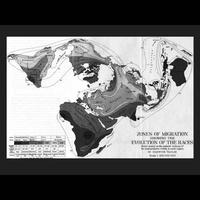
A Theory You've Never Heard Of | Michael Robinson | TEDxUniversityofHartford (2)
Let's treat them slightly different
than these people that we think of as being black African."
So, over the course of the late 19th century,
some groups, like the Bahima, the Batusi of Rwanda,
the Nyamwezi of Tanzania were called white,
and other groups were called, like the Bahutu of Rwanda,
were called black.
Now, at the time,
Africans themselves did not have the same idea of racial concept, right?
They thought mostly in terms of ethnic or clan terms,
and yet, these ideas caught on.
And it also allowed Europeans and North Americans,
when they looked at the great kind of legacy of African civilizations,
when they looked, for example, at Great Zimbabwe or the great Pyramids,
they said, "Clearly, black cultures couldn't have created these.
These must have been the Hamites, right?
Those ancient, highly advanced white invaders
who were here thousands of years ago.
So this Hamitic hypothesis
became a way of explaining, justifying, white colonization,
as well as all of this cool stuff that you find in Africa,
and that was essentially taken away from Africans themselves.
There is a very dark side to the Hamitic hypothesis as well,
which is this:
even after Europeans left Africa in the 1960s
and these countries became independent,
even after the Hamitic hypothesis
essentially was exploded as not being true,
even after that time
Africans themselves had started to adapt and adopt the Hamitic hypothesis
as a part of their own history.
So for example, the Batusi of Rwanda
considered themselves as having an origin outside of Africa,
and other groups in Africa as well.
The Iraqw of Tanzania see themselves as having a Mediterranean origin,
not an African one.
And this racial conflict between the two groups
was something that became important in the Rwandan genocide of 1994.
It was much easier for the Hutu to see the Batusi as foreign,
as literally non-African invaders of their own country,
and made it that much easier for them to exterminate them.
I'm not saying that's the only reason for the Rwandan genocide,
but it was one of the important factors.
So that's the sad part of the story.
But there's another part and I want to end on this other part,
which is an interesting part of the story,
which is we really haven't actually gotten back to the original question,
which was: if these things aren't true,
if Stanley wasn't actually seeing white people in the heart of Africa,
then what was he seeing?
So I went to Africa in 2013,
and I actually climbed that mountain that Stanley was looking at,
which I was totally unprepared for.
I mean, I run; I thought I was in pretty good shape,
but this mountain is 17,000 feet high!
There is a glacier on the top of it, and I wasn't really prepared for that.
But here I am before I got to that point.
(Laughter)
And I wanted to see, as I told my guide, I wanted to see what Stanley saw,
and my guide, who was a member of the Bakonzo tribe, he looked at me
and said: "There's no white people on the top of that mountain, man."
(Laughter)
And I said, "I know that there aren't."
But I want to think about what Stanley saw.
I came up with a provisional hypothesis, and the provisional hypothesis is this:
I think Stanley did see difference; I think he did look at people and said,
"These people do not look anything like these people."
We now know that in terms of human diversity,
Africa is the most diverse continent in the world.
There's more human diversity, i.e. physical diversity, in Africa
than any other place
because within Africa is a much longer evolutionary period of time
for the human species than outside of it.
So I think he did see human difference, and then it was filtered through -
this is my own theory, and I'm very proud of it -
it filtered what I call the Mr. Magoo Hypothesis.
(Laughter)
So for those of you who are too young to remember Mr. Magoo,
he was this Don Quixote-like figure
who was so nearsighted that you would stick him in a room,
and he wouldn't really know where he was, and he thought he was somewhere else,
but everything that he, like, bumped into or knocked into,
he interpreted as if he was in that other place
because his expectations of where he was were so strong
it filtered virtually all information coming in.
And I think that almost all explorers - probably all tourists -
suffer from the Mr. Magoo hypothesis,
which is that they too, in a sense, filter everything they see
through their expectations of what they should see.
And I think Stanley, in a sense,
wanted to see people who were like him, who were European.
He was a desperately lonely man; he was living in Africa for three years,
oftentimes without anyone else from Europe or North America,
and I think in a sense, he wanted to identify with people
and saw this difference - cheekbones, aquiline nose, lighter skin color -
and traced that as white.
Ultimately, to finish it off, why should we remember this strange hypothesis?
OK. It was a kind of inkblot test for the way people looked at the world.
But ultimately, I think we should remember the Hamitic hypothesis
because when we think about master races and Aryan domination,
we think about kind of the very short, very violent history of Nazi Germany,
but in fact, there was a much longer and a much more profound racial theory
that continues to exist today, and that is the Hamitic hypothesis.
Thanks very much.
(Applause)
