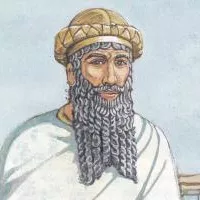
Hammurabi of Babylon, the Master of Mesopotamia
In the last episode, we left off with the passing of Sin Mubalit and the dangerous neighborhood
that the relatively young kingdom of Babylon was now a part of.
It was surrounded by enemies, or at least potential enemies, on all sides.
Rim Sin of Larsa had gobbled up Babylon's two main allies, Uruk and Issin, and no doubt
now had eyes on Babylonian territory.
To its north, the kingdoms of Upper Mesopotamia and Eshnunna were looking to expand.
It was into this dangerous world that Hammurabi became king in 1792 BCE.
With so many rivals, the question was not whether Babylon under Hammurabi would thrive,
but would it even survive?
Let's find out.
Hammurabi is a name that most of us have likely heard of.
He's most well known as a lawgiver, and for the code of laws that have been attributed
to him.
However, this was written towards the end of his 42 year reign.
More than just a lawgiver, he was a shrewd king, administrator, diplomat, tactician,
and builder.
Ruling between the years 1792-1750 BCE, the contributions that Hammurabi made in reshaping
the ancient Near East cannot be overstated.
I really believe that he's one of the most fascinating people in the history of the world.
In this program, I want to expose you a bit to the political life of Hammurabi and how
he became the most powerful man of his day.
Let's start at the very beginning of his life.
Already we're at a bit of a loss because we don't know exactly when Hammurabi was
born.
His mother's name is unknown, but his father was Sin Mubalit, the king of the moderately
sized kingdom of Babylon.
We call the dynasty that he was part of the First Dynasty of Babylon, which was founded
by an Amorite chieftain named Sumuabim.
Though we don't know his birth date, we do know through the painstaking work of archaeologists
and historians who have translated and cross-referenced thousands of ancient cuneiform documents,
that he became king of Babylon in the year 1792 BCE.
Because his reign was so long, he must have been relatively young at the time of his ascension
to the throne, but whether he was in his teens, twenties, or even his early thirties is unknown.
Regardless, Hammurabi's first year as king was an interesting, if not dangerous time
for Babylon.
As mentioned earlier, it was surrounded by several kingdoms, three of whom posed the
greatest threat.
In the south was Babylon's oldest rival, the kingdom of Larsa, who Hammurabi's father,
Sin Mubalit, had fought on at least two occasions.
While Larsa was definitely the older and, you could say, more seasoned enemy, at the
time, Eshnunna actually posed the greater threat.
Located in the Diyala river valley, Eshnunna was expanding rapidly to the west and the
south.
This was most apparent during the reigns of two of its more ambitious kings, Epek Adad
II and Naram-Sin.
The Naram-Sin we're talking about here was a king of Eshnunna and a different person
than the famous Akkadian king of the same name.
The other great king of the north was Shamsi Adad.
In the years prior to Hammurabi's coronation, his kingdom had grown leaps and bounds to
include not just the cities of Ekalatum and Ashur, but the wealthy and strategically located
city of Mari as well.
Though his kingdom was much more powerful than Babylon, Shamsi Adad had an intense hatred
of Naram-Sin of Eshnunna.
This is because shortly after he ascended the throne of his relatively small kingdom
in 1833 BCE, he was forced to abandon it and flee as Naram-Sin's forces invaded.
During this time, he sought refuge in Babylon for a few years, after which he left, gathered
a sizable force of his own, and seized a city called Ekalatum, somewhere on the Tigris river.
The precise location of Ekalatum has never been found, but we know that it was not far
from another city, Ashur, which was the holy city of the people we later call the Assyrians.
At the time though, Ashur was just a small kingdom, perhaps more like a city-state.
After residing in Ekalatum for three years, Shamsi Adad captured Ashur in 1808 BCE and
temporarily made it the capital of his expanding kingdom.
Though an Amorite, the Assyrians claimed him as one of their own, and he is often remembered
as the first great king of Assyria.
In the end, Shamsi Adad left Ashur and went around conquering other parts of the region,
including areas to the west such as the great and wealthy city of Mari in 1792 BCE, which
was actually the same year that Hammurabi became the king of Babylon.
As mentioned earlier, Hammurabi ascended the throne of Babylon in 1792 BCE.
The first five years of his reign were rather uneventful.
From various archives that have been uncovered, it seems that much of his time was spent on
financial matters and in rebuilding temples and canals.
In 1787 BCE, he launched his first known military campaign against Larsa and captured Isin and
Uruk, two cities that had at one time been his father's allies against Rim-Sin.
However, archived documents discovered in both cities indicate that it was not a permanent
victory because just a few years later, Rim-Sin is cited again as being the ruler of both.
The same was true for another city, Malgium, which was a small independent kingdom on Babylon's
border with Larsa on the Tigris river.
Hammurabi claimed victory in a battle here as well, but like Uruk and Isin, eventually
the city reverted back to Rim-Sin.
So if Hammurabi had ambitions of holding a great empire, things were not going so well
for him.
In the summer of 1775 BCE, Shamsi-Adad passed away and soon after this, so did his empire.
Many of the kingdoms that he'd conquered declared their independence, including Mari.
Its new king, Zimri-Lim, claimed to be one of the sons of Mari's last king, Yedun-Lim.
Zimri-Lim had regained the throne of Mari with the help of the king of Yamhad, a man
named Yarim-Lim.
Now of all of the kings from that time period, Yarim-Lim was undoubtedly the most powerful.
One letter found in the archives of Mari, an address to Zimri-Lim, states, and I quote,
No king is really powerful on his own.
10-15 kings follow Hammurabi, the man of Babylon, Rim-Sin, the man of Larsa, Ibal-Piel, the
man of Eshnunna, and Amut-Piel, the man of Katna.
However, 20 kings follow Yarim-Lim, the man of Yamhad.
The letter was written by a government official in Mari, perhaps warning Zimri-Lim to maintain
his friendly relations with Yarim-Lim, who from other letters seems to have been his
benefactor.
Yarim-Lim also happened to be Zimri-Lim's father-in-law, since the latter was married
to his daughter.
Yarim-Lim would prove to be an invaluable ally for Zimri-Lim, especially against kingdoms
to the east of Mari, such as Eshnunna.
With Shamsi-Adad gone,
