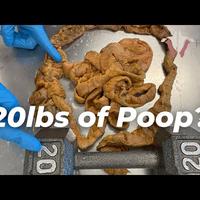
How Much Poop Is Stored in Your Colon??
Do you really have pounds of toxic poop or stool in your colon? Because there are claims out there
that say you can have anywhere from five to twenty pounds. Some claiming as high as forty pounds of
stool in the body. So in this video, we're gonna talk about if this is even true or even possible,
how our body processes and gets rid of that waste and what the overall implications would be
with that much stool or poop in the body. So, let's go take a look at a colon.
So, first, let's start with, where does poop or feces come from? Well, you may be thinking, well,
it starts with eating and food but how does something like this truly contribute to the
formation of your stool? Well, it starts by taking this delicious item and putting it in your mouth
or like geeky anatomous like to refer to as the oral cavity that you can see here with the probe.
Now, just for references, this is a sagittal head or a cut through the midline of the body so you
can see the internal relevant structures here. And it's in the oral cavity where digestion begins.
We start with mechanical digestion by chewing the food and we also get a chemical digestion because
salivary glands are gonna secrete saliva into the oral cavity and those will contain enzymes
which will break down the food and also help soften the food so it can pass smoothly back to
the next portion which is the pharynx which is a fancy pants name for the word throat.
Then, we'll move that food from the pharynx into the esophagus here and you can see the
esophagus is just right in front of the vertebral column or the spine there. So,
the esophagus is in the midline of the body and that esophagus is going to transport that food
down from the throat or the pharynx and into the stomach that you can see here.
Now, let me just explain this conglomeration of guts here. This is essentially the rest of
the digestive tract from the stomach down to the rectum here and it's about how it would
be oriented in the the body, the stomach, the small intestine, and then the large intestine
kind of bordering around there and we'll go into a little bit more detail of each segment
as we go through this creation of poop or our story of poop. We'll also make
some references to how it truly sits in the body or an intact body here as we go as well.
So, back to the stomach though. The stomach is going to continue
the process of digestion by secreting
hydrochloric acid and some other digestive enzymes to continue to break down the food
but one of my favorite things that the stomach does is creates this muscular blender action.
These contractions are gonna move the food and if you've seen previous videos, you tend to know that
I like to do this with the stomach to show these contractions but as that stomach contracts, it'll
mix the food with the digestive enzymes and the acids and we actually change the name to chyme.
Chyme is essentially the mixed food with the secretions of the digestive tract.
Then, the stomach is going to regulate the passage of that food from itself into the small intestine
here. Now, let me reflect the colon here so you can that. There's a really cool sphincter here
called the pyloric sphincter. It's - I can feel it underneath my fingers. It's a really
muscular sphincter so the passage from the chyme into the small intestine can be highly regulated
but this first portion of the small intestine is gonna give a really important contribution
to what we know as poop or feces, but let me mention one other thing - The first part
of the small intestine is referred to as the duodenum or sometimes pronounced the duodenum.
It's about twelve finger breaths in length. So, four, eight and then twelve. So,
about to this region here and it's still going to be participating in digestion because the pancreas
is gonna secrete pancreatic enzymes into this tube to further digestion and, important - the liver
and the gallbladder are going to secrete bile into there and you can see the liver right there,
at least the bottom portion of it hanging out in
that right side or right upper portion of the abdomen here.
Now, bile does help with digestion. It's really important for breaking down fats
but as far is contributing to poop or a stool,
bile is responsible for the color of the stool as it gets injected into the small intestine here.
Now, to be fair, bile, when it's first secreted is actually a greenish, yellowish color
but as that bile gets mixed into the chyme and the chyme just passes through the length of the guts,
and this is the small intestine I'm passing through, and as it continues to pass through
the guts, it enters the large intestine and in the large intestine, there's a lot of bacteria.
Maybe you've heard of flora or good bacteria. The bacteria will further
break down the vial which will change its pigment
to that brown color that we all know and love. So, speaking of passing through the guts,
understanding this process of moving through twenty feet of small intestine is gonna
truly help us understand or put the finishing touches on the story of poop or stool formation.
But let me ask you a question first. How many pounds of food do you think the average adult
eats per day? Because the answer to this question is quite relevant when we think about
this bolus of chyme moving through here or food moving through here,
what's gonna happen is the small intestine or at least the majority of it is gonna suck
in those nutrients and absorb them into the bloodstream.
Let me show you on this other cadaver here. You can see, this is kind of the conglomeration of
the small intestine but if I open it up, you can see this yellowish - yellowish tissue
that you can't see on the tray and this yellowish tissue is called the mesentery.
It does help hold the small intestine to the back wall of
the body but it all is full of tons of blood vessels that are gonna help
suck those nutrients in from the tubing that you can see here. Now, not everything is gonna be
absorbed. There's things that are indigestible or therefore, unabsorbable, things like fiber.
So, kinda think about this for a second. As that bolus of chyme or foods moving through here,
it's going to be - at least some of the things are gonna be sucked into the bloodstream. So,
as it's passing through the tubing here, it's gonna get smaller
and smaller and smaller until everything's absorbed and those things that can't be
absorbed will pass as you can see from the small intestine to a much larger diameter tube
called the large intestine which most people will refer to as the colon.
And by the way, the answer to that question of how many pounds of food the average adult eats per day
is about three to five pounds per day. Now, some of you might be like, okay, well, three to five
pounds, that five pounds is getting closer to that claim of having five to twenty pounds of
toxic poop in the colon but remember, when we are passing through here, whether you ate three
pounds, whether you ate four or five pounds during that day, not all of that is going to make it all
the way to the colon cuz the significant portion is going to be absorbed into the bloodstream.
So, even that fibrous portion or whatever we can't digest not gonna be over five pounds
if you're eating the average of what people might eat per day. That's definitely a far cry from the
twenty-pound claim or even the forty-pound claim but some still may push back even more and say,
well, let's say even two or three pounds make it in there cuz you know, you're eating a lot
of food that day. Then, couldn't build up over time and I would say to them, do not insult
my colon, let alone your colon because it's not like when that indigestible material passes from
the small intestine to the large intestine, it's just gonna sit there and stagnate.
No, your colon is much cooler than that and let me give you some here. First,
the first part of this large intestine is referred to as the Cecum.
Then, it passes up to the ascending colon then into the transverse colon, the descending colon,
and then the curved portion, the sigmoid colon into the straight part which is the
rectum here. Now, I just wanted to mention those so we can have some context for a discussion.
One of the things that happens is the large intestine, and you've probably seen it on pictures
is segmented into little pouches and those pouches are called haustra or singular haustrum. Now,
what happens when each individual haustrum gets filled with feces?
It has a reflexive or at least a peristaltic or a contractive motion that contracts and pushes
the poop into the next haustrum and then that one gets filled and pushes it into the next.
So, every time a haustrum gets filled or is a little stretch to it, it contracts and forces it
further downstream. So, that's one cool thing that helps to propel the feces downstream.
Another is just general peristalsis. If you haven't heard of peristalsis before,
the idea is that all of the tubing, the large intestine and even the small intestine
here has built-in smooth muscle into the wall and peristalsis is essentially when
the smooth muscle layers coordinate their contraction and to propel food
throughout the digestive tract and in this case, we're dealing in the colon here, feces.
Now, the colon will contract essentially about three to twelve times per minute just naturally
anyway. So, that's the second way to propel the feces further downstream. My favorite is something
called mass peristalsis. Mass peristalsis is essentially - really takes place in the transverse
colon downstream. What really happens is it's this wave of strong contractions that propels feces or
the poop from the transverse colon all the way down into the rectum to stretch out the rectum.
Now, that happens about three to four times a day and it's usually around
when you're eating meals or right after and I'm sure you guys have all probably experienced this
at one point or frequently or every day where you're like, okay, you get up maybe it's your
morning routine where you have some coffee or you have your breakfast or maybe you're at work
and you have a big lunch and right after the lunch you're like "Uh oh, my rectum is trying to
tell me something" and the rectum is essentially because of that mass peristalsis moving all those
feces down into the rectum, it's essentially saying, stretch, okay, you need a release
and hopefully, you're gonna satisfy the need of the rectum and give it a bowel movement.
So, let's say you don't listen to the demands of the rectum or in other words,
pay attention or at least just kind of ignore that sensation of stretch in the rectum that's saying,
hey, we need to evacuate and have a bowel movement. What happens in that scenario and
how many bowel movements does the average adult have? Well, first, if the uh, if you ignore
the actual sensation here and you just hold it for lack of a better word or description, we
essentially know this about the colon. One of the functions I didn't mention is as the stool passes
through the large intestine and as you can see, the majority of it is referred to as the colon,
it also sucks the last part of water or absorbs the last part of water
and salt. Out of the stool. And if the stool is in there longer, again,
saying like you decided to hold that sensation of having a bowel movement rather than going,
it's going to continue to take that water out of the stool in there for make it a little bit harder
and even make it a little more difficult to possibly have a bowel movement in the future.
Now, as far as how many bowel movements the average adult has, there's a wide range of data
out there. It essentially ranges from three times a week all the way up to three times a day. Now,
as far as three times a week, I think that's pushing it a little bit or I guess not really
pushing it if that makes sense and so, in these conversations with my patients in the clinic when
we're talking about their stool and their bowel health, I essentially say, "let's shoot for one
healthy bowel movement per day" and we kinda define healthy as a well-formed stool that's not
too hard that you don't have to strain to get out of the body and any extra bowel movements
on top of that that aren't considered diarrhea, then we just kinda consider those an added bonus.
So, bringing this all together and this whole idea of potentially having five to twenty pounds
of toxic poop in the cone - if you're one of those people eats the average of three to five
pounds per day, maybe you even eat a little bit more than the five pounds but if you're
having a regular bowel movement on a day-to-day basis, you're gonna find it pretty challenging to
even hit that five-pound mark because stool is constantly gonna be moving out with your
consistent bowel movements and that's keeping up with essentially with what you're ingesting.
Now, even when I'm in the urgent care clinic working with patients,
I've seen a lot of abdominal X-rays and one of the things that I'll evaluate for and even the
radiologist looking at those is X-rays is we look at things like possibilities for
dilated loops of bowel that's like stretching out the tubing that could indicate possibly a bowel
obstruction. We'll obviously take a look at the bony anatomy like the spine and the pelvic bones
but one of the things we like to evaluate for is the stool burden. In other words,
how much stool is in the colon and the majority of these patients do not have this
increase or this excessive amount of stool or a high stool burden just sitting in their colon.
The majority of them just have a regular amount of stool in there and not just packing in pounds and
pounds and pounds of stool in there. Now, granted, there are some patients that get constipated and
I've had patients come in that's like, I haven't had a bowel movement in 7 days or in a week and
in those cases, you're like, okay, could we get up to maybe that five to even that ten-pound range?
I think that's possible through the - if you really distribute it throughout the whole colon
but let me just give you some context on ten pounds here. That is a ten-pound weight. Just
hanging out next to the descending in the sigmoid colon going down to the rectum here.
Now, granted, this isn't a perfect comparison cuz stool will form a little bit differently and it
is not nearly as dense as this but think about just this ten-pound weight. How
challenging is it to get it in and we'd have to distribute it throughout the whole colon.
You know, it's possible in some kind of extreme
forms of constipation I would say but let's go even further.
That is a twenty pound weight.
Wow! That would be extremely challenging and in most cases would be very hard to get that amount
of weight just stuffed into the colon. Again, I understand there are some limitations to this but
this is more dense. You're gonna have a harder time packing feces to this level of density and
so again, pretty challenging to fit it in the whole colon that we have here and another thing
I wanna mention about that... In those cases with the patients that are constipated, in some cases,
I'm like, is it mild and we can just up the fiber, is it something where we need to try
a laxative or is it even kind of on the higher end of constipation where I give them the bowel prep.
For those of you who've ever had a colonoscopy, you know about the glorious bowel prep that
clears your whole colon free of stool so that the doctor can stick the camera up through the anus
and take it up there so they can view the colon looking for things like polyps or colon cancer
and I can tell you this, when I give people the bowel prep, they're not losing twenty pounds of
weight. It's just not happening. They'd be hard pressed to even lose ten pounds of weight and
some of that might be a little bit of water weight depending on the type of laxatives that you might
use and the last thing we need to talk about is this word toxic. What do they even mean by that?
You'll often hear people making claims that even if you are having regular bowel movements that you
can still get this build up of toxic sludge on the inside of the colon and the only way to get
rid of it is from some bowel cleanse or some special supplement to help clear out sludge.
Well, if you talk to the doctors who actually do colonoscopies and stick a camera up to actually
visualize that, you're not seeing any toxic sludge buildup. When you actually see the pictures of
those colonoscopies, they're typically squeaky clean so they can actually visualize potential
problems like polyps and possible cancer. They're not visualizing this random sludge just building
up over time and let me just finish with this... I don't have any particular problems with say,
you know, bowel cleanses or supplement that help kinda clear the bowel out. The reality is,
a lot of those products just use laxatives that work somewhat similar to other laxatives that
are actually FDA approved but again, I don't really have that big of a problem with them
but when we're talking about health and wellness. Whether it's the cardiovascular system, the
pulmonary system or any other system in the human body and obviously, the digestive system that
we're talking about today, it's more about the everyday consistency that you are willing to do.
It's about having a well-balanced diet that has
enough fiber so you're constantly having motility through your digestive tract
and pushing things along and that is the best way for you to have consistent, healthy poop.
Thanks for watching the video, everyone and Jeffrey wants me to let you know I'm really
bad at promoting the merch. So, he wanted it to be front and center. This is one of our
pieces of anatomical artwork. We've actually taken this picture and even put it on T-shirts
and hoodies. So, if you feel like supporting the channel, we'll put the link in the description.
Also, if you like the video, consider subscribing, smash the like button, and you know, blow up the
comment section. Let us know what you thought of the video, ideas for videos you wanna see in the
future and even some ideas on what we can get better at because working with this guy makes
you get pretty good at receiving constructive criticism and we'll see you in the next video.
