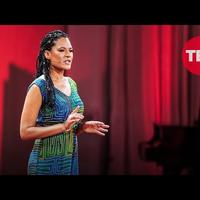
Sasha Sarago: The (de)colonizing of beauty | TED
Transcriber:
Today, I would like to talk to you about beauty
and how we've got it all wrong when it comes to our perceptions of women,
particularly Aboriginal women.
But before I do, I would like to acknowledge the traditional custodians
of the land in which I stand upon:
the Gadigal people of the Eora Nation.
I pay my respects to the elders past, present and emerging
and give thanks to our ancestors who guide and protect us.
It was 1990, and I was pumped.
I was off to my first birthday party,
just before I hit the terrible teens.
No chaperone,
and no bratty sister to tag along so she could snitch.
I had my cute little outfit on,
gift in hand,
and I was hoping that this little cutie that I liked would show up.
And I was hoping that this little cutie would ask me this one question.
You know that question that makes your heart beat right out your chest --
Do you want to be my girlfriend? --
even though I had no business having a boyfriend at that age.
But it didn't matter,
because back then, it was all about the rush.
I never did get asked that question.
But the question I did get asked was:
What's your background?
And like any proud Aboriginal child would declare,
“I'm Aboriginal.”
Given the reaction of the room,
being Aboriginal was clearly a dirty word.
And at the tender age of 11,
I was told by my best friend's adult sister
that I was too pretty to be Aboriginal.
By this time, my mouth is dry, my blood is boiling,
and I'm trying so hard to fight back what feels like an ocean of tears.
I calmly join my circle of friends
and begin to fake laugh at whatever is funny
to mask my embarrassment,
as I clutch on to my newfound complex.
And this is why we need to change our perceptions of beauty.
And how we do this is by learning from Aboriginal women,
their stories and perspectives.
Because right now, "pretty" hurts.
Pretty hurts because you're trying to erase my Aboriginality,
to applaud my proximity to whiteness.
Pretty hurts because aimed at an Aboriginal woman,
it is a weapon loaded in racism,
sexual exploitation
and cultural genocide.
You see, what this woman didn't realize
when she declared that I was too pretty to be Aboriginal
is that she took something precious from me:
pride in my identity.
You see, I belong to the oldest living culture in the world,
but that day, that legacy --
it was replaced with shame,
and it's been this filthy stain I've been trying to get rid of
for 20 years.
And this is where my obsession for beauty comes from,
over the years, trying to mimic it as a model,
advocating for diversity in fashion,
to launching "Ascension" magazine to celebrate women of color,
whose beauty is still underrepresented.
With much pain and trauma behind one word,
“pretty” taught me, through my indigeneity,
I could reclaim my beauty.
To Indigenous women,
true beauty came from the traditional roles we upheld,
our kinship systems,
connection to country and the waterways
and how we pass this ancient knowledge down to the next generation.
The way we express beauty
was never defined against a Eurocentric ideal of beauty.
You see, in my culture, our beauty is not monolithic.
It's not measured by a thin waistline, porcelain skin or slender hips.
It runs much deeper than that.
So what does indigenous beauty look like?
Oh, it's fierce, defiant and proud.
And one ancestor who epitomizes indigenous beauty is Barangaroo,
a powerful Cammeraygal woman.
Revered for her wisdom and independence, Barangaroo, like the Eora other women,
took pride in their status as being the main food providers for their tribe.
A skillful and patient fisherwoman,
Barangaroo would access Sydney Harbour and its surrounding waters
for its abundant food supply,
only taking what was needed.
So you can just imagine how furious Barangaroo was
when she saw British colonists troll 4,000 salmon off the north shore
in just one day,
then gifting some of this catch to her husband
and some of the other men from her tribe.
Barangaroo knew such a wasteful act
would threaten the Eora women's cultural authority within the tribe,
furthermore destroying their traditional way of life.
So Barangaroo rejected British laws and customs,
their food, drink and social etiquette,
even when her husband decided to conform.
When Barangaroo and her husband Bennelong were invited to dine with Governor Phillip
and the British party,
Barangaroo stayed true to who she was.
instead of wearing colonial attire --
a tight corset and a gown layered in silk finished with pearls --
she came sporting her traditional wares:
white ochre and a bone through her nose.
What Barangaroo illustrated was: indigenous beauty is authentic.
Aunty Beryl Van-Oploo, a respected Gamilaraay elder,
shared a story with a group of women one day,
and she said,
"We all have a bit of Barangaroo in us."
Later that evening, I thought about Aunty Beryl's message.
And what I received from her message was,
no matter our culture,
color or how we identify,
spirit is what we share.
It's what connects us.
You see, if we indigenize beauty,
the meaning is transformed from aesthetically pleasing
to a state of divinity;
beauty now becomes spirit manifested.
Not only is spirit found within us,
it's in all things.
It's in the landscapes, it's in the elements.
The Yolngu people of northeast Arnhem Land,
they have a Dreamtime story:
Walu, the Sun woman.
They say Walu lights a small fire each morning,
which creates the dawn.
She then paints her body in red ochre.
And as she does, some of it falls onto the clouds,
creating the sunrise.
She then makes a torch from a stringybark tree
and carries this fire across the sky from east to west,
creating the daylight.
And when it's time for her journey to end,
she descends from the sky.
And as she does, some of the red ochre from her body falls onto the clouds,
creating the sunset.
Indigenous beauty can be seen right across this continent,
each Aboriginal nation with its own creation stories of how we came to be --
astronomy, medicine, agriculture, architecture, education, innovation.
And when we had conflict,
we had lore, l-o-r-e, to restore order.
Like the seasons, flora and fauna, night and day,
we are all interconnected.
One does not work without the other --
the very principles which binds humanity together.
Over the years, my obsession for beauty,
it's led me to this truth:
you cannot appreciate beauty
if you cannot recognize it in yourself.
So how do we change our perceptions of beauty?
We have to get real with ourselves
and start by asking: Who am I?
Where do I come from?
The world that I live in -- how did it come to be?
And more importantly: Where to from here?
You may not like what you discover.
But sit with it, feel the discomfort.
Colonization has stolen from us
one of the greatest treasures we can obtain:
each other.
This year alone, we've witnessed pathological political and social unrest.
That is why healing is the antidote humanity needs
because it leads us to unity.
When we decolonize beauty,
we are reintroduced to our authentic selves.
I used to wonder whatever happened to that woman from the birthday party,
you know, the one that told me I was too pretty to be Aboriginal.
A moment that was so devastating helped me to embrace my girgorou.
"Girgorou" means "beautiful" in Jirrbal, my grandmother's language.
I now know that my girgorou is mighty,
like Barangaroo.
And my girgorou, like Walu,
it's everlasting,
from when that sun rises to when that sun sets.
Are you ready to embrace your girgorou?
Thank you.
(Applause)
