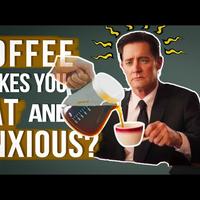
Does Coffee make you Fat and Anxious?
Well, it's brown and it's hot. People drink it in the morning for energy.
Will coffee make you fat? Maybe not but I'm pretty sure it helped make me fat and kinda anxious.
So is coffee bad for you? How much should you drink?
In May 2017, a 16 year old Californian had a large Mountain Dew, a Cafe Latte and chugged an energy
drink within 40 minutes. He then collapsed and died from a “caffeine induced cardiac event.”
The total amount of caffeine he had was around only 400mg, the equivalent of 4 cups of coffee.
On the other hand, a 2008 study on 817 Finnish adults found that the more coffee people drank,
the longer they lived with those drinking as much as 7 cups of coffee a day living the longest.
The 16 year olds case is an incredibly rare one,
but clearly caffeine can have very different effects on different people. But why?
It's hard to predict how each person will react to their own personalized cup of coffee because
everyone metabolizes caffeine differently, and there are tons of other compounds in
coffee that change depending on everything from how the coffee is grown and processed
to how the beans are roasted to how you even prepare each cup of coffee. For example it's
been found that french press coffee raises cholesterol whereas filtered coffee does not.
Personally, I'm always more jittery with cheaper coffees and I usually
feel better with organic coffees - the difference is probably that
non-organic coffees are doused with all kinds of pesticides. Also I'm prone to feeling hot,
nauseous and jittery with black coffee but feel fine with coffees with milk in it or lattes.
About two months ago, I posted this poll on youtube that got 15000 votes from y'all.
It's interesting to see that 21% of you said you felt way better
after stopping drinking coffee and 12% of you said you felt at least a little bit better.
At the end of May, I proudly posted to my Patreon page this weaning strategy I used to get off
coffee - I ended up being coffee-free for a little over a month and I was a lot better for it. The
changes were subtle and came on slowly. I usually clench my jaw when I'm feeling tense which is why
my masseter muscle is so large. Sometimes I clench it so hard at night that I wake up with headaches
and a lot of tension in the sides of my face. Then, I noticed that when I'm not drinking coffee,
I clench my jaw less and wake up with less tension in the side of my face. I'm also less anxious
throughout the day and have more stable focus without coffee. Most surprising to me, quitting
coffee drastically reduced my appetite. When I was drinking 3 cups of coffee a day it was like the
only way to get full was to physically stretch my stomach with a huge mass of food. Once I cut out
coffee it was like …my satiation hormones actually worked again and I could eat like a regular human.
But caffeine is a slippery slope. I ended up having a couple coffee dates with friends
and by July I was once again drinking 3 double shot lattes each morning.
It took about 10 days to notice that I was getting a little bit hungrier,
I was in general a little bit more anxious and my focus throughout the day was less stable.
The official stance is that we should keep our caffeine intake under 400mg,
4 cups of coffee worth a day. But, Research has found that depending on who you are,
it can take anywhere from 2.3 hours to 9.9 hours to metabolize half of your caffeine dose.
Other research has found that if you're a slow metabolizer of caffeine,
high caffeine consumption can increase your heart disease risk,
but if you're a quick metabolizer of caffeine then it can even lower your heart disease risk.
In fact, you may even enjoy the flavor of coffee more or less depending on how quickly you can
metabolize caffeine. This study found that people who metabolize caffeine more slowly
actually perceive it as more bitter.
Now you might think Nice, well if I'm a fast metabolizer of caffeine I'll
get the benefits from coffee rather than detriments. ”A damn fine cup of coffee."
However, my DNA report shows that I actually metabolize caffeine faster
than average yet I seem to still have these issues with coffee. "Hot coffee! You idiot!"
So first, Let's take a look caffeine and hunger. Caffeine activates the stress axis and raises the
stress hormone cortisol and cortisol has been found to increase appetite.
And while another study didn't find that caffeine directly increases appetite,
it did find that caffeine makes it harder for cortisol levels to fall. In fact,
Stephen Cherniske, author of Caffeine blues writes that “people who consume more than 300
milligrams of caffeine per day may have elevated serum cortisol for eighteen [hours a day.]”
Also, caffeine may make it to where we perceive and physiologically react to stressful things
as if they're even more stressful. "The fact is, you and I are sitting here today because
this will be your last week of employment at this company." A 1974 study found that, in a group of
people told that they were going to be fired from their job, stress-related noradrenaline output
was greater in those who regularly drank caffeine. Essentially their physiological response to stress
was even greater thanks to the caffeine. These caffeine drinkers, were probably feeling
specifically more anxious about losing their job considering noradrenaline provokes anxiety.
Is this enough to say that coffee was making me fat and hungry? Well I suppose not,
but higher stress levels has been linked to higher abdominal fat and there's evidence
that people with more body fat secrete more of the stress hormone cortisol,
and again cortisol raises appetite, making for a vicious cycle.
And It has been found that increased anxiety increases people's appetite
and the food actually relieves the anxiety.
So, let's take a look at coffee and caffeine's relationship to anxiety, because maybe,
my increased appetite is simply downstream of the increased anxiety I get from drinking coffee.
Research has been done showing coffee consumption has people with bruxism
clench their jaw more. As I explained earlier,
this is the case for me too and I happen to clench my jaw when I'm anxious or tense, and it seems
that I'm generally more anxious throughout the day when I'm regularly drinking coffee.
There's multiple papers talking about the anxiety inducing effects of caffeine
and There have been cases in the past of normal healthy people
suffering from panic attacks from just 500mg of caffeine - about 5 cups of coffee.
A paper looking at people with a panic disorder found that 71% of the patients said drinking
caffeine felt similar to the experience of having a panic attack but to a lesser degree of course.
Several papers describe a phenomenon called “caffeinism” which is essentially chronic
anxiety from drinking too much caffeine. As early as 1978, it was written that there is
no reliable way to tell the difference between someone who actually has an anxiety disorder
and someone who is simply sensitive to caffeine and is drinking too much of it.
In fact, in a study looking at 6 different cases of people with an
anxiety disorder to the degree that they were taking medication for their anxiety,
all 6 of them had massive improvements in their anxiety after quitting caffeine
and 5 of the 6 no longer needed any anxiety medication after stopping the caffeine.
Actually, one of the people, after going caffeine free and getting rid of his anxiety,
accidentally had caffeinated coffee one
day and then experienced anxiety symptoms for the next two weeks.
Many papers find that more caffeine leads to more anxiety in normal people,
and of course people with anxiety disorders are much more sensitive to caffeine.
So what if caffeine is inducing at least some small subtle amount of anxiety in
everyone and you just notice it more or less depending on how sensitive you are to caffeine?
How easy is it to tell if you're just having a bad day or if you've had a little bit too much coffee?
Here's the thing about caffeine - clearly it's changing something in the brain.
If the caffeine just made you feel feel good and focused and for a little while
and then completely disappeared from your system after a couple hours,
then we wouldn't have withdrawal effects if we missed our morning cup of coffee, but we do.
Caffeine works by blocking the action of the chemical adenosine in our brains.
When adenosine normally acts on an adenosine receptor, we feel sleepy, and part of the
reason caffeine has its effects is because caffeine blocks this sleepy adenosine receptor.
I think most people have heard about the cool neurotransmitters like dopamine and serotonin,
but people don't talk about adenosine very often. Adenosine receptors are in almost all
organs and tissues and they're found throughout the brain and spinal cord. Adenosine has a lot
of complicated functions. Research has found adenosine to have anti-inflammatory properties ...
adenosine regulates sleep, it lessens the excitability of brain cells meaning
it calms you down. And it also has effects on blood vessels. In fact research has found
that when you give people caffeine, bloodflow in the brain is reduced.
Research has also found it to have anti anxiety and anti depressant effects.
You don't have to remember all that but my point for now is that the adenosine system
is very intricate and nuanced. We can't just say “Adenosine is the sleepy chemical.
I don't want to be sleepy. So I'll drink plenty of
caffeine and all my problems will be solved with no side effects.”
When you constantly block adenosine receptors in the brain, the brain
creates more receptors to become more sensitive to adenosine to make
balance in response to the receptors receiving abnormally low stimulation.
To get more specific, there are several types of adenosine receptors, but the main ones are A1
and A2a, and caffeine works by blocking both of these. Constantly blocking the receptors causes
more adenosine receptors to be created. So what happens when you have more adenosine receptors making your brain more sensitive to adenosine?
Well, consider this. Anxiety and depression often appear together. Research has found
that if you expose rodents to chronic stress, it creates more adenosine A2a receptors. And,
this increase in A2a receptors is accompanied by an increase in depression like behavior.
Another way you can increase A2a adenosine receptors is by drinking caffeine.
The brain changes you see in the brain when you constantly drink caffeine,
are similar to the brain changes you see when constantly exposed to stress.
So sure, caffeine may have actually an anti-depressive effect temporarily because
it blocks these A2a receptors. As you know, caffeine improves your mood, but this research
suggests that the brain is changed in a way that when the caffeine starts to wear off,
your overall mood is worse compared to when you didn't have a caffeine habit.
Another thing is that activating A1 receptors has antidepressant effects. In
fact, sleep deprivation oddly enough seems to have an antidepressant like effect on people.
The longer you stay awake, the more adenosine builds up and this adenosine acts on A1 receptors
and gives an anti depressant effect. But remember, caffeine blocks these A1 receptors.
This made sense to me. When I was drinking coffee,
I did notice that my mood was little more variable. I would feel especially positive
and confident after I had my coffee, but as the caffeine started to wear off,
I noticed I was a little more unsure of myself and was a little bit more pessimistic about things.
Other than the adenosine receptors, caffeine also causes physical changes to
several other brain receptors very important to mood like adrenaline receptors, GABA receptors
and serotonin receptors. Adrenaline is part of the fight or flight response,
serotonin is an important neurotransmitter for positive mood
and GABA is an inhibitory neurotransmitter meaning it helps you relax.
A lot of research has been done on the importance of GABA in anxiety disorders.
In fact, as this 2012 review explains, a deficit of GABA signaling in the brain
is a commonality between anxiety disorders and major depression.
And, Caffeine disrupts the normal metabolism of GABA. Research has found that putting caffeine
in mice's drinking water decreases the amount of GABA (and glycine) in the mice's brains..
So does this prove that the anxiety you experience in your life is mostly due to caffeine?
No. Though at least for me specifically, I don't need to read all these research papers
to understanding that caffeine enhances at least a little bit, my base line level of anxiousness.
At the start of the video, I explained individual differences between people is to say that if you
enjoy caffeine and you don't consider yourself an anxious person and are totally content with
how you feel, then you probably don't have to go out of your way to change your morning routine.
Some of you might be wondering why tea makes you feel better than coffee.
It might be because of a compound called L-theanine, which is found in
tea and not coffee. This study found that taking 250mg of L-theanine with 150mg of caffeine
led to people having better reaction times, they had less headaches,
felt less fatigued and felt more alert than just taking caffeine alone. In fact L-theanine
is a popular supplement specifically for that reason - it's taken to reduce coffee jitters.
One last thing, maybe you want to try quitting coffee, but you want to live
forever like those 7 cup a day Finnish people. But is coffee really making them live longer?
Or is it simply that people with super robust bodies and livers who can happily
process coffee without any ill effects are just naturally more robust and therefore live longer?
After all, the reason people with liver disease don't drink so much caffeine is
probably because their weakened livers have a really hard time processing it.
So it's probably not the case that drinking a bunch of coffee makes people live longer,
but that the people that can drink a bunch of coffee live longer.
So if you're looking for some advice, try a couple different quality coffees until you find the one
that makes you feel the best. and then if you're not totally satisfied with how you feel, you could
pair it with L-theanine. If you're not having any luck with that, then you could at least try seeing
how you feel without coffee for a couple weeks. Since blocking adenosine receptors has tons of
downstream effects, you might notice some changes that don't seem like they would be caused by
coffee. But make sure you pay attention. Honestly it took me 2 cycles of quitting coffee for a
month, having less appetite, starting coffee again and then having more appetite to finally confirm
for myself that yes I was gaining weight from my coffee habit. The changes you feel will probably
be very slow, and you also have to pay attention to distinguish them from the withdrawal effects.
