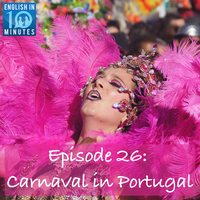
Episode 26: Carnaval in Portugal
Nick: Today Wendy and I are talking about two Carnaval parades that we got to see last week in Portugal. And when people think about Carnaval around the world, obviously the most famous and the most iconic Carnaval is in Brazil, in the city of Rio. But Brazil was, once upon a time, a Portuguese colony, and so here in Portugal they also have a tradition of Carnaval, right?
Wendy: They do, yeah, and it's celebrated in different ways, so there are some towns where they have a much more, uhh, Portuguese tradition that's very different from the kind of parades that you see in Rio. And then there are other towns, uhh, where they celebrate it Rio-style, and, you know, it's kind of … that celebration or that tradition has been kind of re-exported back to the motherland, if you like, so there's this real mix of influences between Portugal and its colonies - its former colonies, including Brazil.
Nick: Right, so the first one we went to was one of these more Portuguese traditional Carnavals. It's in a town called, uhh, Torres Vedras, which is near, uhh, Lisbon. And they call this the most Portuguese of the Carnavals in Portugal. So what does that mean?
Wendy: I'm not sure exactly what it means, but it's definitely very different from the Brazilian-style Carnavals. So, uhh, there's a lot of political satire, and because we haven't been in the country that long and we don't know the ins and outs of Portuguese politics, a lot of those jokes went over our heads. Uhh, but it was still interesting to see, so they have big floats, umm, in the parades, uhh, and images of, yeah, different politicians. Some of them we could recognise because they were European politicians like Angela Merkel, umm, but, yeah, others we didn't know exactly what was going on.
Nick: Right, so usually in a Carnaval type of parade, you have these floats like you mentioned, which are moving vehicles, and in the Brazilian style there'll be dancers and things like that on top of the floats. But, no, here there were these, umm, these figures or these caricatures of this politicians and slogans and, umm, jokes and things like that.
Wendy: Yeah, and there was still music playing and it was still the same, uhh, type of music that you would hear in a Rio Carnaval. It was samba. Umm, but for the most part it wasn't live musicians that it was … that were playing it, it was, uhh, just a recording that was being played of this samba music, this Carnaval music. Umm, and the music and the dancing and the drums and all of that, that wasn't the emphasis of this Portuguese Carnaval.
Nick: Right, and in between the floats, yeah, there were some drummers and there were some other dancers but they weren't really in, umm … yeah, they weren't in Brazilian style. And so, for that reason, that's why they call it the most Portuguese of Carnavals. And so we actually went on my birthday, and it was a surprise to me, and we dressed up, uhh, even though I didn't know what we were doing.
Wendy: Yeah, well that is part of the tradition, that people do dress up. Umm, so, much like, you know, because I'm American we celebrated Halloween when I was a little kid and we always dressed up in costumes and that's what they do, uhh, at Carnaval as well.
Nick: Right, and so we went in our, what's called ‘onesies', which are our one-piece, umm, kind of warm, pyjama-type clothes, and so mine is in the form of a monkey and yours is in the form of a lemur, umm, and so we must have looked quite interesting walking through Lisbon as we were making our way, umm, towards transportation to get out to this other town. Wendy: Right, because as far as I can tell, Carnaval is not really celebrated that much in Lisbon itself, so that's why we went to these other towns outside of Lisbon to celebrate. So yeah, when we were walking around, you know, to get to the metro and then to get to the bus, uhh, to go these towns, yeah, we were the only ones in the streets who were dressed up. Umm, but I think most Portuguese people knew, they knew it was Carnaval and so they knew what we were doing and they didn't think much of it. Uhh, I think it was mostly the tourists who were giving us funny looks and saying, “What's going on here?”
Nick: And so that was on the Sunday and then on the Tuesday, which was the final day of these celebrations - it's known variously as, uhh, Fat Tuesday or, uhh, Shrove Tuesday or Pancake Tuesday.
Wendy: Yeah, I know it as Fat Tuesday.
Nick: Right, uhh, and then we went to this town called Sesimbra, which is also close enough to Lisbon that you can go in an hour or so, umm, unless a lot of other people are trying to get to the Carnaval at the same time and then the traffic is a bit slow.
Wendy: As it was, yeah.
Nick: As it was. Uhh, and that's completely different. That's an absolute Brazilian-style Carnaval.
Wendy: Yeah, so lots of dancers. Well basically you have a series of groups, umm, so musicians and dancers together who have come up with their own song, their own Carnaval song, umm, and so the musicians are actually playing. Sometimes … and they'll have a float, but it's not really … some of them were decorated floats but they weren't decorated as much as the ones in the previous one when we talked about all of the politicians and satire and everything that we saw. Sometimes these floats were just a bus, umm, and it was mostly just a vehicle for the musicians to ride on and they would ride on the top and you would see them playing their instruments at the top. And also more musicians walking, either in front of the bus or behind the bus, and then you have the dancers, umm, who were in very skimpy costumes, they're not wearing very many clothes.
Nick: Yeah, and I mean, not all of them, some of them for sure.
Wendy: Yeah, that's true, yeah.
Nick: But others were dressed up in different ways. But the costumes were really great, regardless of what exactly they were. Umm, you know, there were mostly girls but there were also guys, umm, you know, there were drummers that were dressed up and all sorts of stuff. So that was really great, I thought. It was very much … you know, Sesimbra is a small town, it's right on the ocean and there's this little fort right there on the ocean and it's this road that goes, umm, along the coast and that's where the parade is. And so it's just a great atmosphere, umm, you know, there are people lined up along the parade route and then the beach is just right behind you and then the water is right there and everything. I thought it was really great.
Wendy: Yeah, I had actually been there once before a few years ago because I used to play drums in a samba group. Uhh, I'm not a musician, I don't really have musical talent but it was something that I just did for fun because I loved Brazilian culture and Brazilian music and, uhh, so it was a fun way for me to stay connected with that. And so my group - this was when we were living in Geneva - so our group from Geneva, umm, travelled to Sesimbra, uhh, to play. This was in the summer, and every … in addition to the big Carnaval that they hold every winter, which is … it depends on the time of Easter, but it's usually in February. Umm, so they have that every year but then they also have another celebration every year, uhh, where a whole bunch of samba groups come and play and also march through the streets of the town. So I got to do that a few years ago and I really enjoyed it and had lots of great memories from that, so it was fun to be able to go back there and show you the town and do it together this time.
Nick: Right, because you said that Sesimbra is this really big samba town.
Wendy: Yeah.
Nick: And that's unusual because it's a small town and it's, umm, it just seems strange that there would be this huge samba culture there, but there is.
Wendy: Yeah, I don't know how that got started, umm, but, yeah, there are several samba schools that are based in the town of Sesimbra and then you have others in nearby towns as well, umm, so, yeah, they really love their samba in Sesimbra.
Nick: And so we stayed for, what? three or four hours, umm, until all of the parades had gone, or all of the groups had gone in the parade. And so there, I think, what? ten, twelve, uhh, different groups like you talked about and then in each group there's one float and then a group, several groups of dancers, several groups of musicians and things like that. So it goes on for quite a while but it's always different and you're always interested, uhh, in seeing what the next group will do and what their costumes will be and what music they'll play.
Wendy: And they usually have some kind of theme that runs throughout, so within a single group they'll have the dancers divided up into different, kind of, sub-groups. And so, you know, the first sub-group may be young girls, you know, very beautiful, thin girls who are wearing the skimpy costumes and then you might have some older women, uhh, behind them, who are wearing different kinds of costumes. Uhh, but there's always a theme, so I remember one of them, the theme was chocolate, and the Aztecs, uhh, and so they were … their costumes had cacao on them and different things related to chocolate, so, yeah. it was fun to see the different themes that they came up with.
Nick: And so I think it's probably fair to say that of the two, the Portuguese style and the Brazilian style, we really did prefer the Brazilian style.
Wendy: Yeah, for sure.
