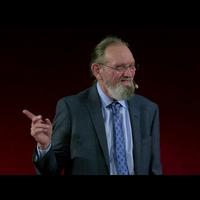
Forest hermit to Professor, it's never too late to change. | Dr. Gregory P. Smith | TEDxByronBay
Transcriber: Nguyen Phuong Nga Reviewer: Rhonda Jacobs
I look just like an ordinary person, don't I?
(Laughter)
When I was two years old, my father picked me up by the leg
and threw me hard against the wall of our home.
As a result, I'm profoundly deaf in that ear today.
My life got worse from there.
At the age of 10, my mother gave me away,
abandoned me and my siblings to an orphanage.
Abandonment leads to anger.
Anger leads to action.
I spent many of my formative years
venting that rage in inappropriate and antisocial ways.
This, of course, had consequences.
Minda Juvenile Detention Centre in Sydney
is one of the places that I frequented as a teenager.
In fact, upwards of 60 per cent of my youth
was spent locked up in one fashion or another.
In the early 70s, trauma wasn't really recognised as a medical condition.
In fact, the acronym PTSD didn't even exist back then.
It's strange to consider that because we all know trauma is very real.
While the effects of trauma weren't recognised
by the medicos at Minda, sociopathy was.
At the age of 17,
I was diagnosed by the state psychiatrist as a sociopath.
Don't get me wrong,
it takes a lot of hard work to live up to the label.
(Laughter)
But it did have its advantages.
Finding a communal seat
or a seat at the communal dining table wasn't that difficult.
(Laughter)
People were just downright afraid of me.
But I often wondered if their fear matched the internal terror that stalked me.
At the age of 19,
I was ejected from the homes and the punitive institutions
for the very last time.
The state had done its job.
I was then expected to take my place in society.
What place?
How?
With whom?
The fruits of my childhood
were beginning to show in the adult I was inevitably becoming.
I suffered a complete and utter [disconnection]
to the society I was supposed to join.
This created a great void, a terrible void
that I filled with a burning hatred of myself.
The social disconnect and loneliness
fed a massive hole within me.
Violence was the only form of release I knew.
A sideways glance from a casual passer by,
a curious passer by, was seen as a threat or a challenge,
and I dealt with them swiftly and brutally.
Add alcohol to the mix,
and I detonated like a bomb.
Size didn't matter.
As a child, I'd survived many rounds with my father.
I had no fear of fighting, to the death if need be.
This little sociopath didn't know what self-preservation meant.
I was volatile and dangerous,
and yet I truly longed to fit in.
I tried to integrate into society as much as anyone
with severe mental and emotional trauma could.
I saw other young men
taking wives,
building homes.
Instead of taking a wife, I took a hostage.
Poor Juile.
It wasn't long before she realised she'd made a terrible mistake
and she ended it.
Not long after that, I ended up in the psychiatric wards
and then on the streets.
Not for the first time
and not for the last time.
Over the next few years, I bounced along the bottom of society,
looking up at that ladder of success
unable to grab hold of that first rung.
I tried and failed over and over again
to get a job and start a new life.
I even tried to start a cleaning business,
and that ended with a big bang.
Well, it was more of a giant fireball started by me.
Suffice to say, when the smoke cleared on that particularly bad day,
I was homeless again.
I had no idea how unwell I was.
And then quite unexpectedly, when I was about 35,
I found a place that I felt quite at ease.
It was in a moment when I was squatting on a on a wet leech covered floor
in a mountaintop rain forest not far from here.
Night was falling, so was heavy rain as it tends to do in a rain forest,
but I'd never felt safer in all my life.
And then I realised the reason I felt so secure
is there was no one else around.
I had successfully left society wholesale.
I decided I'd stay up on that mountaintop a little while longer.
I became a forest dwelling hermit.
Alone,
angry,
paranoid,
traumatized,
stoned,
drunk,
homeless.
Still,
I convinced myself that
I would stay in that little secret hideaway place in the forest.
After all, I had everything I needed up there.
Fire,
plenty of ferns to sleep on
and an endless supply of alcohol.
Green beer, I called it,
made in a plastic garbage bin
with home brew
and often foul-smelling creek water.
I grew my own crop of dope.
By then, I'd become a fully fledged alcoholic and drug addict,
self medicating to kill the pain of a shipwrecked and shattered life.
I would sit in the bush for hours
staring down at the valleys of my forest home,
wondering why my life was so cursed.
Food was an issue, of course.
In the early days, I ate whatever I could catch.
Bats, worms, lizards.
Eventually I started to drift up into the towns like Byron Bay
to trade my crop for food and supplies,
and I'd get drunk in appalling chemical benders.
And then I'd scurry back to the mountaintop
with my fire and my bush bed until the next time I needed supplies.
With each passing year, it was becoming quite obvious
that I was getting sicker, physically and mentally.
Until the aliens stepped in.
(Laughter)
It was painfully obvious that psychosis had taken hold.
But I was sitting at my campfire one night,
and these two very tall, thin, gothic, white aliens appeared.
And using a simple logic, they argued that
if I was to die up in the forest and nobody found my body,
the family that I hadn't seen for so many years would experience great pain.
So with this, they convinced me to give society one more chance.
And I left my forest home.
I'd been up there for 10 years.
I was emaciated.
I weighed 41 kilos,
half the size of the guy you're looking at here today.
I lost most of my mind,
and most of my teeth,
and I almost lost my life up there.
I was hospitalized and slowly recovered.
And when I was released,
I realised I was in the exact same place
that I was the day before I went to live on that mountaintop.
Lonely,
angry,
traumatized
and homeless.
The only difference was that now I was 45 years old,
a little bit long in the tooth to be starting out again.
Something had to change.
Me.
First, I had to get well.
It was painfully obvious that drugs and alcohol were doing me untold harm.
They had to go.
I quit and cold turkey.
A year long odyssey
that delivered me to a healthier, clear-headed place.
Now, I could really start in society afresh.
All I needed was a job.
For some strange reason, employers weren't looking for
a middle-aged sociopath with bad beer-brewing skills
(Laughter)
and all the satorial elegance of Charles Manson.
Charles Manson.
That's what they used to call me in the soup kitchens
up on the Gold Coast where I frequented.
Every single application that I put in was either rejected or ignored.
After a while, I realised the reason I wasn't getting any work was
I had no skills, I had no qualifications.
My education, which ended at the age of 14,
was fleeting and short circuited by the horrors of domestic violence.
And if I was going to survive in this new world,
I had to get an education.
I had a basic primary school-level grasp of reading, writing and maths.
But the only books I'd ever read in my life
were The Hitchhiker's Guide to the Galaxy,
the trilogy.
(Laugher)
I found myself
a free Cert 1 computer course
and threw myself into it.
I learnt two things from that course.
One, I don't like computers.
(Laughter)
Two, I love to learn.
Next, I thought I'd go and do the Year 10 school certificate.
Dad had pulled me out of school before I could earn mine,
and I had long considered it to be the pinnacle of academic success.
Yeah?
I asked around the colleges and the TAFEs
if they did the the school certificate.
They didn't.
But I learned about a bridging course -
that if I did well enough it would get me into university.
Me? Go to university?
To my amazement, I was accepted into the course.
I threw myself into it.
I had no idea what I was doing, but at least I was doing something.
And at the time, that was very important.
Study gave me purpose and something to do through the day.
I was still sleeping rough, but at least I was a very busy, rough sleeper.
My dedication to study,
usually in a makeshift home in the sand dunes of Surfers Paradise
paid off.
In 2003, I graduated.
I was 48 years old,
and this was the first meaningful achievement in my life.
And I had enough marks to get into university.
My first day at university, I was intimidated
but very proud that I'd made it.
I chose to study sociology,
hoping to learn why I hated society so much.
(Laughter)
Maybe then
I can learn and understand how to live in a society
that I still really didn't fit into.
To my amazement,
I realised I didn't hate society.
I just never learnt to be a part of it.
I remained homeless until 2005, halfway through my degree.
When I graduated, I received a phone call from one of my lecturers
offering me work, marking and tutoring,
meaningful employment and my name on an office door.
Yet for all the glittering milestones and achievements,
I still felt like an uneducated, sociopathic loser.
That feeling remained with me until I was conferred
with a Ph.D. in early 2016.
In Australia -
(Applause)
(Cheers)
In Australia, it's estimated that
1.2 per cent of the population have a Ph.D.
As a homeless person, I was one of the 0.48 per cent
or the 116,000 homeless people that sleep rough every night.
This truly meant that I was coming up in the world of percentages.
(Laughter)
Becoming Dr Gregory P. Smith was a surreal moment
in a long and fragmented academic journey.
Along the way, I'd not only learnt to read and write properly,
I learnt to let people into my life,
into my heart.
I made some strong connections with my university peers
who became beautiful and special friends.
They encouraged me, forced me
to see myself as I truly was.
Not as a hermit.
Not as a homeless man.
Not as the sociopath.
To them, I was just a man.
Just another person doing the best I could.
Sure,
I'd had a rough trot in life,
but I wasn't the only one.
My doctorate meticulously studied and gave voice
to what the Australian Senate in 2004 called the Forgotten Australians -
upwards of 500,000 people
who had suffered abuses in out-of-home care, much like I did.
In a way, I'd found my tribe, my mob.
The wounds of trauma run very deep,
very painful and very complex,
And very difficult to heal.
But I'm living proof that no matter how far a person goes off track,
there's always a path back.
And it's never ever too late.
Thank you.
(Applause)
