Tried Duolingo?
Here's what comes next.
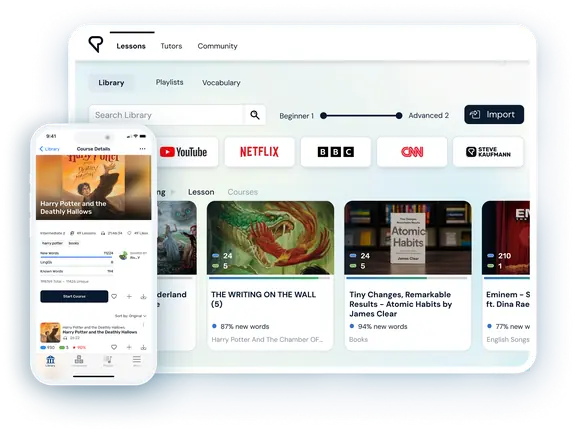
Your brain doesn't memorize a language through streaks and exercises. Language develops over time, through massive exposure to content that actually interests you. LingQ is the app built to do just that.
- 4.7 on the App Store
- 4.5 on Google Play
- iOS, Android and web
As featured in:







Duolingo got you started. It won't get you fluent.
Duolingo works the way most language apps do. It breaks the language into small exercises, gamifies your engagement, and rewards you for showing up. You get streaks. You get XP. You feel productive.
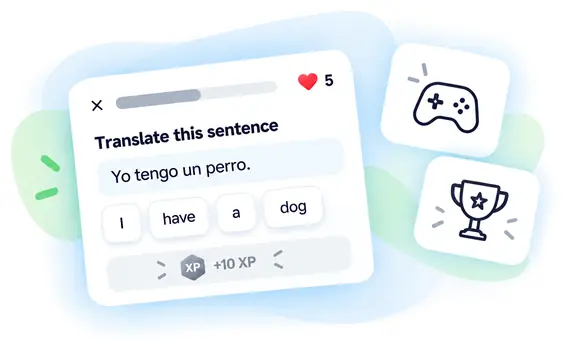
But you don't acquire a language by translating disconnected sentences or matching words on flashcards. That's most of what Duolingo asks you to do. The linguist Stephen Krashen on the input hypothesis, and Geoffrey Hinton on how memory forms, point the same way: language comes from massive, meaningful exposure, not from gamified practice.
What the app measures
- Days in a row
- XP earned
- Lessons completed
- Exercises answered correctly
What your brain actually grows
- Words you recognise in context
- Hours of the language you have heard
- Associations between a word and its uses
- How much of a new text you already understand
Which is why people finish the course, keep a two-year streak, and still can't hold a conversation.
The app trained them on the app. It didn't train them on the language.
How your brain actually learns a language.
And why Duolingo doesn't train it.
Acquisition, not learning.
Krashen spent decades on this distinction: two separate processes. Learning is the conscious kind, grammar rules and vocabulary lists, the work most apps are built around. Acquisition is what happened with your first language, when you absorbed it without studying it. Rules can help you fix a slow sentence. They won't make you fluent on their own; fluency comes from acquisition.
Source: Krashen, S. Principles and Practice in Second Language Acquisition.
The brain isn't a filing cabinet.
Geoffrey Hinton won the 2024 Nobel Prize in Physics for his work on neural networks. His research points to something different about memory. Words aren't filed away somewhere, waiting to be looked up. A word is a web of other words, contexts, sounds and places you met it, tuned a little by every exposure. Knowing it means having the whole web. A flashcard hands you one thread.
tiempo
- no tengo tiempo
- Time
- hace buen tiempo
- Weather
- tiempo verbal
- Grammar
Compelling content lowers the wall.
Krashen also found that boredom and pressure block acquisition, and that curiosity speeds it up. The same hour does far more for you when you actually want to be there. Content you care about isn't a nice extra: it's a core part of why immersion works at all, and why gamified drilling has a ceiling.
The implication.
Language isn't installed. It's grown, from repeated exposure to content you can mostly understand and actually want to finish. That's what LingQ is built around. Most apps, Duolingo included, aren't.
A different approach.
LingQ is the product implementation of the acquisition method, the part Duolingo and apps like it skip entirely. Every feature exists for one reason: to keep you in contact with compelling, comprehensible content.
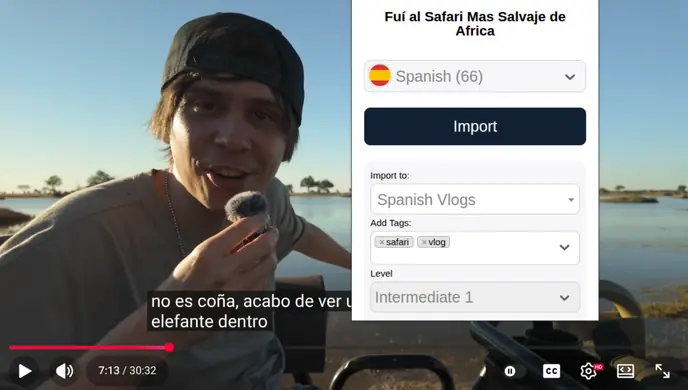
Real content, from day one.
Import podcasts, news articles, YouTube videos, ebooks. Or pick from our library of curated lessons in 50+ languages.
The principle: you acquire language from input you find genuinely interesting. Boredom and obligation block acquisition. Curiosity drives it.
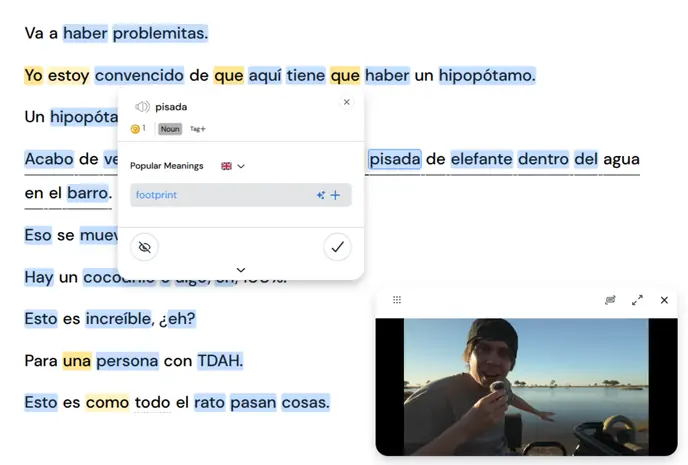
No friction between you and the words.
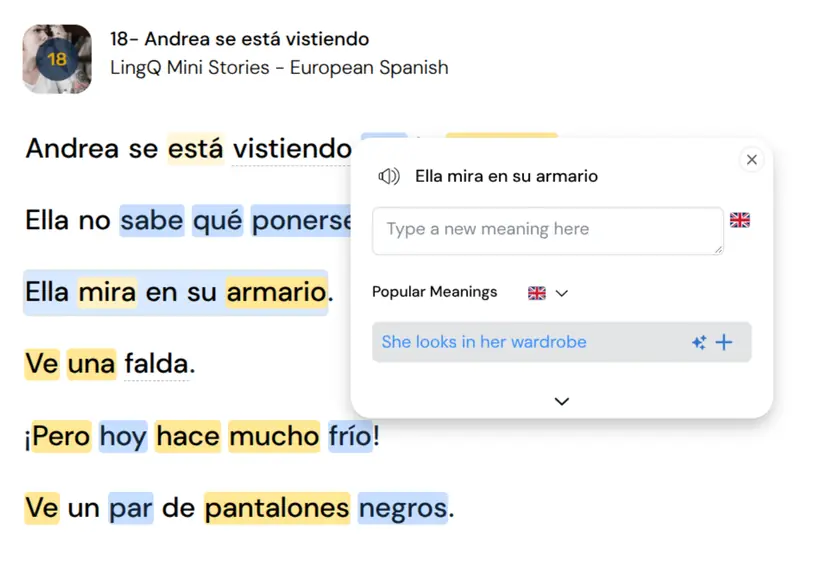
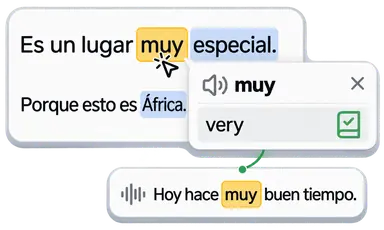
Tap any word for an instant translation, in context. No flipping to a dictionary, no switching tabs, no leaving the flow.
The principle: every distraction away from reading and listening is a lost acquisition opportunity. We remove them.
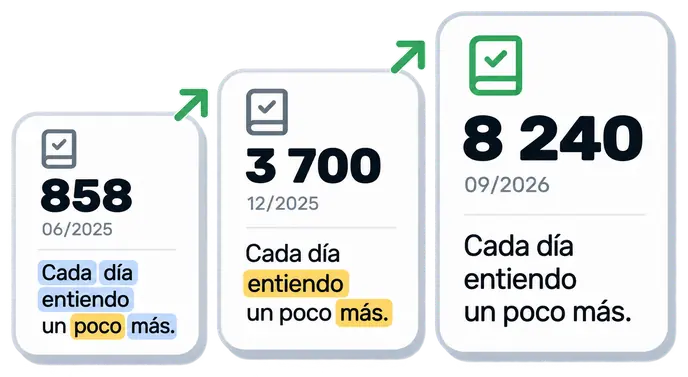
Words grow into knowing, in context.
A word isn't learned in one encounter. It's met, half-forgotten, re-met in a different context, gradually made familiar. LingQ shows you which words you're working on, which ones you know, and how much of any new lesson you'll already understand before you start.
The principle: knowing a word means having a network of contextual associations, not storing a definition.
- Beginner 1
- Beginner 2
- Intermediate 1
- Intermediate 2
- Advanced 1
- Advanced 2
Built for every level, from your first lesson.
Mini Stories provide comprehensible input for absolute beginners. Intermediate learners move to real content. Advanced learners import anything. There's no other app to graduate from first.
The principle, drawn from Krashen's "i+1" idea, is that content slightly above your current level produces the most acquisition. We help you find that level at every stage.
LingQ vs Duolingo:
different categories, not different levels.
Duolingo and LingQ aren't competing on the same thing. Duolingo is the best in the world at building a daily habit around language exercises. LingQ is built around language acquisition itself. Both have a place. They just don't replace each other.
| Aspect | Duolingo | LingQ |
|---|---|---|
| Method | Gamified exercises, streaks, XP | Reading and listening to content you choose |
| What you do | Translate sentences, match words, complete a tree | Engage with real content, save words you don't know, watch them become familiar |
| What it measures | Streaks, XP, lessons completed | Known words, listening hours, words read |
| Languages | 40+ | 50+ |
| Speech recognition | Built in | Built in via sentence review |
| Realistic ceiling | A2 | C1+ |
| Best at | Daily habit around exercises* | Actual fluency |
Streaks and XP are real. They just don't measure the language.
Built by a polyglot, on the science of acquisition.
LingQ was co-founded by Steve Kaufmann, who speaks 20+ languages. He learned the first 9 while developing the method that LingQ is built around: read books, listen to podcasts, look up unknown words, stay in the content. He learned the next 11 using LingQ itself, where modern technology makes the same method significantly more efficient and effective.
The method he developed across decades lines up almost exactly with what researchers Stephen Krashen and Geoffrey Hinton established independently about how acquisition works. LingQ exists to operationalize that method. The app is what most language apps, Duolingo included, would be if they were designed around how the brain actually learns, instead of around what's easy to gamify.

You don't learn a language. You acquire it, by spending time with content you genuinely enjoy.
Steve Kaufmann, LingQ co-founder
People who actually got the language.
"I have a 3,800+ streak on Duolingo and it barely does anything. Would you actually like to learn a language? Well, this app will help you do that."Read his story

Jonathan
Italian learner, 3+ years on LingQ
"LingQ uses live speech at higher speed which helps for the cohesion of the language."

Hajo
Spanish learner
"Duolingo is like a toy, really. It's a fun toy. And I feel like LingQ is just so much more of a serious tool."

Ian
German learner
How it works.
-
Import content you actually want.
Articles, podcasts, YouTube videos, ebooks, anything in your target language. Or pick from our library. The principle: compelling input drives acquisition.

-
Tap unknown words to learn them in context.
Translations appear inline. Every word you save becomes a LingQ, tracked from new to known. The principle: words grow into knowing through repeated contextual exposure.

-
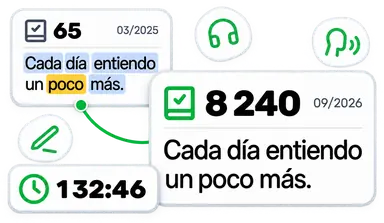
Watch your known words grow.
Your known-words count is the most honest fluency tracker in language learning. Watch it climb, day by day. The principle: that growing network of connections is what fluency actually is.

Free to start. Paid when you're ready.
LingQ has a free tier that gives you the full reading and listening interface, the Mini Stories library, and the known-words tracker. Most people try LingQ free for a week or two, decide it's the right tool, and upgrade.
FREE
$0
- Limited LingQs (saved words)
- Full reading and listening interface
- Mini Stories library
- Progress tracking and statistics
Premium
$10.00 /mo
or $14.99 month to month
- Unlimited LingQs
- All 50+ languages
- Every feature, on web, iOS and Android
Plus
$22.50 /mo
or $29.99 month to month
- Everything in Premium
- 6x audio transcription
- AI voices
- Advanced Lynx Chat
- AI-simplified lessons that adapt to your level
Common questions.
What's the best alternative to Duolingo?
LingQ is built for learners who want to move past gamified drilling into real fluency. Instead of exercises and streaks, LingQ has you reading and listening to content you actually choose, news, podcasts, YouTube videos, books, while tracking every word you know and every word you're learning. It's the app to move to once Duolingo's ceiling starts to show.
Is LingQ harder than Duolingo?
At first, yes. Duolingo holds your hand with bite-sized exercises that always feel manageable. LingQ asks you to engage with real content. That engagement is exactly what produces acquisition. The Mini Stories make the on-ramp gentle, even for absolute beginners.
Is Duolingo bad?
No. Duolingo is excellent at building a daily habit around language exercises, and that has real value. It's just doing a different thing from what LingQ does. If your goal is consistent daily practice and a feeling of structured progress, Duolingo works well. If your goal is to acquire a language, to actually speak, read, and understand it, you need exposure to real content. Plenty of learners use both, for different reasons.
Can a complete beginner use LingQ?
Yes. Start with the Mini Stories, then move to real content as you build vocabulary. There's no requirement to use another app first. Beginners can also pair LingQ with Language Transfer or a similar audio introduction for the first few weeks if they want a guided overview of the language's grammar.
What does the free tier include?
The full reading and listening interface, the Mini Stories library, and the known-words tracker. You can use LingQ free for as long as you want, with a cap on how many words you can save (LingQs) per account.
How is this different from reading articles online with Google Translate?
LingQ tracks every word you know and every word you're learning. It remembers your progress, shows you the words you've already saved, and tells you how much of any new piece of content you'll understand before you start. Google Translate gives you a translation. LingQ gives you a learning system that grows with you.
Does it work on iOS and Android?
Yes. iOS, Android, and web. Everything syncs automatically.
What languages do you offer?
50+ languages, including Spanish, French, German, Japanese, Korean, Mandarin, Arabic, Portuguese, Italian, Russian, Dutch, Polish, Turkish, and more.
Stop drilling. Start acquiring.
No credit card required. Upgrade whenever you're ready.