
How to Learn Hebrew: A Complete Beginner’s Guide
 Tyler Tolman
29 May 2026
Tyler Tolman
29 May 2026
Hebrew is a language that bridges ancient history and modern culture. It’s deeply beautiful, logical, and expressive. While it might look intimidating at first glance, Hebrew is consistently structured and feasible for any curious language learner. This guide gives you an honest breakdown of the language, answers the common questions about difficulty, and walks through an immersion-based roadmap to conversational fluency.
TL;DR
Hebrew is harder than Spanish but easier than Mandarin. The Foreign Service Institute classifies it as Category IV, meaning roughly 1,100 hours to professional working proficiency. Most independent learners reach basic conversational comfort in 12 to 18 months of daily practice. The first decision to make is which Hebrew you actually want: Modern Hebrew for everyday conversation, or Biblical Hebrew for ancient texts. The rest of this guide is built around the modern, spoken language.
Why Learn Hebrew?
Hebrew is a linguistic marvel. For centuries, it remained primarily a liturgical and written language. In fact, Hebrew was often considered a dead language. In the late 19th and early 20th centuries, Hebrew was revived as a spoken tongue. Today, it is a vibrant, modern language with approximately 9 million speakers worldwide.
The revival is one of the most remarkable stories in linguistic history. Eliezer Ben-Yehuda, a Lithuanian-born Jewish lexicographer, dedicated his life to transforming Hebrew from a language of prayer into a language of daily life. He raised his son as the first native modern Hebrew speaker in over two thousand years, compiled a comprehensive dictionary of modern Hebrew, and coined hundreds of new words for concepts that hadn’t existed in biblical times. No other language has been successfully revived as a native spoken language at this scale. When you learn Hebrew today, you are speaking a language that was deliberately rebuilt for the modern world within living memory.
There are several reasons to learn Hebrew:
- Travel and culture: Speaking the local language of Israel transforms your travel experiences, allowing you to connect with locals on a deeper level than English alone would allow.
- Historical and religious texts: If you want to engage with historical scripts, spiritual texts, or archaeological records, Hebrew gives you a direct line to the original source material.
- Career and industry: Israel is home to one of the world’s most active tech ecosystems, with thousands of startups in cybersecurity, biotech, and AI. Hebrew opens professional doors in tech, academic research, journalism, and diplomacy. Many roles in defense, security, and regional analysis explicitly value Hebrew language ability.
- Heritage and personal connection: For many learners, Hebrew is a connection to family history, religious tradition, or cultural identity. The motivation that comes with this kind of personal connection tends to sustain learners through the harder early months.
- A linguistic delight: As we will explore, Hebrew is built on a highly logical system of roots that makes vocabulary building surprisingly logical once you catch on to the patterns.
Important: Choose Your Register (Modern vs. Biblical)
Before buying your first book or diving into an app, clarify your personal goals with Hebrew. Hebrew exists in two primary registers: Modern Hebrew and Biblical (or Classical) Hebrew.
While they share the same foundational core, script, and root mechanics, they lead to entirely different outcomes. Biblical Hebrew focuses on reading comprehension for ancient texts and prayers, using archaic vocabulary and complex grammatical structures that are no longer used. Modern Hebrew is spoken on the streets of Israel today. If your goal is to hold real conversations, enjoy modern media, and communicate freely, Modern Hebrew should be your definitive target.
Is Hebrew Hard to Learn?
For an English speaker, Hebrew is a difficult language. According to the United States Foreign Service Institute (FSI), Hebrew is classified as a Category IV language. This means it is linguistically and culturally distant from English. Unlike a Category I language such as Spanish or French, an English speaker learning Hebrew will find less shared vocabulary and syntax.
The FSI estimates that it takes roughly 44 weeks (or 1,100 hours) of intensive classroom instruction to reach professional working proficiency. This sounds daunting, but it is not a perfect estimate. Classroom time does not account for independent learning and individual motivation.
It’s also worth noting that the difficulty of Hebrew is front-loaded. The writing system and initial vocabulary take time to adapt to, but the grammar is actually quite systematic and predictable for an English speaker. Once you break through the beginner phase, your pace will accelerate dramatically.
How Long Does It Take to Learn Hebrew?
For most English speakers, reaching basic conversational Hebrew takes 12 to 18 months of consistent daily input. Professional working proficiency takes around 1,100 hours of focused study, which translates to roughly 3 years at one hour per day or 18 months at two hours per day.
Here is what the learning timeline typically looks like:
- First 3 months: You learn the Alef-Bet, can read short texts with vowel markings, and can recognize the most common root patterns. Comprehension of native content is minimal.
- 6 to 9 months: You can follow simplified Hebrew podcasts and slow news (like Yanshuf or Simply Hebrew). You start to read short texts without vowel markings. Basic conversation about everyday topics is within reach.
- 12 to 18 months: Real conversational fluency. You can hold a conversation, follow most Israeli TV with subtitles, and read modern articles on familiar topics. This is what most people mean by “speaking Hebrew.”
- 2 to 3 years: Comfortable fluency. You read books, watch Israeli films without subtitles, and discuss most topics with confidence.
The variable that matters most is not aptitude. It is the number of input hours you log per week and how consistently you log them. Learners who reach fluency in Hebrew are almost always the ones who showed up nearly every day, even on the days they didn’t feel like it.
Understanding the Basics: The Hebrew Alphabet (Alef-Bet)
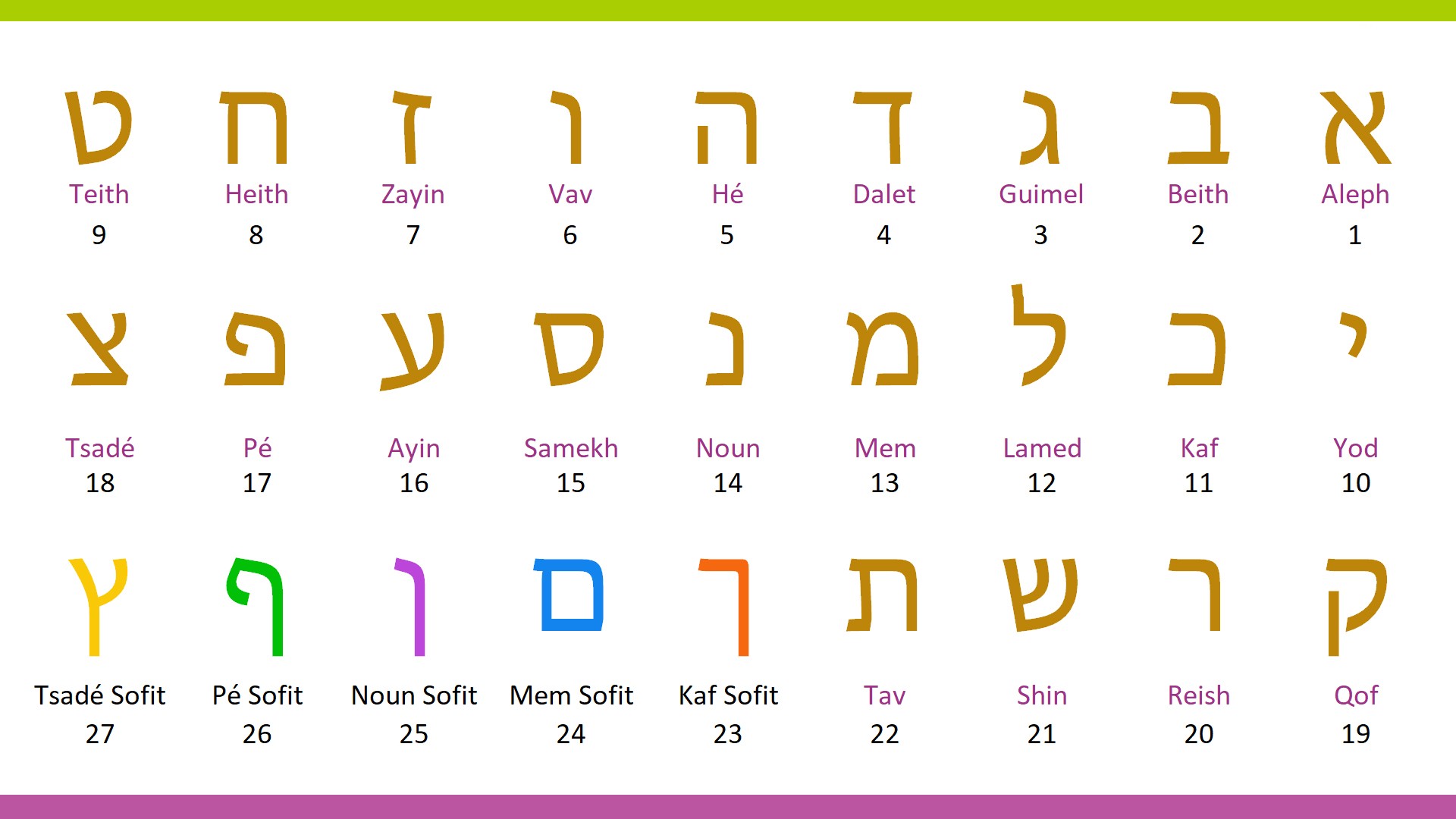
The very first milestone for anyone learning how to learn Hebrew is getting comfortable with the Hebrew alphabet, known as the Alef-Bet. Here are the key characteristics you need to know:
- Right-to-left: Hebrew is read and written from right to left. This feels strange at first, but you’ll adapt quickly. Within a few weeks of regular practice, the directionality stops registering as unusual.
- 22 consonants: The alphabet consists of 22 letters, and all of them are consonants. There are no dedicated vowel letters like A, E, I, O, or U.
- The missing vowels (Nikkud): To help children and early learners, Hebrew uses a system of dots and dashes underneath or inside letters called nikkud to represent vowel sounds. However, modern writing completely omits these vowel marks. When reading Israeli news or websites, you are reading pure consonants, using context and root familiarity to know the exact pronunciation.
- Five final forms: Five letters have a different shape when they appear at the end of a word. These are called sofit forms. They look different but are pronounced identically to their regular versions. This trips up beginners briefly, then becomes automatic.
- No capital letters: Hebrew has no distinction between uppercase and lowercase. The letter forms are constant regardless of position in a sentence.
Plan to spend your first two weeks with the alphabet alone. Practice writing it by hand if you can. The physical act of forming the letters helps your brain encode their shapes faster than passive recognition. Most learners who struggle with reading Hebrew later trace the problem back to rushing through the alphabet in week one.
Hebrew’s unique writing system cannot be unlocked through memorization alone. To read fluently, you must acquire vocabulary through rich, continuous input across thousands of word encounters.
A Common Question: Hebrew vs Yiddish
Beginners frequently ask about the relationship between Hebrew and Yiddish. While they use the same alphabet and share some historical overlaps, they are completely distinct languages from entirely different language families.
Hebrew is a Semitic language native to the Middle East, deeply tied to ancient history and modern Israel. Yiddish, on the other hand, is a Germanic language that developed among Ashkenazi Jews in Central and Eastern Europe during the 9th century. Yiddish combines a Germanic core with vocabulary borrowed from Hebrew and Slavic languages.
If you are looking to communicate in Israel today, navigate modern commerce, or listen to contemporary podcasts, Modern Hebrew is what you need.
The Best Way to Learn Hebrew: Input-Based Learning
If you want to compress that FSI timeline and learn Hebrew efficiently, you must take an immersive approach. Prioritize comprehensible input over grammar drills and vocabulary lists. The human brain acquires language when it is exposed to messages, stories, and contexts that you actually care about and can mostly understand.
The secret weapon of Hebrew grammar is the Shoresh (root system). Almost every verb, noun, and adjective is built from a core three-letter or four-letter consonant root. For example, the root K-T-V (כ-ת-ב) is universally related to writing:
- Kativ (כתיב) = Spelling
- Michtav (מכתב) = A letter
- Katav (כתב) = He wrote
Your brain acquires vocabulary by encountering new words and phrases across several different contexts. Through consistent listening and reading, you will develop your vocabulary naturally while building a sense for how Hebrew works.
Top Resources to Learn Hebrew as a Beginner
To build a highly effective immersion routine at home, you need a sufficient repertoire of interesting, meaningful content:
- News in simple Hebrew: Resources like Yanshuf or Simply Hebrew offer current events paced slower with simplified phrasing. Excellent bridge content between beginner and intermediate.
- Israeli podcasts: Shows like Streetwise Hebrew are fantastic for intermediate learners, breaking down cultural expressions, street slang, and root words in short bites.
- Immersive television: Shows like Shtisel (slower-paced, dialect-heavy) or Fauda (modern, fast-paced) immerse you in authentic Hebrew with subtitles to support comprehension.
- Music: Modern Israeli pop, hip-hop, and folk music are widely available on Spotify and YouTube. Lyrics give you patterns and emotional anchors that prose lessons miss.
- Conversation partners: Once you have a few months of input behind you, a weekly tutor session on platforms like italki accelerates everything. Speaking comes more naturally after you have heard enough Hebrew to draw from.
How LingQ Accelerates Your Journey to Learn Hebrew
The major hurdle for beginner Hebrew learners is reading native content without the vowel markings (nikkud). If you try to read a normal Israeli website, you will find yourself constantly copying and pasting terms into external dictionaries just to see how a word is pronounced.
This is where LingQ comes in clutch for Hebrew learners:
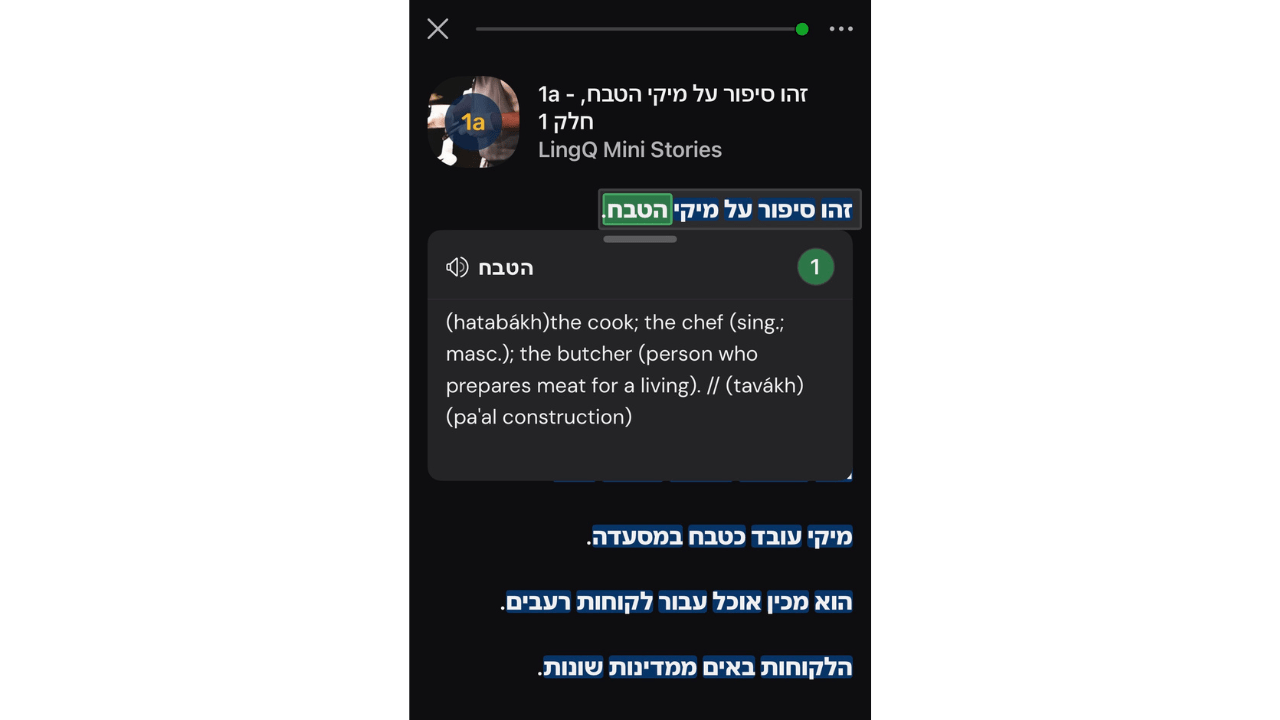
- Instant translation: On LingQ, you can import any Hebrew text, song lyric, or podcast transcript. Every single word becomes clickable. If you see an unfamiliar word without vowels, simply tap it to instantly see its phonetic transliteration, pronunciation, and English definition.
- The Known-Words tracker: LingQ’s tracking system quantifies your growth. You can watch your knowledge of Hebrew grow from your first 100 words all the way to reading speed.
- Massive library and custom imports: You can dive into LingQ’s Hebrew library or use the extension to import your own favorite Hebrew content, transforming any piece of media into your own custom language lessons.
If you want a closer look at how this system works, check out our complete Importing Guide and browse our Hebrew content, such as LingQ’s Hebrew Mini Stories.
Stop relying on textbooks and dive into the language. Create a free account on LingQ today to start interacting with authentic Israeli media, tracking your vocabulary growth, and building a genuine intuition for the language.
Frequently Asked Questions (FAQ)
Yes. According to the FSI, Hebrew is a Category IV language. The separate writing system and lack of shared vocabulary makes Hebrew an especially difficult language for English speakers, though the grammar itself is more systematic than the writing system suggests.
Hebrew is a Semitic language and the official language of Israel. Yiddish is a Germanic language historically spoken by Ashkenazi Jews in Europe. They share the same alphabet script but have entirely separate structures and origins.
While beginners learn using nikkud (vowel dots), native speakers read sentences using context and their existing knowledge of word roots. By practicing consistent input-based learning, you will recognize the consonant patterns and fill in the vowels automatically.
Devoting one hour per day to learning Hebrew through listening and reading, many independent learners achieve basic conversational comfort within 12 to 18 months. Reaching professional working proficiency typically takes 2 to 3 years at that pace.
Writer Bio

Tyler is an American language teacher and language learner. He’s taught Spanish, French and Latin in the K-12 system since 2018. Tyler also speaks Thai and Italian. Currently, he’s learning German and Polish on LingQ!
You might also like