
Japanese Numbers: The Complete Guide (1 to 1 Million)
 Tyler Tolman
27 May 2026
Tyler Tolman
27 May 2026
Japanese numbers look simple until you try to use them. You start by memorizing one through ten. Easy enough. Then, when counting three dogs, you realize that the word for “three” suddenly changes. That’s when you learn there’s a whole second number system. Then you discover that the way you count flat things differs from the way you count long things.
This guide covers everything. The two number systems and when each one is used. Counting from one to one million in hiragana and kanji, with pronunciation. The counter system, which is what trips up almost every learner past the beginner stage. And practical ways to actually retain all of this rather than re-Googling it every time you order two beers in Tokyo.
TL;DR
Japanese has two number systems. The Sino-Japanese system (ichi, ni, san) is used for most counting situations: phone numbers, dates, prices, mathematics. The native Japanese system (hitotsu, futatsu, mittsu) is used when counting general objects up to ten without a specific counter word. Both systems are written using the same kanji (一, 二, 三). Beyond the basics, Japanese uses “counters,” small suffix words that attach to numbers depending on what you’re counting. Reading Japanese numbers becomes natural through repeated exposure in real content, not memorisation.
The Two Japanese Number Systems
Most language learners discover with some surprise that Japanese has two parallel ways to count. Unfortunately, they aren’t interchangeable. After memorizing the digits themselves, learners will have to grasp when to use each one.
System 1: Sino-Japanese Numbers
These numbers came from Chinese and are used in almost every counting situation in modern Japanese: prices, phone numbers, years, addresses, times, mathematics, etc.
| Number | Kanji | Hiragana | Pronunciation |
|---|---|---|---|
| 1 | 一 | いち | ichi |
| 2 | 二 | に | ni |
| 3 | 三 | さん | san |
| 4 | 四 | し / よん | shi / yon |
| 5 | 五 | ご | go |
| 6 | 六 | ろく | roku |
| 7 | 七 | しち / なな | shichi / nana |
| 8 | 八 | はち | hachi |
| 9 | 九 | きゅう / く | kyuu / ku |
| 10 | 十 | じゅう | juu |
Notice that 4, 7, and 9 each have two versions. This isn’t a typo. The “shi” reading for 4 sounds identical to the Japanese word for death (死), so “yon” is preferred in many contexts, especially when counting people, hospitals, and anything related to gifts or formal occasions. Similarly, “shichi” can blur with other words, so “nana” is often used for clarity. For 9, “kyuu” is the default; “ku” appears in fixed expressions and time-related vocabulary.
This kind of variation, where the “right” reading depends on context, is everywhere in Japanese. You will not master it from a chart. You’ll absorb it by hearing native speakers use the numbers in real situations, dozens of times, until the right one starts to come automatically.
System 2: Native Japanese Numbers
These numbers are older and come from the original Japanese language, before Chinese influence. They’re used only for counting general objects from one to ten, when no specific counter applies.
| Number | Hiragana | Pronunciation |
|---|---|---|
| 1 thing | ひとつ | hitotsu |
| 2 things | ふたつ | futatsu |
| 3 things | みっつ | mittsu |
| 4 things | よっつ | yottsu |
| 5 things | いつつ | itsutsu |
| 6 things | むっつ | muttsu |
| 7 things | ななつ | nanatsu |
| 8 things | やっつ | yattsu |
| 9 things | ここのつ | kokonotsu |
| 10 things | とお | too |
When would you use this system? Most likely, you’ll use these numbers to count something but don’t know (or don’t want to bother with) the specific counter word. Ordering food at a restaurant is the classic case: “biiru, futatsu” (two beers) is perfectly natural and will be understood everywhere.
Past ten, the native Japanese system effectively stops. From eleven onward, you use the Sino-Japanese system (ichi, ni, san) regardless of what you’re counting.
Counting 1 to 100 in Japanese
Once you have one through ten in the Sino-Japanese system, building larger numbers becomes mechanical. Japanese counts using a base-ten system, but with a logic that differs from English in one important way: instead of having separate words for “twenty,” “thirty,” and “forty,” Japanese builds them as “two-ten,” “three-ten,” “four-ten.”
| Number | Kanji | Hiragana | Pronunciation |
|---|---|---|---|
| 11 | 十一 | じゅういち | juu-ichi |
| 12 | 十二 | じゅうに | juu-ni |
| 20 | 二十 | にじゅう | ni-juu |
| 25 | 二十五 | にじゅうご | ni-juu-go |
| 30 | 三十 | さんじゅう | san-juu |
| 40 | 四十 | よんじゅう | yon-juu |
| 50 | 五十 | ごじゅう | go-juu |
| 60 | 六十 | ろくじゅう | roku-juu |
| 70 | 七十 | ななじゅう | nana-juu |
| 80 | 八十 | はちじゅう | hachi-juu |
| 90 | 九十 | きゅうじゅう | kyuu-juu |
| 99 | 九十九 | きゅうじゅうきゅう | kyuu-juu-kyuu |
| 100 | 百 | ひゃく | hyaku |
The pattern is consistent: take the digit, add “juu” for the tens place. Twenty-five is “two-ten-five” (ni-juu-go). Forty-three is “four-ten-three” (yon-juu-san). Once you’ve internalized the pattern, you can construct any number from 11 to 99 without memorization.
Hundreds, Thousands, and Beyond
Above one hundred, Japanese continues using the base-ten logic. Note, however, that there is a separate word for ten thousand.
Hundreds (百)
| Number | Kanji | Hiragana | Pronunciation |
|---|---|---|---|
| 100 | 百 | ひゃく | hyaku |
| 200 | 二百 | にひゃく | ni-hyaku |
| 300 | 三百 | 三びゃく | san-byaku (notice the change) |
| 400 | 四百 | よんひゃく | yon-hyaku |
| 500 | 五百 | ごひゃく | go-hyaku |
| 600 | 六百 | ろっぴゃく | rop-pyaku (changes again) |
| 700 | 七百 | ななひゃく | nana-hyaku |
| 800 | 八百 | はっぴゃく | hap-pyaku (and again) |
| 900 | 九百 | きゅうひゃく | kyuu-hyaku |
The sound changes at 300, 600, and 800 happen because Japanese pronunciation rules prefer certain consonant combinations over others. Again, relying on memorization will only lead to frustration. Subtleties and exceptions become intuitive through repeated exposure.
Thousands (千)
| Number | Kanji | Hiragana | Pronunciation |
|---|---|---|---|
| 1,000 | 千 | せん | sen |
| 2,000 | 二千 | にせん | ni-sen |
| 3,000 | 三千 | さんぜん | san-zen (changes) |
| 8,000 | 八千 | はっせん | has-sen (changes) |
| 10,000 | 一万 | いちまん | ichi-man |
Japanese has a special word, 万 (man), for ten thousand. This unit is the building block for larger numbers in Japanese.
Above Ten Thousand
In English, we say “one hundred thousand” or “one million.” In Japanese, those numbers are constructed differently:
| English | Japanese | Pronunciation |
|---|---|---|
| 10,000 | 一万 | ichi-man |
| 100,000 | 十万 | juu-man (literally “ten ten-thousands”) |
| 1,000,000 | 百万 | hyaku-man (literally “hundred ten-thousands”) |
| 10,000,000 | 一千万 | issen-man |
| 100,000,000 | 一億 | ichi-oku (a separate word for hundred million) |
Converting between English and Japanese large numbers is a common stumbling block for intermediate learners reading Japanese news or financial articles. Direct translation causes confusion. A salary of “三百万円” is not “three thousand yen,” it’s “three million yen” (three hundred ten-thousands of yen). This takes real practice to internalize.
Counters: The Heart of Japanese Counting
When counting most things in Japanese, you don’t just say the number. You attach a small word, called a counter, that classifies what you’re counting. English does this occasionally (“two sheets of paper,” “three loaves of bread”). Japanese is a bit more thorough.
There are hundreds of counters in Japanese. You don’t need to learn them all. The most common ones cover the vast majority of everyday situations.
Counter for people: 人 (にん / nin)
| Number | Pronunciation | Meaning |
|---|---|---|
| 一人 | hitori (irregular) | 1 person |
| 二人 | futari (irregular) | 2 people |
| 三人 | sannin | 3 people |
| 四人 | yonin | 4 people |
| 五人 | gonin | 5 people |
Notice that one and two people use the native Japanese counting roots (hito, futa). From three onward, you switch to the Sino-Japanese numbers with “nin” attached. These two irregulars (hitori, futari) come up often.
Counter for flat things: 枚 (まい / mai)
Used for paper, tickets, plates, shirts, photographs, leaves, anything you’d describe as “a sheet of.”
- 紙一枚 (kami ichi-mai) = one sheet of paper
- 切符二枚 (kippu ni-mai) = two tickets
- シャツ三枚 (shatsu san-mai) = three shirts
Counter for long, thin objects: 本 (ほん / hon)
Used for bottles, pencils, umbrellas, trees, anything long and cylindrical. This counter is also notorious for its sound changes.
| Number | Pronunciation |
|---|---|
| 一本 | ip-pon |
| 二本 | ni-hon |
| 三本 | san-bon (changes) |
| 四本 | yon-hon |
| 六本 | rop-pon (changes) |
| 八本 | hap-pon (changes) |
You’ll hear this counter when ordering beer (biiru ippon), purchasing an umbrella, and in countless other daily situations.
Counter for small objects: 個 (こ / ko)
The universal small-objects counter. Apples, eggs, candies, balls, anything roughly round or compact. This is the “safe” counter when you don’t know the specific one to use, alongside the native Japanese system (hitotsu, futatsu).
Counter for animals: 匹 (ひき / hiki) or 頭 (とう / tou)
Small animals (cats, dogs, fish, rabbits) use 匹. Large animals (cows, horses, elephants) use 頭. Like other counters, 匹 has sound changes: ip-piki, ni-hiki, san-biki.
Counter for machines and vehicles: 台 (だい / dai)
Cars, computers, washing machines, televisions. Simple, no sound changes: ichi-dai, ni-dai, san-dai.
Counter for floors of a building: 階 (かい / kai)
Used for floor numbers in buildings. Lives partially in irregularity: ikkai (1F), ni-kai (2F), san-gai (3F, the sound change again), yon-kai, go-kai.
How to Handle Counters as a Learner
Here’s the honest truth about counters: they’re going to take awhile to master. In fact, native speakers themselves get them wrong sometimes. Therefore, there’s broad acceptance of using 個 (ko) or the native Japanese system (hitotsu, futatsu) as a fallback when you’re unsure.
You’ll learn counters by hearing them used hundreds of times in context. Knowing that the right counter for “three trains” is less likely to come from memorizing a chart than having heard “san-ryou” (using the train counter 両) enough times. The goal is to use the language intuitively, using your knowledge to produce “what sounds right”.
This is where reading and listening to real Japanese content in volume becomes essential. Not flashcards. Not memorisation drills. Exposure.
How to Count in Japanese (and Actually Remember It)
The standard advice for Japanese numbers is “memorize the chart.” This is good short-term advice, but it’s not sustainable for fluency. You don’t need to memorize a chart. You need to encounter Japanese numbers in real contexts, repeatedly, until they become automatic.
Here’s what works:
Listen to Japanese audio that contains numbers naturally. News broadcasts (prices, dates, percentages), Japanese podcasts (interviews, language-learning shows), shopping vlogs (talking about costs). The context and repetition help you grow accustomed to the Japanese number system without stress from active recall.
Read Japanese text that contains numbers in real use. Recipes, news articles, Wikipedia entries, manga, novels. Numbers in real text are connected to meaning. A page that says “彼女は三十五歳です” (she is 35 years old) builds the san-juu-go pattern into your memory differently than the same digits written on a flashcard.
Practice with content that interests you. A learner who reads Japanese sports news for an hour a week will have automatic recall of dozens of numbers within months, because sports articles are saturated with scores, dates, ages, attendance figures, salaries. A learner who drills “1-100 in Japanese” with a flashcard app for an hour a week will know the numbers but won’t be able to use them fluently in conversation.
Learn Japanese Numbers with LingQ
LingQ is built around this approach. Acquire the Japanese number system through comprehensible input, not sheer memorization. Import any Japanese content you’re interested in (a podcast, a YouTube video, a news article, a manga chapter), and the platform turns it into an interactive lesson where every word, including every number with its kanji and reading, becomes clickable. You see the meaning instantly, save the word to your personal vocabulary database, and the system tracks how many times you’ve encountered it.
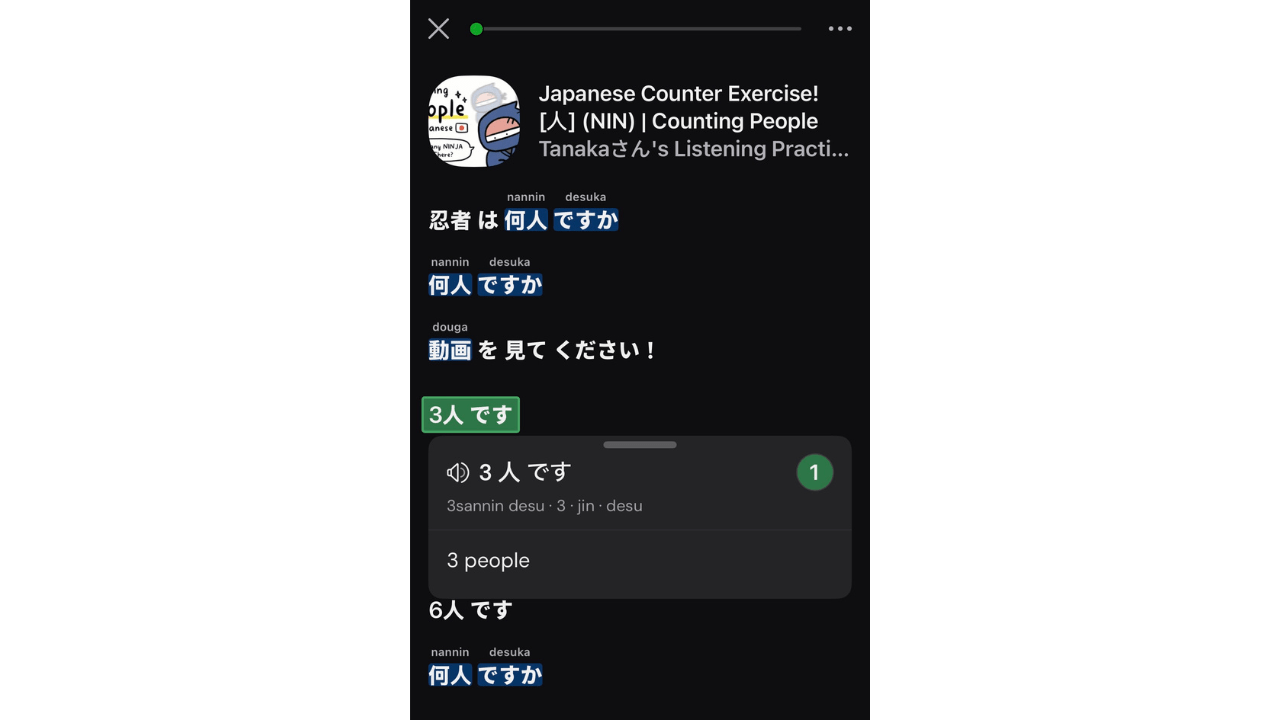
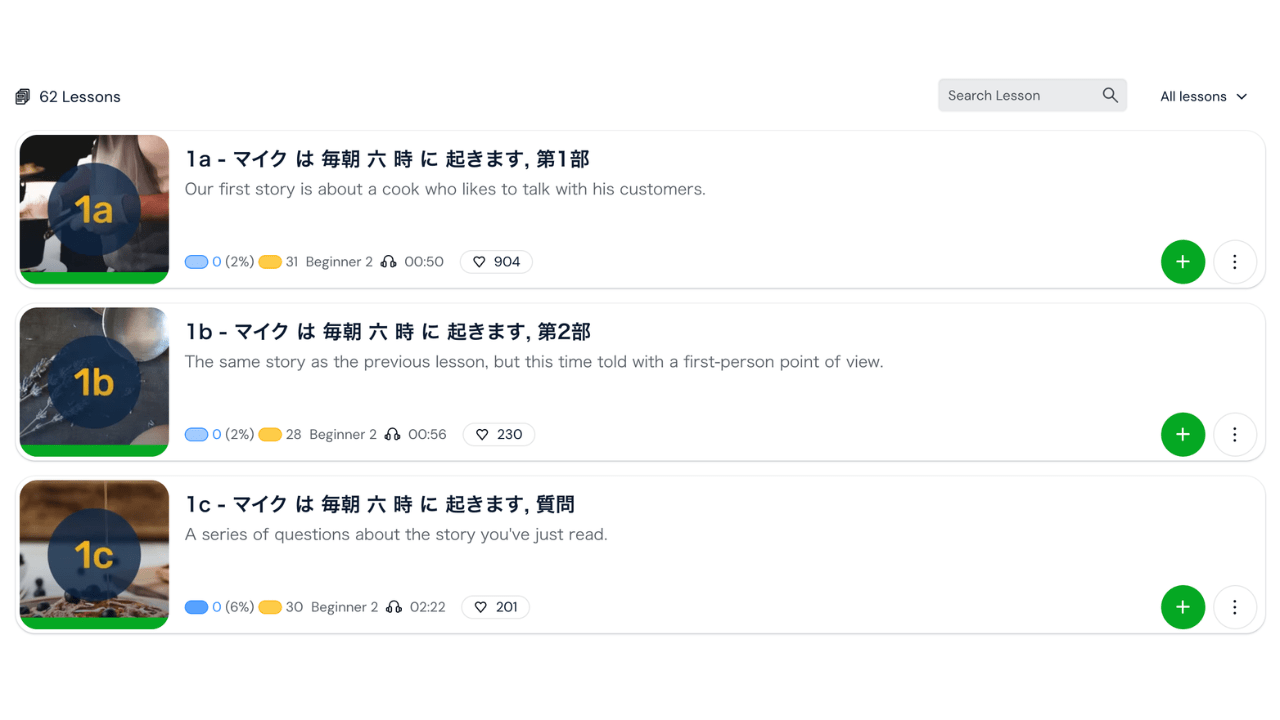
For Japanese specifically, the platform includes furigana support, audio sync with text, and a library of Japanese content at every level. The Japanese Mini Stories are particularly useful for beginners because they’re paced for learners while still using natural Japanese, including the number system in realistic contexts.
If you’re earlier in your Japanese journey and still working on the writing system, our guide to the Japanese alphabet covers hiragana and katakana, and our post on reading kanji goes into the kanji system in more depth.

A Practical Plan for Counting in Japanese
Here’s a sequence that works for most learners:
Week 1-2: Memorise 1-10 in the Sino-Japanese system (ichi through juu) and the native system (hitotsu through too). Don’t worry about counters yet. Practise saying them out loud while writing the kanji.
Week 3-4: Build up to 100. Learn the base-ten pattern. Practice common number-heavy content: telling time, ages, prices, phone numbers. The pattern matters more than the individual numbers.
Month 2: Start looking for counters in context while reading and listening. Focus on the three or four most common (人 for people, 枚 for flat things, 本 for long things, 個 for small objects). Don’t try to learn all counters. Encounter them in real content.
Month 3 and beyond: Move to large numbers (hundreds, thousands, ten-thousands). Get comfortable with the 万 (man) jump for ten-thousand. Start reading Japanese news, where large numbers appear constantly. By this point, the sound changes (san-byaku, rop-pyaku) should start to feel automatic from exposure.
Throughout: Listen to Japanese audio every day. Numbers in context will reinforce everything you’re learning.
Trying to learn all of this at once is overwhelming and counterproductive. Learn it slowly, with consistent exposure to real Japanese content, and the knowledge will actually stick.
FAQs
Japanese has two main number systems. The Sino-Japanese system (ichi, ni, san) is used for most everyday counting, including phone numbers, prices, dates, and any number paired with a counter. The native Japanese system (hitotsu, futatsu, mittsu) is used only when counting general objects up to ten without a specific counter word. Both systems use the same kanji characters.
Numbers like 4 (shi/yon), 7 (shichi/nana), and 9 (kyuu/ku) have two readings because of pronunciation preferences and cultural superstition. “Shi” sounds identical to the Japanese word for death, so “yon” is often preferred. Which reading to use depends on context.
A counter is a small suffix word that attaches to numbers when counting specific things. Different counters are used for people (人), flat things (枚), long things (本), small objects (個), animals (匹), and many other categories. Counters are essential because using the wrong one (or none) sounds noticeably unnatural to native speakers. Beginners can use 個 (ko) or the native Japanese system as a fallback when unsure.
Japanese counts in units of ten thousand (万 / man) rather than thousands. So 100,000 is “ten ten-thousands” (juu-man), and 1,000,000 is “one hundred ten-thousands” (hyaku-man).
Exposure to real Japanese content. Listen to Japanese news, watch Japanese shows, read Japanese articles. Numbers appear in almost every context, and seeing them in real use builds automatic recall far faster than memorising a chart. Tools like LingQ that let you read and listen simultaneously, with one-click translation, are particularly effective for this kind of contextual learning.
Start Learning Japanese With Real Content
Japanese numbers are one of those areas where the path from beginner to fluent is paved with repetition in context, not memorization in isolation. Charts and tables are useful as a reference, but you won’t actually internalize them until you’ve encountered the numbers in dozens of real situations.
The fastest path is to start consuming Japanese content you genuinely enjoy, with a tool that lets you understand what you’re reading and hearing. Numbers will follow.
Start learning Japanese on LingQ for free and use real Japanese content (news, podcasts, manga, dramas) to encounter numbers the way native speakers actually use them. The kanji, the pronunciation, the counters, the sound changes: all of it makes sense once you’ve seen it in context enough times. Trust the process and stay curious. Happy learning!
Writer Bio

Tyler is an American language teacher and language learner. He’s taught Spanish, French and Latin in the K-12 system since 2018. Tyler also speaks Thai and Italian. Currently, he’s learning German and Polish on LingQ!
You might also like