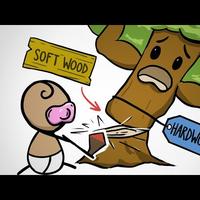
Why Hardwoods Are The Softest Woods
Do you know any hardwood trees?
You're probably thinking of a tree like oak, whose, well, hard wood is used for making
sturdy furniture and long-lasting campfires.
But guess what other tree is a “hardwood”?
Balsa – that lightweight, some might even say soft wood that people use for making model
airplanes.
So, “hardwood” doesn't necessarily mean that the wood is hard.
Ugh, English.
Doesn't the “hard” have something to do with “hardness?”
Well, it used to.
Back in the medieval timber trade, while cutting trees for building material and fuel, loggers
found trees like oak more difficult to cut, so they called them “hardwoods.”
Pine trees, on the other hand, were comparably easier to cut so loggers called them “softwoods.”
And most trees with hard wood also happened to have broad leaves and flowers, genetic
traits eventually used by scientists to categorize trees into the taxonomic group known as “angiosperms.”
So “hardwood” - a name based on physical properties - and “angiosperm” - a name
based on genetics - became synonymous.
And the term “softwood” was mostly applied to trees with needle-like leaves and unencased
seeds, traits used by taxonomists to categorize trees as “gymnosperms.”
And these colloquial terms and taxonomic terms generally align, angiosperms (AKA hardwoods)
are, on average, harder than gymnosperms (AKA softwoods), and their ances-tree may help
us understand why.
Softwoods evolved a few hundred million years before hardwoods did, and 90% of their wood
consists of the same long thin cells running parallel with the tree's trunk.
This means different softwoods have similar cellular structures and therefore are also
of comparable hardness.
That is, according to the Janka hardness scale, which ranks trees from softest to hardest
based on how much force it takes to drive a steel ball into their wood.
The differences in hardness that do exist among softwoods come mainly from the speed
at which different species grow and mature: fast growth leads to thinner cell walls and
less-dense, softer wood.
And slow growth means thicker cell walls and denser, harder wood.
Eastern redcedar - the hardest softwood - is only about three times as hard as northern
white cedar - the softest softwood.
This relative lack of diversity in cell structure, and generally among softwood species is partly
attributed to their pollination strategy: mainly, growing tall and letting the wind
spread their pollen.
Hardwoods, on the other hand, have co-evolved with the animals that pollinate their flowers
and distribute their seeds.
This has allowed hardwoods to spread rapidly in a variety of environments, leading to tree-mendous
species diversity, including in the variety of their cellular structure.
Hardwoods run the gamut of the Janka scale from the softest woods like balsa, which grows
very quickly and has extremely thin cell walls to the hardest woods like palo santo, which
grows slowly and has tightly packed thick-walled cells, making it 65 times harder than balsa!
Knowing this, you'd think we wood have retired the softwood/hardwood terminology by now,
but some habits die hard.
I'm gonna go out on a limb here and guess you'll really love the sponsor of this video,
CuriosityStream.
It's like smart TV for your smart TV!
CuriosityStream has thousands of expertly curated History, Science, Food and Travel
shows - all for just $19.99 a year - and even LESS if you use our promo code.
Personally, I got sucked into the Paradise Preserved series, particularly the episode
on Ecuador's cloud forests, which is made up of hundreds of tree species that are home
to thousands of animals.
Branch out with your streaming content by signing up at curiositystream.com/minuteearth
and use code “minuteearth” to get an annual subscription for just $15 bucks that also
includes access to Nebula, which has exclusive content from your favorite educational YouTubers!
Thanks, CuriosityStream!
