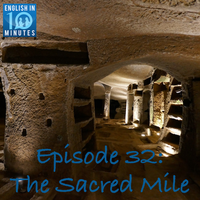
Episode 32: The Sacred Mile
Nick: Today Wendy and I are coming to you once again from the city of Naples. It's such an interesting place that we could just have many, many episodes surrounding this city and the different cultural aspects of it and the things that you can do outside the city as well as inside, underground and all of that. Umm, but what we want to talk about today is a particular area of the city or a particular, umm, route that you can take which, in Italian, they call Il Miglio Sacro, so in English it's the Sacred Mile, or I think they like to translate it as the Holy Mile, umm, but I prefer the Sacred Mile. And it's this area north of the historic centre of the city in a neighbourhood that's called the Sanità, uhh, which is related to the word for health because a hospital is near that area and it's also a cognate with the English words sanitary and sanitation.
Wendy: Yeah, and it also dates back to a fresco of the Virgin Mary that, uhh, supposedly was able to heal people. So people who were sick would come there and touch the fresco and they would be healed. And, yeah, so it's related to this word for health and healing.
Nick: And we first heard about this just a few months because I was doing an online course which was by being offered by a university here in Naples. And the theme or the main subject of the course was what they called patrimonio abandonato, which you can translate literally into English as abandoned patrimony but I think we would call it more abandoned cultural heritage, which is a very strong expression, or maybe endangered cultural heritage. And the course was basically about two things: firstly that in Italy and especially in southern Italy, they just don't have the funds, the resources and everything that they need to both protect and to manage the extraordinary amount of cultural heritage that they have.
Wendy: Umm-hmm.
Nick: And so a lot of the funding goes to the more famous sites, and if you think of some of these famous sites, even like Pompeii or even one like the Domus Aurea in Rome which is Nero's golden palace - even in those famous sites, there's a lot of degradation, and there's been these incidents, you know, in the last several years where certain things have collapsed and things like that. And these are the A-grade sites. And then when you go a step down to the B-grade sites, they're not really getting any funding at all. And so in Naples there are a huge number of churches, hundreds of churches, that are closed, because there's just no funding to keep them up.
And so the second part of this course was dealing with how there are alternatives to the main government body for dealing with cultural heritage, and how in some cases there are local organisations, non-profit organisations and they're using volunteers and people from local areas who are passionate about their cultural heritage, and they're finding other ways to maintain and protect their own cultural heritage. And one of the examples that they gave which was a very positive example was this Sacred Mile, which is in this very poor area of Naples, the Sanità. Even within Naples, which is already a poor city, it's, sort of, one of the poorest areas I would say.
Wendy: Yeah, and it's an area that probably a lot of local people would be hesitant to go through. They would try to avoid it if they could because it's seen as perhaps unsafe and, uhh, just not a very good part of town.
Nick: And on that topic, there's a bridge that - because the Sanità is kind of a sunken neighbourhood, it's sort of below the level of most of the city, and so there's a bridge, a road bridge, that goes over the top of it. And so if you're driving you just drive right over the top and you don't even have to go into it. And so I think people just basically forgot about it or just left it to its own devices. You know, out of sight, out of mind. And only just recently they've begun to start the process of rejuvenating the area a little bit, or at least opening, or restoring and opening, some of the sites that you can go and visit there.
Wendy: Umm-hmm.
Nick: And so again, this is kind of a grass roots campaign which was begun by … was begun by a priest, I believe, in the area, and he could a lot of young people involved and interested in learning about things that were right on their doorstep. And so they got involved and then a lot of people were interested in the project and they began to open some sites. Because one of the sites, for example, was … or is a catacombs, and it was being used as storage for the hospital.
Wendy: Right.
Nick: So they were just putting their equipment and stuff in there, and then finally this priest said, ‘You know, this is a really important place. We need to not use it for stuff like this and we actually need to open it, maintain it and display it to the public, have people come and pay to visit it, and, umm, then you can help rejuvenate the whole area.' So yesterday morning we took a guided walk of this area, and it took a long time, basically half the day. It took about four-and-a-half hours.
Wendy: Yeah, I think it was advertised as being three-and-a-half hours and it really took about four-and-a-half hours. So our guide was very, very knowledgeable. He was one of these young people that you're talking about. It sounded like he had been with the association from the beginning, more or less. Umm, and he was a fountain of knowledge about the area and, uhh, went into great detail about it. Uhh, so yeah, we learned an awful lot on that tour.
Nick: And so there are several key sites that you go to on this tour. Umm, the first of them is the Catacombs of San Gennaro which was, I think, probably the highlight of the tour, this amazing early Christian underground area, umm, for burials, still with some frescoes that you can see dating back as early as the second or third century. And they've done a really good job with the lighting and everything else and so it's really an incredible atmosphere down there, it's really amazing.
Wendy: Yeah, absolutely, yeah. Frescoes still on the walls and a few mosaics as well and, yeah, just the whole ambience of the place.
Nick: So I think that's the kind of star attraction in the Sanità and so some people just go and see that and then leave. But you also have the option of staying a bit longer and doing a walk through the whole area. And so one of the great things about it was that we walked through the Sanità and it's very much still a very authentic, local area. Umm, all these houses with washing hanging from the balconies and from the exterior walls of all the houses and things like that. So it's not at all gentrified…
Wendy: No.
Nick: …or tourist-ified yet. Maybe that will come but I think it's quite a long way away.
Wendy: Yeah, it's still very much a working-class neighbourhood. Umm, I mean, the area of town where we're staying in, which is, you know, really the heart of the city, it also, you know, still feels like the real Naples, but at the same time you do see a lot of signs in English and a lot of things catering to tourists and, you know, it's obvious that the city is adapting in that way, whereas the Sanità neighbourhood, I didn't feel like it had adapted much at all. I felt like it was really the same as it had been.
Nick: No, there were no tourist shops or souvenir shops at all. And in fact even Antonio, the guide, I think he mentioned that having a pizzeria with, uhh, with an English menu was kind of the thing that they were just starting to get in the Sanità and that's kind of the first sign that it's opening up a little bit to foreign visitors. But…
Wendy: But he saw that as a positive thing too, because he was saying, ‘Look, we've shown the local people in this neighbourhood that there is something worth seeing here and that foreigners want to come and see this,' and so that's given them self-confidence, self-esteem, it's made them look at their neighbourhood in a different way and look at themselves in a different way. And it's true that … well, we went on an Italian-language tour, so I believe we were the only foreigners. I think everyone else on our tour was Italian. Umm, but I was encouraged to see how many people there were on the tour. We were quite a large group, and in fact they had to split us up into two groups at the very beginning because we were too large to do it all together, so it seems like it's been really successful.
Nick: Right, and so apart from the catacombs the other major site, I guess, in the Sanità was this cemetery that was really unlike any cemetery that I've ever seen.
Wendy: Yeah, I mean it's a little bit like the catacombs in Paris, maybe, in the sense that, uhh, you have lots of bones that are just there, visible. They're not, you know, hidden in tombs, uhh, you can actually see the skulls and the other bones, uhh, from the skeletons.
Nick: Right, they're kind of piled up.
Wendy: Yeah.
Nick: Umm, but the whole area used to be a quarry for tufa, so it's this kind of underground cave, uhh, with huge high ceilings because of the nature of it as a quarry originally, and now you just have all these bones everywhere. So it's a very haunting kind of place, it's quite confronting…
Wendy: Yeah.
Nick: …you know, it's not for the faint-hearted at all. But, umm, it was a really fascinating place.
Wendy: It was, yeah. And we learned there a lot about the local culture, things, too and how people still venerate the dead and in some ways have this kind of special relationship where they will adopt a soul who is there. They will find a particular skull that they think speaks to them and comes to them in dreams and, yeah, there's this whole tradition of, umm, you know, this connection between the living and the dead in Naples that's really fascinating.
Nick: Alright, so if you come to Naples, apart from the usual things that there are to do, you might want to also check out the Sanità.
Wendy: Yep, I recommend it.
