Episode 31: Holy Week in Spain
Nick: It's almost Easter as we are recording and publishing this conversation, and Easter is obviously a very interesting time of year in many countries, especially Christian countries. Umm, probably one of the most interesting countries for Easter, Wendy, is Spain.
Wendy: Yep, I would definitely agree with that.
Nick: And so in Spain the week leading up to Easter is called Semana Santa in Spanish. We would call it Holy Week in English. And it's not just the four days of Easter that we tend to celebrate more in the anglophone countries, but it's this entire week leading up to Easter and including Good Friday, Easter Sunday and these important days on the calendar.
Wendy: Umm-hmm.
Nick: And so we've actually been in Spain for Holy Week the last two years.
Wendy: Yep.
Nick: And so we've had some interesting experiences around Holy Week, and so we thought we would talk about those today. And so two years ago we were travelling through a region of Spain in the west of Spain called Extremadura, close to Portugal, and we realised by looking at the map that we weren't that far - once we got to the southern part of the Extremadura - from Seville, which is where the most famous of these Holy Week celebrations takes place. And so we decided to basically, uhh, interrupt our little journey in the Extremadura and quickly just go down to Seville and then to come back up the next day. Umm, Seville's a wonderful city but it's a place that we'd already been to. We went there as part of our honeymoon.
Wendy: We did.
Nick: Umm, and we've since been back, or I've at least been back one other time, so it wasn't the first time for us going there, but essentially the only reason that we came - and it took us about three hours to get there from where we were, on a bus, and then then three hours back up - was to see if we could be part of the Holy Week processions which are so famous and so incredible in Seville.
Wendy: Yeah, well we weren't actually part of the processions, we were observing the processions.
Nick: To be part of the atmosphere and to be part of the celebrations and things like that.
Wendy: Yeah, yeah, to take part in the celebrations.
Nick: But we weren't marching, no.
Wendy: Just to make that clear.
Nick: Uhh, and so what you have in Seville is this … these series of these marches which take place throughout the city as, uhh, people are marching towards the Cathedral and the first thing and the most obvious thing that people are aware of is the distinctive dress that the people are wearing.
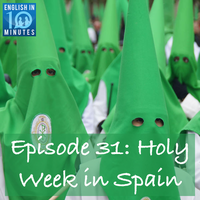
Wendy: Yeah, so, uhh, they wear these robes, uhh, and they're in different colours depending on which, uhh, they're called cofradías, so like a brotherhood or an organisation of people, and each brotherhood will have their own colours, so you'll see some in purple, you'll see some in green. Umm, but they all are wearing these robes, these gowns, and then a matching coloured hat, or it's actually a mask, so it covers their face, so you just have the, uhh, holes for their eyes and I guess their nose and mouth as well. Umm, and then it's a very long, tall and pointy cap, umm, which unfortunately, in the U.S. anyway, where I'm from, it's … that kind of, uhh, cap and mask is very much associated with the KKK, the Klu Klux - I can never say this right - Ku Klux Klan.
Nick: There you go.
Wendy: Uhh, but in Spain it has nothing to do with racism or white supremacy or anything like that. It's, uhh, it's a much older tradition that goes back hundreds of years and, uhh, is related to these Holy Week processions.
Nick: Right, and so I'm not sure but I think they have the processions perhaps throughout the week but then it's the Thursday night, I think, going into Good Friday which is the biggest night, and that's the night that we were there. Umm, and so there are a lot of people, the route that they take to get to the cathedral is barricaded at the sides, umm, so … you know, to make it safe, to make it clear for them. Uhh, so you can just kind of try to find a spot somewhere along the route and watch them go.
Wendy: Yeah, and, uhh, so, yeah, they're … I'd say dozens if not hundreds of people in each brotherhood. It's quite a large procession usually, umm, and so they're all wearing these, like I said, these gowns and these, uhh, masks with the tall, pointy hats. But then the other really characteristic thing is that some of them are carrying these really heavy statues, or it's like a float. In a lot of processions you would see a float that would be, umm, some kind of cart that would be running on wheels. And at first glance you might think that that's what this is, but it's not. It's not on wheels at all, it's actually being carried by people who are underneath, carrying it on their shoulders. And they're incredibly heavy, and they have to stop every few minutes and put it down and get … drink some water to keep going. Uhh, so that's an impressive thing to see too.
Nick: And basically these processions go all night, or almost all night, so we stayed up quite late too to keep watching them, umm, and it was really fascinating. It's something that I wanted to see for years, so I was really happy that we had the chance to see it.
Wendy: Yeah, yeah I was too.
Nick: And so then the next day we went back up towards the Extremadura where we'd kind of left off, umm, and went to a town called, uhh, Badajoz, which is close, very close to … it's a border town with Portugal. Umm, and we accidentally bumped into a small procession there as well.
Wendy: Yeah, ‘cause it's not just Seville. I mean, most people outside of Spain, you know, most foreigners, when they … if they know about Semana Santa in Spain, they probably know about it in Seville, ‘cause that's definitely where the most famous processions are. But there are lots of other towns and cities around the country that celebrate it too, so Badajoz had its own celebrations and we got to see those. And it was … I really enjoyed that one. Umm, I think you perhaps didn't enjoy it quite as much, but I liked the contrast of seeing, you know, a very local, very provincial celebration where it was just the locals. I don't think many people had come from outside to watch these celebrations, but they were impressive nonetheless. And I really liked the, you know, the intimate nature of it, where in Seville, like you said, there are barricades on both sides of the street and lots and lots of people and big crowds and, you know, you're having to jostle your way through the crowds and try to get a good place where you can get a good view. And in Badajoz it wasn't like that at all, like, you know, you're just right there on the street right next to the people who are in the procession, you could reach out and touch them if you wanted to. And sometimes people did touch them, some of them had little candies that they were giving away to the children, the kids who were watching them. And so they would just reach out their hand and put the candy in the child's hand and, you know, they were literally right there and I enjoyed seeing that.
Nick: No, you're right. The contrast between the two was very striking. It's just that I had put so much focus and attention on seeing it in Seville that suddenly to see this local festival the next day … I wasn't quite ready for it or I'd sort of spent all of my energy, I guess, the night before. But, no, it was really interesting to see, you're right. And then last year we were in another region of Spain called Aragon, and we saw another procession in the capital of that region which is Zaragoza which is, I think, the fifth largest city in Spain. And this was I guess between those two other ones.
Wendy: Yeah, it wasn't as big as the ones in Seville, but definitely not as small as the one in Badajoz either. It was a very impressive procession, and I think there were a lot of people who had come from out of town to see it.
Nick: And so it's centred around this main plaza in the centre of Zaragoza and most of the people marching were again wearing these robes and these pointy hats like you've described, uhh, and they were mostly in green.
Wendy: Umm-hmm.
Nick: And so that was quite amazing to see hundreds of people marching in that colour, and this was during the day, so also there was … it was just a little bit easier to see everything, whereas in Seville it was in the middle of the night.
Wendy: Yeah, and maybe there were processions during the daytime at some point in Seville too, but the ones that we saw were at night. So, yeah, seeing them in the day in, umm, in Zaragoza was a different experience.
Nick: And then there's also people playing music, there's people playing drums as they're going, beating drums, and that was really interesting.
Wendy: Yeah, I really enjoyed the drums too. In Seville, the music that I remember most is, uhh, the trumpets, or, yeah, it's very, umm, yeah, very kind of slow, kind of sad trumpet sound, whereas in Zaragoza there was a lot of really upbeat, umm, drum-based music that was being played and so I enjoyed that.
Nick: So, basically, the lesson is - because we didn't know about that either before we went and then we thought, “Oh, well it's Holy Week, maybe there's something going on here as well,” - and so the lesson is that if you're in Spain the week before Easter, no matter where you are, you may stumble across a really interesting festival that you can enjoy.
Wendy: Yeah, and if you are there then look for one, because it's definitely worth checking out.
