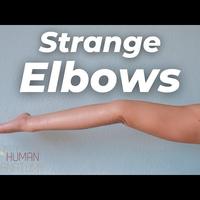
Women Have Weird Elbows...
Today's video is sponsored by Brilliant.
Find the link in the description below.
Some of you have really weird elbows.
Now, before you get upset at me, let me build my case.
For some of you out there, your elbows literally go farther and actually move out to the side
more than the rest of us and to me, this is actually pretty cool even though it makes
you look like you belong more in a science fiction film rather than reality, but the
reason why it's so amazing is because it highlights just how adaptive the human anatomy can really be.
So, in today's video, we're gonna take a look at the elbow to figure out exactly what's
going on with all you squiggly elbowed people.
It's gonna be an interesting one.
Let's do this.
[Intro]
In order to best understand the weirdness that elbows may exhibit, we need to have a
brief discussion around what are called secondary sex characteristics.
These are characteristics that primarily show up in one sex over another.
Although, not all the time, there is crossovers so they're not completely exclusive and they
don't have a direct involvement in reproduction.
So, what I mean by that is, they're not essential for reproduction to occur.
If you contrast those with what are called primary sex characteristics, these are things
like genitals, the uterus, the prostate.
All of those are essential for reproduction to occur.
Secondary sex characteristics are gonna be things like facial hair or chest hair, overall
more body hair and thicker body hair in males and an enlarged thyroid cartilage or the Adam's
apple, deeper voices.
Again, those are all gonna be primarily male characteristics.
For females, you're gonna have breasts, wider hips.
Wider hips are gonna be very important for our conversation today as well as a higher
pitched voice.
Literally soft skin due to the fact that females have higher body fat composition.
All of those are classically gonna be thought of as more female characteristics but I wanna
be very clear about something, just because someone has more of that characteristic than
another does not make them any more masculine or feminine than this one.
So, think about it like this...
I would love to have a very deep voice like this [Speaking in deep voice] really deep
bass voice that's just earth shattering when I speak.
That would be cool but I don't have that and that's okay and that also means though that
anyone who does have that earth-shattering deep-based voice, it's not as though they're
more masculine than me.
Any more so than the fact that I can grow facial hair doesn't make me any more masculine
than someone who can't grow facial hair.
Masculinity, femininity, there's far more to it than just these characteristics, but
at some level, we are attracted to these characteristics.
Otherwise, they wouldn't show up in our species like they do and believe me, they don't just
show up in our species - secondary sex characteristics are found all throughout the animal kingdom.
I mean, lions manes are a real easy, classic example of it but the simple fact that they
are still there shows that we do find some attractiveness to this.
So, that's why they can be indirectly related to reproduction but not directly related to
reproduction.
So, what does this have to do with weird elbows?
Well, now, we can finally have a discussion around what's called the Carrying Angle.
Now, you can actually do this activity at home.
We're gonna roughly determine your carrying angle.
So, first off, if you place your arm in front of you like this, with your palm facing upwardly,
this is a position that we call supination or a supinated position.
Then, if you rotate your palm like so, now it's facing downwardly, this is a pronated
position.
I often describe this to my students as though you are holding a bowl of soup or you are
pouring it out.
Then, at the elbow, if you are going like so, this is called flexion and then the opposite
direction is extension.
To properly determine your carrying angle, you need to be in a fully supinated and extended
position at the elbow with your arms down at your side and as you do this, you're probably
gonna notice a gap - a space is forming between your elbow and your body.
This is roughly your carrying angle.
The reason I say "roughly" is because to properly determine it, we'd have to draw a midline
down the middle of your brachium, another midline down the center of your forearm and
then, we'd have to measure an angle between those and that can actually move and change
based on movement of the elbow itself but for our purposes, this space will do just
fine for now.
And some of you probably already noticed that your forearm is actually coming out at a more
excessive angle than you may have anticipated or what you're used to seeing.
And if that is the case, I'm willing to place a bet that you are probably, again, I'm saying,
probably, female.
The reason I say that is because researchers have performed studies all over the world,
cross culturally and have found that females by far and large tend to have larger carrying
angle than males which has led a lot of to suspect that it might be a secondary sex characteristic
just like the other ones we spoke of in the beginning of the video.
Now, there's - now, if you actually think about this, it gets a little more interesting
because there's another secondary sex characteristic down in the hips for females more often than
not that might line up with it - wider hips.
And this is actually been the leading hypothesis for many years now is that it could be that
the carrying angle exists to actually avoid those wider hips during gate or when you're
walking.
Now, here's the thing, I personally don't quite buy it.
The reason being is I don't know about you but I don't walk like this, fully supinated,
right?
That would be ridiculous.
When I walk, I walk pronated or at least semi-pronated like you're in a hand shaking position and
if you do this, you can do this with me at home, if you go ahead and go back to that
carrying angle position, pronate, and you do that, the gap, the space disappears and
that's because when you're in a pronated state, as the radius starts to spin, what that will
do is shift the ulna ever so slightly and basically the carrying angle just disappears.
So, if you think about it, I don't really - it personally, just doesn't make much sense
to me that the carrying angle exists because of wider hips.
Also, we find that an excessive carrying angle can exist in individuals who don't have wider
hips.
So, it's not a one-on-one correlation so it doesn't really line up that way and I don't
know about you, more often than not, I'm in a pronated state, resting, like if I'm just
relaxing or sitting, I'm more often in a pronated state.
Well, the thing is, that means there's a gap that has formed between the ulna - actually,
I have a couple plastic bones right here that I can grab for us.
Reason why they're plastic is cuz I didn't feel like ripping apart Jeffrey just to illustrate
this point but if we go right here and I place these like so - so, here's the ulna, here's
the humerus...
If we go like this, right?
What happens is - I didn't grab a radius but there would be a radius here.
As the radius is spinning and it pronates a little bit of space will form right here
between the ulnar and the humerus.
Well, when that happens, the bone will actually grow.
There will be some bony growth in that space because the body doesn't just let that space
exist and what that would mean when you go back into supination and it tries to come
back - whoa - it tries to come back, there's bone in the way and what that ends up doing
is it's permanently stuck this way which means the more pronated you are or the longer you're
in a pronated state, that can actually have an effect to increase your carrying angle.
Now, there's another thing we have to talk about though because that alone, what I just
discussed happens in both males and females.
So, why is it still that females exhibit more of a carrying angle?
Well, there's another very important thing that researchers have found and that is, for
individuals who are shorter and have shorter forearms, they tend to have an excessive carrying
angle when compared to taller and longer individuals, right?
And the reason being is because when you start to change the length of these bones, that
changes the dynamics and small movements can actually have further or greater repercussions.
So, small adjustments like supination and pronation can actually create larger gaps
in those spaces.
What that means is - I'll put these bones back - is that shorter individuals tend to
have larger carrying angle.
Think about this - in human beings, on average, females tend to be shorter than males.
That to me really lines up with, you know, expectations then.
I mean, things start to make sense.
Especially, if there are any of you out in the audience watching this who were like,
"Justin, a male and I have an exaggerated carrying angle".
Well, then, the data would suggest that you are probably shorter than most individuals
and that would create that excessive angle.
Very, very interesting to think about but if that's the case, that would mean that an
excessive carrying angle isn't a secondary sex characteristic in the same way that your
Adam's apple or wider hips would be which is strange because this tends to show up on
the onset of puberty just like other secondary sex characteristics.
So, there's really some interesting intrigue and mysteries still attached to it but it's
endlessly fascinating nonetheless.
But if you're interested, maybe there is a an experiment you could do yourself this weekend
to determine, at least in your own mind, if it is indeed a secondary sex characteristic.
Remember, we find them attractive at some level.
So, maybe what you could do is walk into the club, kick down the door, and walk around
like this, making deep eye contacts with everybody in the club and see if they check out your
elbows.
It may not be the most scientifically accurate test but it may catch you a mate.
I was really excited to do today's video because this topic is such an easy way to dip your
toes into the world of kinesiology or the study of movement.
Kinesiology is the perfect blend of structure and function.
It literally describes how your body moves through the environment around you and how
you can get the most or best out of it.
If you're interested in physical therapy, exercise science, or really just anything
to do with improving your own body, you'll definitely wanna check out the sponsor of
today's video, Brilliant.
Brilliant is an interactive online platform for STEM subjects.
That is math, logic, science, and computer science.
We've been fortunate enough to work with Brilliant for a little while now and I mean this when
I say this, they know what they're doing.
Take today's video for example...
Kinesiology is all about shapes, angles, and the movement involves with them.
Brilliant's newly redesigned geometry fundamentals course can help you develop spatial reasoning
and intuition about geometric principles and you'll be learning with interactive visualizations
and challenges which is much more fun and engaging than your typical geometry textbook.
This is just one of over sixty courses on Brilliant that you can use to learn STEM.
If you're interested, visit Brilliant.org/IHA or you can just click the link in the description
below and the first 200 people there will get 20% off their annual subscription.
Thanks for watching everybody and we'll see you in the next video.
