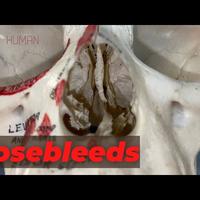
Why Picking Your Nose Is Dangerous...
I know you pick your nose and if you don't pick your nose even just a little bit, I don't
think I can trust you because you're probably a robot.
The fact is, picking your nose is part of what it means to be human, but with that said,
if you're two knuckles deep looking for buried treasure, that's definitely not a good way
to go about it and your nasal anatomy would agree.
And that's why in today's video, I want to talk all about nosebleeds.
Have you ever really thought about this?
Like take a moment to think about it - why is it that I can scratch or you could scratch
pretty aggressively all over your entire body but if you stuck your finger up your nose
right now into that same thing, we all know what would happen.
That's what we're going to figure out today, what makes the nasal cavity and the nasal
anatomy inside of it so different from other places that you can palpate.
It's going to be a gross one, let's do this.
Let's start off by orienting you to what we're looking at and then we can more fully understand
nosebleeds.
So, first off, this right here is a head that has been cut in the mid-sagittal plane or
right down the middle.
This is the anterior direction which makes this the posterior direction.
You can even see the cervical spine right there.
This is going to be the tongue and then this would also then be going up towards the brain
which we've removed which would be sitting in here.
So, that's going to make this portion that i'm outlining with my probe the nasal cavity
and this is going to be the important area we're talking about today.
Now, before we get into the nasal cavity you obviously have a nose, and that's what again
this is right here in front of the nasal cavity.
Now, I'm not going to do this, you're welcome to do that - I'm covered in preservatives
but if you're at home and you want to just start touching and moving your nose, feel
free.
The nose is going to be soft, flimsy but still firm and rigid, that's because it's made of
cartilage, specifically what's called hyaline cartilage.
Hyaline cartilage is found all over the body, it's really good at reducing friction, so
you'd like to put it in places like joints, really good for the bones rubbing against
each other but think about when you're breathing in and out, that's a lot of airflow.
So, it makes perfect sense that you'd want to have something that's really good at reducing
friction in that area but the main reason it's made of cartilage and not entirely bone
is because you want it to be able to deform under pressure.
Think about it - you got punched in the face which your nose is a huge liability, it's
just sticking out there.
Imagine it's all made of bone and you just get popped, right?
You can just completely break your nose, but also laying on a pillow or anything like that
just pushing it, it makes sense to have it be soft and flimsy, right?
But still be able to retain its shape most of the time.
That actually begs the question - if the nose is made of cartilage, what are you actually
breaking when you break your nose and I this is actually - I actually broke my nose.
If you look at my nose, you're going to see - I forget which direction it is but it's
skewing to one side or the other.
When I was 16 goofing off with one of my friends, was kind of like play fighting and then he
just pops me in the face and breaks my nose.
I never really got it taken care of I mean, I'm 16 and irresponsible but the real question
is, what did I break.
And so, if we'd come over here, so the nose is made of cartilage, there's another structure
here I want to point out to you - this is part of what's called the nasal septum but
this is the cartilaginous portion of the nasal septum.
We've cut a window here but what we removed in order to see these structures there is
the rest of the nasal septum and this was made of bony tissue.
So, you've probably heard of a deviated septum - the septum is a divider divides the nasal
cavity into left and right sides.
Part of its cartilage part of it's actually going to be made of bony tissue.
It's possible when you get hit in the nose or whatever happens that you could break that
bony portion and that could be part of your broken nose.
Another thing it could be is up here, this is called the nasal bone.
There's gonna be two nasal bones, one on either side and they're coming off of the frontal
bone here and what happens is the cartilage just comes off of it to form that cartilaginous
flimsy part of your nose as does this cartilaginous portion of the nasal septum.
So, you could either break the nasal bones or the septum and that would make sense to
be breaking your nose.
So again, appreciate the fact that your nose is primarily made of cartilage because that
would be - that'd be such a rough injury if your whole nose just shattered, be a rough
day at the office.
But going back here, so again, we removed the nasal septum so we could see these deeper
structures here.
These are what are called conchaes or conchi.
So, we have an inferior nasal concha, so I'm kind of outlining the best I can with a probe,
and then we have a middle nasal concha and then we have a superior nasal concha.
So, a conch - these are also called turbinates, so some of you probably heard of them be called
turbinates.
These are bone, bony structures that are actually - like they come down and then they actually
like they curve around and what that curving does is it actually increases the surface
area inside of the nasal cavity so more air - so air can actually come into contact with
more of this tissue that's on top of it because you can see, it doesn't really look like bone
even though there is some bone - I don't know if you're gonna be able to hear it but there
is some - these are bony structures that are wrapped in mucosal membranes, connective tissue,
epithelial tissue and the reason - that's gonna be very important for the function of
your actual mucosal membranes, but just understand these conchas are going to just come down
and circle around dramatically improve - and increasing the surface area in that space.
But there's also passageways between them.
So, you'll probably not be able to see this all that much but my probe is actually going
underneath this inferior nasal concha.
This is called the inferior meatus and then right here, you can definitely see this one.
This is the middle meatus and then there's a superior meatus.
These are the passageways - meatus essentially means passageway.
This is the passageway the air will take as you're breathing it in and then it'll go to
your nasopharynx and then we'll go down your pharynx and then we'll go down to your respiratory
tract.
So, to really understand nosebleeds, we need to understand the mucosal tissue, these mucosal
membranes because these are highly highly vascularized tissues and that's on purpose
because - think about it like this - when you take a bite of something that's too hot,
what are you going to do immediately?
You're going to take a bite [Breathing in rapidly] right?
Or you spit it out.
But let's say you breathe in really quickly, when you're doing that, you're cooling it
down.
When you're breathing in through your nose, what's happening is you're also cooling down
the air and that's not a good thing for your respiratory tract.
So what exists inside of these mucosal membranes is a bunch of superficial blood vessels that
are there to warm up the air so you don't freeze out your lungs and respiratory tract.
Now, these don't just exist here on the conchas, they're also going to line that nasal septum
as well and in fact, the most vascularized area of it is right here, what I'm tracing
with the probe.
This is called little's area or the kiesselbach - kiesselbach's plexus.
And this is an area where several blood vessels are all converging and it's so superficial.
90% of nosebleeds happen right here in what's called an anterior nose bleed or the real
name is epistaxis, that's the fancy name for nosebleed is epistaxis.
So, you can have an anterior epistaxis or you could also have a posterior epistaxis.
So, if you have a bleed back here, pretty much anywhere other than little's area, that's
defined as a posterior nose bleed and this one is far more rare and it's actually more
dangerous because if you notice again, we go back, the nasal pharynx is right here,
blood can start pouring down the back of the throat and you can start swallowing it.
So, if you - that same thing can happen if you're bleeding in this area and you leaned
your head back, then the blood could pour down and pull and go down here which is why,
as most of you will probably intuitively understand, if you have a nose bleed, you want to lean
forward.
By leaning forward, the blood is actually going to come out the nostrils, right?
It's not going to go down your throat and then you're not tasting the blood and all
that nastiness.
Let's talk about how to stop that nosebleed.
If it's an anterior nose bleed, well what they recommend is you actually pinch it, right?
So you actually on like - you're going to - because you want to compress little's area
and those blood vessels.
So again, I'm not going to do this but if you squeeze your nostrils together, you're
going to lean forward, squeeze those nostrils together.
By compressing it, what you're hoping will happen very quickly is a coagulation of the
blood and it'll then stop the blood loss, right?
So you just kind of lean forward pinch it and wait.
That's literally the best thing you can do for an anterior nose bleed.
A posterior nose bleed is going to be more difficult because obviously, when you're picking
your nose are you really going to be able to get all the way back here?
Can you stick your fingers all the way back here?
You can't.
That just doesn't really make much sense, so you can't really compress anything.
So, they still recommend you lean forward but then - you're going to kind of have to
wait for this to try and resolve on its own that the body can take care of it, the blood
can coagulate on its own.
If it doesn't resolve in about a half an hour or so, that's when it's recommended that you
go seek medical attention.
They have a series of things that they can do to try and stop that bleeding but you can
actu - this is actually - can be pretty serious because if you - you can lose a lot of blood
from a posterior nose bleed and then you can bleed out essentially.
Not bleed out and die, maybe that might be too aggressive but it can have some severe
consequences because maybe you get light-headed, maybe you pass out or something along those
lines.
But I want you to think about this, okay, to bring it all back together.
So, when you're picking your nose, right, you're coming in here - well, what's happening
is you may be trying to go for boogers and by the way, those boogers are a product of
the mucosal membranes because what will happen is they also secrete mucus.
That mucus is going to be there to help catch pathogens and then hopefully you will blow
it out or pick it out, right?
It actually makes sense to pick your nose, to pick the boogers out - those dried out
crusted pieces of mucus that are containing dirt and all sorts of stuff inside of it,
all right?
So, you go in there, you're picking your nose but you want to be careful because if you
pick too aggressively and you scratch - say again, 90% of nosebleeds are going to happen
in little's area - if you scratch that too much, you can rupture those blood vessels
and then it starts to bleed, but it also could be a product of just being dry.
I know we live here - I live here in Salt Lake City, Utah.
We're a desert as it is and then in winter it seems to get even drier.
There's plenty of times that I'll be just - I remember as a kid, I'd be outside you
know, just having snowball fights and all that fun stuff and my nose would just bleed
- maybe I bumped it or did something like that and I cracked the mucosal membrane.
That is also another possibility to get a nosebleed.
But I mean, it could be trauma, it could be a whole bunch of different things, even medications
have been known to dry out those mucosal membranes which makes them more susceptible to cracking
which then ruptures the blood vessels and you have a nose bleed.
One thing I do also want to add real quick - as a function of those - the mucus in there
is also going to help to provide humidity to the air as you are breathing in and so,
that's the thing.
You also don't want to just freeze out your lungs and your respiratory tract, you don't
want to dry them out either.
So, that's why it's important to actually have snot, the mucus.
It's important to have all of these things in there but just because you do doesn't mean
you have to just let it sit there, right?
Blowing your nose is a good thing, picking your nose a little bit might also be a good
thing.
But just don't blow your nose too hard, don't scratch and pick your nose too hard because
you will eventually rupture some of those superficial blood vessels and that's when
you have a nose bleed.
Thanks for watching everybody, I hope you enjoyed this gross topic of nosebleeds and
nose picking.
If you did, be sure to like and comment on this video.
Those little types of things actually help the video perform well in the algorithm so
that more people can see the grossness of nosebleeds and nose picking.
Also if you want to look awesome like me and Jonathan and wear some legitimate Institute
of Human Anatomy merchandise, there'll be links down in the description below, again,
that goes to support the channel so we can continue making these awesome videos.
I guess I just want to leave you with this - if you're going to pick your nose just be
soft.
Be like a soft little ninja, you know, just kind of go in and out, in and out.
Don't be going two knuckles deep because as you just saw, that's not going to work out
too well for you.
