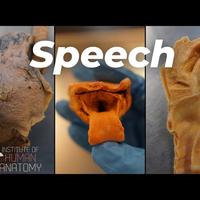
Humans Have an Actual Superpower...
This video is made possible by our supporters over on Patreon.
Find the link in the description below.
Right now, I am forcefully and precisely exhaling air out of my vocal tract.
It's zipping by my vocal cords, bouncing around in my throat, rolling off my tongue as it
exits my mouth and you assuming you speak and understand English are comprehending it.
That's absolutely incredible and in today's video, we're going to use the cadavers to
look at the human vocal tract.
We're going to see exactly what makes it so unique in the animal kingdom that I'm willing
to go as far as to call it a legitimate human superpower.
It's going to be a fun one.
Let's do this.
Speech is such an incredibly complex process that we're going to need an entirely separate
video to address the neurological side of things.
In today's video, I want to focus on the vocal tract anatomy and what makes it so unique
in humans that we're the only creatures on the entire planet to have it structured the
way that we do.
I also want to mention that if you're interested in what I'm talking about today, you might
want to check out this book right here, The Evolution of the Human Head by Daniel Lieberman.
He's a Harvard professor, paleoanthropologist, and does a fantastic job in this book of condensing
and consolidating 60 plus years of the published research and literature into a somewhat approachable
format.
It's a dense book, not going to lie but if you're interested in the whys, the hows, of
just the human body, especially the human head, this is a fantastic read.
I will leave a link to the book and the description below If you're interested in that and plenty
of his other books which are all phenomenal.
Let's start off by discussing the lungs because this is obviously where speaking is going
to have to begin because when you're speaking, you are actually speaking exhaled air.
If you want, you can try and speak as you're breathing in.
I'll do it right now.
How how are you doing?
Right?
Like, it's completely ridiculous and impractical to try and speak as you are breathing in.
So, what happens is you are breathing out.
So, let's take a look at this lung real quick and this is a right lung and first off, just
so you know, this is a healthy lung, this black you're seeing here, these are blood
vessels.
This is a really good-looking lung.
This is exactly what we'd want to see.
Although it is missing an entire lobe but that's a different story for another day but
this is the right lung and I want you to know that inside of this what you're - this tissue
you're looking at is a series of hollow tubes and I'm going to kind of pull this up here
and you can see - kind of rest that - this long tube right here, this is called the trachea
and then that's going to transition into what's called the larynx and this is going to be
in a very important player later on in our discussion but these respiratory tubes are
going to come down and then they're just going to start branching and they branch many times
and completely permeate and fill up this lung.
So, there's a bunch of hollow tubes surrounded and embedded inside of an elastic-based connective
tissue.
A lot of elastin protein fibers are going to be in here and the reason why that's important
is because elastin recoils.
You can literally think of it like a rubber band, right?
If you stretch the rubber band and release it, it's going to recoil.
Or when you're breathing normally, like right now, I assume you're breathing normally - Well,
what's happening is most of that recoil is passive.
Like you breathe in and then you kind of just let go and the lungs just kind of snap back
and that's the vast majority of that exhalation.
However, when you're speaking, that has to be different because if you did that and you're
speaking, all of the air would just come out at once.
So, it's like, "how are you doing?
Hey, hi, my name is Justin".
Alright, that's a very ineffective way to communicate.
So, what you need to be able to do is more slowly exhale as you're speaking and you're
also going to want to make it consistent loud but let's just go right here real quick - real
quick is that I have a chest plate here that has a bunch of muscles attached because in
order to combat the natural passiveness of the lungs and their desire to just release
the air, you're going to need to inhale slightly.
So what you'll notice is we have a rib cage up top and then we also have the abdominal
muscles down below.
Well, in between the ribs there are muscles called the intercostals and then the muscle
down that you can probably see is the rectus abdominis.
Well, what's going to happen is you're going to get these muscles that will start to contract
when you are speaking to actually cause some slight inhalation and as you do that, it combats
the exhalation and you create like this rigidity that allows for consistency when speaking.
So, you can do this right now - if you need to pause the video, that's fine.
Once you to start feeling around your chest and your abdomen and then just start talking
and you're going to feel some tightness start to occur.
That's simply just for consistency purposes but what's going to happen is you're just
going to start - let's go back to the lung here, alright?
So you're going to - the lungs are going to start to recoil but then the muscles are going
to contract which is going to try and pull the lungs back out slightly and as you're
speaking though, you still have to release all that air and the air is going to then
come out the trachea and then go to the larynx.
Now, I can flip this over and you can see the inside of the tray here.
Hopefully, I can get this pretty well on camera.
You can see the inside of the trachea as it leads to this amazing cross section of the
larynx or your voice box which is going to be right here.
So, the air is coming up and then this is the next real important part of the story
is going to be your larynx or voice box.
So, what I'm going to do is I'm going to quickly just grab another cadaver, a dissection and
we can in better detail discuss it.
Alright, so what you're looking at here is going to be an anterior view of pretty much
what we were just looking at with a few other things attached.
So, if you look down here there's going to be two branching tubes.
This is part of the bronchial tree so the lungs would be on either side and then what's
happening is they're merging together to form this long trachea, that's that windpipe we
saw earlier and then it's going to come up and you meet the thyroid gland.
Now, that's what this is right here.
The thyroid gland is part of the endocrine system, so it's not really involved in respiration
but just above it, this is going to be the most important player is this whole structure
right here.
I'm going to kind of just slowly turn it around.
This is the larynx or the voice box.
Now, I want to briefly go over some of the anatomy here.
So, right in front, this cart - this is a piece of cartilage called hyaline cartilage
but its name is the thyroid cartilage.
So, you have the thyroid gland and then the thyroid cartilage.
Thyroid means shield and this is just going to act as a shield for the vocal cords which
are going to be deeper down but this does not run all the way around.
Um, it ends about right here on the sides but it's a pretty broad and massive piece
of cartilage and this prominence here can get elongated in males due to testosterone
and we would call that the Adam's apple, although both males and females have the thyroid cartilage.
Then underneath it, there is another piece of cartilage which is going to be more difficult
to see but I'm kind of palpating it with my fingers called the cricoid cartilage.
The cricoid is in fact going to run all the way around.
So, it's a circular piece of cartilage.
Then up top here, you can probably have already noticed, there's this flap.
If I turn it to the side, you can see it can come down.
This is what is known as the epiglotis.
The epiglotis, and it's called epiglotis because it's on top of the glotis which is going to
be in here, right?
So this is an elastic cartilage while the cricoid and the thyroid were hyaline cartilage.
And this is, it's just there to block the airway and what you'll notice is if I open
it up, you can see that opening going down into here - maybe it might be best with the
probe - this opening right there, that is going down into the tracheas, that's the airway.
This opening behind it is going towards this - this is the digestive tract.
So, this is going to be the esophagus.
So, we're looking at the end of the throat as it's transitioning into the respiratory
and digestive systems but looking in there, you can see that there is a gap.
That gap is actually called the rima glottidis and that is just going to be the gap between
the two vocal cords and we're going to be able to see the vocal cords in a slightly
- in a different dissection a little bit better in a second, but that is where air is going
to be traveling through.
So, think about that.
Remember, right?
As you're exhaling and then the muscles are contracting, it's regulating how much air
and the pressure that is coming up the trachea into the larynx and through that rima glottidis,
that gap inside of the larynx.
So, let's go ahead and look back here at this cross section because then we can see a little
bit more of what's going on.
So, to kind of let you understand exactly what we're seeing again - this is that epiglotis,
right?
So, this is that flap that we were just looking at.
Here, you can see - sorry, see this with the probe - this is going to be that thyroid cartilage
and then you see little tiny piece of cartilage here and then this big piece of cartilage
in the back, both of these are the cricoid cartilage.
It's smaller in the anterior or the front and larger or taller in the posterior aspect.
Now, this next part might be very difficult to see but if you look closely, there is another
cartilage right here called the arytenoid cartilage and these - there's actually two
of them but you're only looking at one and what happens is, this is really important
because again, if you look really closely, you're going to see this really thin white
line right here.
That thin white is connecting the arytenoid cartilage to the thyroid cartilage.
That thin white line is called the vocal ligament or what most people would call the vocal cord
and then on either side and attaching to the vocal ligament is a bunch of connective tissue,
epithelial tissue, muscular tissue that we kind of combine all of it together to call
the vocal fold.
So you have the vocal ligaments and the - which are inside of the vocal folds.
Now, what happen is you have two of those on either side, right?
And what will happen is they are going to be able to open and close like this when you're
breathing in and out, like - it's just adjusting how much is going through but what's really
amazing is that when you are speaking, they are going to become taut.
They become really tight and that's due to muscles pulling on the arytenoid cartilages
and then as air is passing through that rima glottidis.
If we go back to this right here, so as air is passing through that rima glottidis, now,
that opening is really large right now because obviously this is a cadaver dissection and
the muscle is all relaxed, but imagine that being very taut, right?
Almost like pulling a rubber band really tight and then as air is passing through it, it's
actually going to start vibrating.
It's going to start vibrating.
It'll move a little bit in either direction and going up and down and this is what the
larynx is for, right?
The larynx or your voice box is for control pitch and loudness.
So, I apologize for what I'm about to do but pitch is going to be things like uh uh uh
uh uh uhhhh...
That was terrible.
I apologize but I tried to keep that as consistently loud as possible but I also could've gone
ha ha ha ha ha haaaa - and what I did is I changed pitch and increased how loud it was.
To make it louder, you're just going to actually send more air through and more forcefully.
So, the voice box is there to control the pitch, right?
Your tone and then, how loud it is.
So, think about this, right?
As you're speaking and right now, I'm trying to put inflection to my tone and I might - I
might whisper, right?
All of that is going to be controlled through here.
And again, we're not even - we're not even taking into account the mind and how it's
going down there.
This is just incredible at all a different muscles that are going back and forth adjusting
as you are speaking or I am speaking to you right now.
It is absolutely incredible to think of all the tiny adjustments that are happening as
you are speaking.
Of all the things that we've discussed so far, they haven't been unique to human beings.
You're going to find lungs, a trachea, a larynx in mammals all across the world as well as
human beings, but from here on out, this is where things start to get very unique.
So, in order to understand this, you are looking at a human head that has been cut in the mid
sagittal plane.
So, right down the middle.
This allows you to see a lot of really interesting anatomy but our focus is going to be right
here because this is going to be that vocal tract.
So, you understand exactly what you're looking at.
This down here is going to be the trachea as it's transitioning into the larynx and
this is a vocal ligament or a vocal chord.
So, this structure here is going to be the larynx.
Then, what you're now seen is what's called the pharynx.
The pharynx is actually pretty big.
It comes all the way up into here but just to make things easiest, we're just going to
call this the pharynx even though this is specifically the oral pharynx but this is
just your throat.
Then, what you would get into is the oral cavity or what most people would refer to
as the mouth and you can see the tongue is absolutely massive and takes up the vast majority
of that space.
So, what we're talking about here is all of this space, from the pharynx all the way out
the mouth the lips, this is what's known as the supralaryngeal vocal tract because it's
on top of the larynx.
So, supra laryngeal vocal tract but no one wants to say all of that so we just shorten
it to SVT for short but there's different components to the SVT.
So, if we come back here we have a vertical SVT and a horizontal SVT and it's specifically
measure from the top of the vocal folds, the vertical one that is, goes from the top of
the vocal folds up to this piece of tissue here which is called the soft palate.
And so, that distance from here to here is your vertical SVT then going from the back
of the pharynx to the lips, this is your horizontal SVT.
Now, here's where things get fascinating because when we're talking about this being different
in humans, what we're really talking about is a difference in face and head shape.
So whether you're a horse, you're a cow, you're a mouse, you're chimpanzee or a human, you're
going to have different structured cranium and that's going to affect the way that the
acoustic properties of speech, right?
So, let's go ahead and pretend like we're discussing like our closest cousin the chimpanzee.
A chimpanzee does not have a flat face like a human.
They're going to have a longer snout.
What that means is they're going to have a longer oral cavity or a longer horizontal
SVT.
But what also happens in a chimpanzee is their larynx doesn't rest as low down as it does
in humans.
Their entire larynx comes up and what that means is they have a shorter vertical SVT.
Also to take note of, the tongue in a chimpanzee is going to be flat.
That's going to play a very important role but so the - now, think about this, when humans
started to evolve a flatter face, what could have happened and likely happened is the tongue
got pushed back and that made it rounded, right?
So, as the tongue got pushed back and rounded, this is going to be so important in order
to articulate different sounds.
It also started to push back into the throat.
You don't see the tongue going down lower into the pharynx like this in a chimpanzee.
At the same time, with humans, our larynx drops.
Over the first three months of life, the larynx is going to drop significantly and then it's
going to continue to drop until you're about six years old.
But before it drops, if you actually look at a neonate or a newborn what will happen
is it's crazy - the epilotus here, the larynx is so high up, the epilotus actually connects
with the nasal - goes into the nasal pharynx.
It connects with the uvula or the soft palate.
So you actually have a completely blocked off system here but as the larynx drops, then
it opens it up and that's - this is a different topic for different day but that actually
creates a choking liability that exist in humans that you actually wouldn't see in other
mammals because with you - like say like if you have a larynx that is high up, this is
the same with chimpanzees.
This is the same with many mammals.
When their larynx is higher up, they actually have this whole airway closed because the
epilotus is in contact with that soft palate.
So it's kind of interesting.
So, what I'm trying to get at here - and I'm getting kind of wordy - is that the larynx
is lower in humans, meaning we have a longer vertical SVT than most mammals, plus a lot
of other mammals, their vertical SVT is more of like an oblique SVT, it kind of comes at
an angle.
But in humans, we have a shorter horizontal SVT.
So, when you actually do it - measure this in human beings, our vertical SVT and our
horizontal SVT are actually more or less the same length creating this L shape.
And that very interesting consequences on the acoustic properties.
Without getting too nitty gritty into it, it allows for humans to make more sounds where
- like if we're to get into the linguistics of it, it would get kind of nitty gritty but
they're called phonemes.
Just understand that humans are able to make more sounds, a more diverse amount of sounds
plus when you add in the rounded tongue as opposed to a flat tongue, that also allows
us to articulate and make different kinds of sounds like [Tongue clicking].
Like we can do some really cool things with the tongue that other mammals can't do.
This is where you get the uniqueness of the human SVT and our ability to speak.
It all comes down to having a flat face, which push your tongue back, which made it curved
and then you have that vertical L-shaped SVT and horizontal SVT.
All of that together creates the uniqueness of the human vocal tract.
I want you to take a step back and just think about this - what has speech done for the
human species?
With speech, we have been able to create music or at least sing to the music that we create.
We've been able to not only just talk with one another, we've been able to communicate
diverse ideas.
We come up with philosophy, we come up with culture.
We're able to communicate very specific things.
We could point to a bush of berries and say, "That bush is poisonous, I saw it kill Ted"
as opposed to having to just communicate with each other through a series of grunts or bodily
gestures.
It's not as though communication only happens through speaking, right?
We all know this, right?
Animals communicate with each other all the time.
I mean, come on, humans have even created American sign language, right?
There's a difference between languages specifically like speaking those languages and communicating
through tones and frequencies as opposed gestures, right?
What's fascinating is that we as humans have created many different languages, different
dialects, and it's allowed for our brains to just be able to evolve in some very interesting,
fascinating ways.
So, for this reason, the sheer diversity of sounds that we're able to produce which no
other animal on this planet can, even though they still can communicate, it's for those
reasons that I believe it to be a legitimate human superpower.
Thanks for watching everyone but real quick, I just wanted to mention that making videos
like this one is possible due to the support from our patrons over on Patreon.
Jonathan and I love making these videos but I'm not going to lie to you, there is a considerable
amount of time, effort, and energy that goes into making each one.
Although, I will say, hopefully, we have been making improvements that you have noticed
such as camera quality, sound quality.
Hopefully, that one's been a pretty big struggle.
Uh, we even painted the walls here in the lab to just make things actually more appealing
but these are small goals and we have much more lofty and big goals that we're looking
to accomplish but we need your help to pull those off.
Think like kids books, eBooks, textbooks, online courses.
There are plenty more that we have in mind but like I said, we need your help to pull
it off.
So, if you're interested in becoming part of the IOHA crew, you'll find a link in description
below to our Patreon page.
Feel free to click it, explore it, see if that's something that is going to be valuable
to you and if it is, we'd love to have you then you can know that your support will help
teach millions more across the globe about their bodies but anyways, thanks for watching
again and I will see you in the next video.
