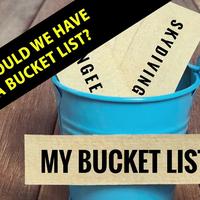
Should we have a bucket list? 6 Minute English - YouTube
Hello. This is 6 Minute English from BBC Learning
English. I'm Neil.
And I'm Sam.
Have you always wanted to learn to dance the
tango, do a magic trick, or skydive? If so,
perhaps you need a bucket list – a list
of all the things you want to do before you
die – that's the topic of our programme.
Bucket lists have been called ‘the greatest
hits of your life' and have helped some
people overcome anxiety and fear of following
their dreams.
But they've also been accused of limiting
the imagination by encouraging people to follow
someone else's idea of the perfect life.
So, what would be on your bucket list, Neil?
Are you a skydiving kind of person?
Not really! Bungee-jumping maybe - as long
as someone checked the elastic rope!
How about you?
One thing I've always wanted to do is swim
with dolphins.
Well, you're not alone there, Sam, because
swimming with dolphins is one of the most
commonly included personal goals on bucket
lists. But which of the following things do
you think tops the list? That's my quiz
question for today. Is it:
a) swimming with dolphins,
b) getting a tattoo, or
c) seeing the northern lights
I'll go for a) swimming with dolphins – one,
because it's something I really want to
do and two, because I've heard so many stories
about how it improves your mental health.
Well, that was certainly true in the case
of blogger Annette White. She listed hundreds
of things she wanted to accomplish - from
learning Spanish to hanging out with penguins
in Antarctica - as a way of improving her
psychological wellbeing. Here she is talking
to Claudia Hammond for BBC Radio 4's
programme, All in the Mind:
You said that you started all this to try
to help you overcome your anxiety –
has it done that?
It definitely has and I feel that the reason
is because that promise to live my bucket
list really continuously pushes the comfort
zone to its limits and beyond it. So every
time I can have a chance to step out of my
comfort zone, a little piece of that fear
of the unknown is removed and replaced with
a little piece of empowerment, and by continuously
doing that, the size of my fear bubble has
gotten smaller.
Annette feels that choosing adventurous goals
for her bucket list helps her step outside
her comfort zone – the situations where
she feels safe and comfortable but where her
ability and determination are not really being
tested.
Moving out of her comfort zone has helped
Annette replace her feelings of fear with
feelings of empowerment – the process of
becoming stronger and more confident, especially
in controlling her life.
Well, that all sounds pretty good to me.
But not everyone is convinced that bucket lists
can really help people like Annette in the
long run. Here's clinical psychologist
Linda Blair to explain why:
I'm not really in favour of bucket lists.
There are a couple of reasons. Most of all,
you're kind of fooling yourself with a bucket
list. We fear death, more than I think we
fear anything else in our existence, because
we can't predict it, and because we don't
know what it's like because nobody comes
back and tells us. And when you create a bucket
list – something to do before you ‘kick
the bucket', the idea that you're giving
yourself is that you can somehow control when
and what death is going to be all about.
We only make sense of our lives at the
end of it. A bucket list takes you away
from the chance to be spontaneous and I think it's
so delicious to be able to say, ‘that's
an opportunity? – oh, I'll do that!'
Linda thinks some people use bucket lists
as a coping strategy to try to control something
uncontrollable – death. In this way they
are fooling - or deceiving - themselves - trying
to make themselves believe something they
know is not really true.
And by having a checklist of adventures to
tick off before they die, people might lose
the chance to be spontaneous – to act in
a natural and impulsive way without planning.
Linda also uses an unusual expression which
gave ‘bucket list' its name in the first
place. A bucket list is all the things you
want to do before you ‘kick the bucket'
– an informal way of saying, ‘die'.
‘Kick the bucket' is an old English expression
that was even used by Shakespeare. It refers
to kicking the bucket away from under the
feet of a hanging man, leaving him to drop
to his death.
Well, anyway, I hope I don't kick the bucket
before I've had a chance to tell you the
correct answer to today's quiz.
Remember, I asked you which personal
goal was most often included in bucket lists?
I said, a) swimming with dolphins
But the actual answer was c) seeing the
northern lights
Well, maybe we could combine the two in a
single trip…
And then get a tattoo! That would be spontaneous!
Today, we've been discussing bucket lists
– lists of all the things you want to do
before you ‘kick the bucket' – an informal
way of saying ‘die'.
Bucket lists can be a great way to feel
empowered – stronger and more in
control of your life, because they take you
out of your comfort
zone – comfortable situations which are
safe but not challenging.
But others think you're fooling – or deceiving
yourself – if you think bucket lists can
really help you control your life. In fact,
they might even make you less spontaneous
– less able to act in natural, sudden and
impulsive ways.
That's all from us for now. Why not go and
make some plans for all the things you'd
like to do in your life?
And start having adventures before we see
you next time here at 6 Minute English from
BBC Learning English.
Bye.
Goodbye.
