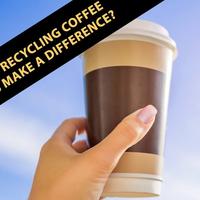
Does recycling coffee cups make a difference? Listen to 6 Minute English - YouTube
Neil: Hello, and welcome to 6 Minute
English. I'm Neil.
Rob: And I'm Rob.
Neil: Now Rob, we've talked before on this
programme about our love of coffee.
Rob: Oh yes, indeed. I couldn't
function without it.
Neil: But have you ever thought
about the environmental consequences
of all those disposable
coffee cups?
Rob: Oh yes, indeed. I always carry
a reusable cup with me so
I don't have to throw one away.
Neil: So if a disposable cup is one
you throw away, a reusable one
is one that you can use
again and again.
Rob: Yes, there is a big problem
with disposable cups in that many
of them can't be recycled,
so there is a lot of waste for something
we only use for a short time.
Neil: What are the big coffee shop chains
doing about this problem? We'll find out a
little bit more shortly, but first,
a quiz for you. Which country
drinks the most coffee
per capita - so not the total amount
of coffee but the average per person. Is it:
a) Japan, b) Kenya, or c) Finland.
What do you think, Rob?
Rob: Ooh, tricky. I don't think the
Japanese are big coffee drinkers
and I know they produce
a lot of coffee in Kenya. I'm surprised the
USA isn't on the list but I'm going to go
with Finland. Just because.
Neil: Well, we'll see if you're right later
in the programme. On a recent BBC You
and Yours radio programme they
discussed the topic of coffee cups.
Some of the big chains are
now charging customers more for
a disposable cup and giving discounts
if people bring their own reusable.
However not all of the shops actually
collect old cups and sort them for
recycling in the shop itself. Here's Jaz
Rabadia from Starbucks. Is the store only
interested in facilities inside their shops?
Jaz Rabadia: It is something that we are
in the process of rolling out and it will
be in all of our stores. It's also not just
our stores in which these cups end up. So
we're doing a lot of work outside
of our store environment to ensure
that paper cups can be recycled
on the go. We're working with our
environmental charity partner Hubbub to
increase recycling infrastructure outside
of our stores because that too is where a
lot of our cups will end up.
Neil: So are they just working in their
stores at improving recycling?
Rob: Well no, after all most people
take their coffee out of the stores,
so they are working
on recycling infrastructure outside
as well. This will be things like
bins and collection
points which are clearly marked
for coffee cups.
Neil: And what about enabling recycling
cups in store?
Rob: Well she said that was something
they are rolling out to all stores.
Rolling out here means
introducing over a period of time.
So it's starting to happen,
but is not finished yet.
Neil: Let's listen again
Jaz Rabadia: It is something that we are
in the process of rolling out and it will
be in all of our stores. It's also not just
our stores in which these cups end up. So
we're doing a lot of work outside
of our store environment to ensure
that paper cups can
be recycled on the go. We're working
with our environmental charity
partner Hubbub to
increase recycling infrastructure outside
of our stores because that too is where a
lot of our cups will end up.
Neil: Not everyone, however, believes
that the coffee chains are doing
everything that they can.
This is Mary Creagh, a member of
the British parliament.
She compares the situation
to that of the plastic bag charge. This was
a law brought in to force shops to charge
customers for plastic bags, which
previously had been free.
Mary Creagh: If you think you're having to
pay extra for something, as we saw with
the plastic bags, we think a similar
psychological measure is needed, a
nudge measure, to encourage
people to remember to bring their
reusable cup with them and
of course this is something
that the coffee shops have been
fighting tooth and nail.
Neil: She thinks that we consumers
need a nudge to help us remember
our reusable cups.
Rob: Yes, we need a nudge, which
is a little push, a reason. In this case,
she is thinking of a law to make
them charge more.
But she says the coffee chains
really don't want this,
they are, she says, fighting it tooth and
nail. If you fight something tooth and nail
you are against it completely
and try to stop it.
Neil: Let's hear MP Mary Creagh again.
Mary Creagh: If you think you're having
to pay extra for something,
as we saw with the
plastic bags, we think a similar
psychological measure is needed,
a nudge measure, to encourage
people to remember to bring their
reusable cup with them and
of course this is something
that the coffee shops have been
fighting tooth and nail.
Neil: Time to review our vocabulary,
but first, let's have the answer
to the quiz question.
Which country drinks the most coffee
per capita? Is it:
a) Japan, b) Kenya, or c) Finland.
What did you think, Rob?
Rob: I took a bit of a guess at Finland.
Neil: Well, congratulations, your guess
was correct. The Finns on average
get through an amazing
12kg of coffee a year, each.
Now, onto the vocabulary.
Rob: We had a couple of related
but opposite words. Something
disposable is designed to be used once
or a few times and then thrown away and
a reusable is designed to be used
again and again.
Neil: We then had rolling out which
in a business sense is the process of
gradually introducing something new.
This could be a new system, new product,
new technology or even a new
way of doing things.
Rob: New ideas often need
new infrastructure. This is usually
physical structures that are
needed to make something work,
for example rail infrastructure
includes tracks, stations and signals.
Neil: A nudge is a small push,
to encourage us to do something.
You don't need a nudge
to carry a reusable coffee cup, do you?
Rob: Oh, no, I'm all for it. In fact
I'd fight tooth and nail to keep
hold of my reusable,
which is quite a coincidence as that
was our last expression today.
To fight tooth and
nail means to make a strong effort to try
to stop something or achieve something.
Neil: Well, that's all from us.
We look forward to your company next
time. Until then, you can find us in all
the usual places on social media,
online and on our app. Just search
for 'BBC Learning English'. Goodbye!
Rob: Goodbye!
