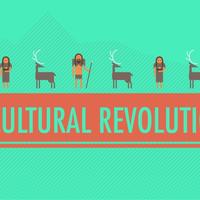
The Agricultural Revolution: Crash Course World History #1
Hello, learned and astonishingly attractive pupils. My name is John Green and I want to
welcome you to Crash Course World History. Over the next forty weeks together, we will
learn how in a mere fifteen thousand years humans went from hunting and gathering...
Mr. Green, Mr. Green! Is this gonna be on the test?
Yeah, about the test: The test will measure whether you are an informed, engaged, and
productive citizen of the world, and it will take place in schools and bars and hospitals
and dorm-rooms and in places of worship. You will be tested on first dates; in job interviews;
while watching football; and while scrolling through your Twitter feed.
The test will judge your ability to think about things other than celebrity marriages;
whether you'll be easily persuaded by empty political rhetoric; and whether you'll be
able to place your life and your community in a broader context.
The test will last your entire life, and it will be comprised of the millions of decisions
that, when taken together, make your life yours. And everything — everything — will
be on it. I know, right? So pay attention.
[theme music]
In a mere fifteen thousand years, humans went from hunting and gathering to creating such
improbabilities as the airplane, the Internet, and the ninety-nine cent double cheeseburger.
It's an extraordinary journey, one that I will now symbolize by embarking upon a journey
of my own ... over to camera two.
Hi there, camera two ... it's me, John Green. Let's start with that double cheeseburger.
Ooh, food photography! So this hot hunk of meat contains four-hundred and ninety calories.
To get this cheeseburger, you have to feed, raise, and slaughter cows, then grind their
meat, then freeze it and ship it to its destination; you also gotta grow some wheat and then process
the living crap out of it until it's whiter than Queen Elizabeth the First; then you gotta
milk some cows and turn their milk into cheese. And that's not even to mention the growing
and pickling of cucumbers or the sweetening of tomatoes or the grinding of mustard seeds, etc.
How in the sweet name of everything holy did we ever come to live in a world in which such
a thing can even be created? And HOW is it possible that those four-hundred and ninety
calories can be served to me for an amount of money that, if I make the minimum wage
here in the U.S., I can earn in ELEVEN MINUTES? And most importantly: should I be delighted
or alarmed to live in this strange world of relative abundance?
Well, to answer that question we're not going to be able to look strictly at history, because
there isn't a written record about a lot of these things. But thanks to archaeology and
paleobiology, we CAN look deep into the past. Let's go to the Thought Bubble.
So fifteen thousand years ago, humans were foragers and hunters. Foraging meant gathering
fruits, nuts, also wild grains and grasses; hunting allowed for a more protein-rich diet
... so long as you could find something with meat to kill. By far the best hunting gig
in the pre-historic world incidentally was fishing, which is one of the reasons that
if you look at history of people populating the planet, we tended to run for the shore
and then stay there. Marine life was: A) abundant, and
B) relatively unlikely to eat you.
While we tend to think that the life of foragers were nasty, brutish and short, fossil evidence
suggests that they actually had it pretty good: their bones and teeth are healthier
than those of agriculturalists. And anthropologists who have studied the remaining forager peoples
have noted that they actually spend a lot fewer hours working than the rest of us and
they spend more time on art, music, and storytelling. Also if you believe the classic of anthropology, NISA,
they also have a lot more time for skoodilypooping. What? I call it skoodilypooping. I'm not gonna apologize.
It's worth noting that cultivation of crops seems to have risen independently over the
course of milennia in a number of places ... from Africa to China to the Americas ... using
crops that naturally grew nearby: rice in Southeast Asia, maize in in Mexico, potatoes
in the Andes, wheat in the Fertile Crescent, yams in West Africa. People around the world
began to abandon their foraging for agriculture. And since so many communities made this choice
independently, it must have been a good choice ... right? Even though it meant less music
and skoodilypooping. Thanks, Thought Bubble.
All right, to answer that question, let's take a look at the advantages and disadvantages of agriculture.
Advantage: Controllable food supply. You might have droughts or floods, but if you're growing
the crops and breeding them to be hardier, you have a better chance of not starving.
Disadvantage: In order to keep feeding people as the population grows you have to radically
change the environment of the planet.
Advantage: Especially if you grow grain, you can create a food surplus, which makes cities
possible and also the specialization of labor. Like, in the days before agriculture, EVERYBODY'S
job was foraging, and it took about a thousand calories of work to create a thousand calories
of food ... and it was impossible to create large population centers.
But, if you have a surplus agriculture can support people not directly involved in the
production of food. Like, for instance, tradespeople, who can devote their lives to better farming
equipment which in turn makes it easier to produce more food more efficiently which in
time makes it possible for a corporation to turn a profit on this ninety-nine cent double cheeseburger.
Which is delicious, by the way. It's actually terrible. And it's very cold. And I wish I
had not eaten it. I mean, can we just compare what I was promised to what I was delivered?
Yeah, thank you. Yeah, this is not that.
Some would say that large and complex agricultural communities that can support cities and eventually
inexpensive meat sandwiches are not necessarily beneficial to the planet or even to its human
inhabitants. Although that's a bit of a tough argument to make, coming to you as I am in
a series of ones and zeros.
ADVANTAGE: Agriculture can be practiced all over the world, although in some cases it
takes extensive manipulation of the environment, like y'know irrigation, controlled flooding,
terracing, that kind of thing.
DISADVANTAGE: Farming is hard. So hard in fact that one is tempted to claim ownership
over other humans and then have them till the land on your behalf, which is the kind
of non-ideal social order that tends to be associated with agricultural communities.
So why did agriculture happen?
Wait, I haven't talked about herders. Herders, man! Always getting the short end of the stick.
Herding is a really good and interesting alternative to foraging and agriculture. You domesticate
some animals and then you take them on the road with you. The advantages of herding are
obvious. First, you get to be a cowboy. Also, animals provide meat and milk, but they also
help out with shelter because they can provide wool and leather.
The downside is that you have to move around a lot because your herd always needs new grass,
which makes it hard to build cities, unless you are the Mongols. [music, horse hooves]
By the way, over the next forty weeks you will frequently hear generalizations, followed
by "unless you are the Mongols" [music, hooves].
But anyway one of the main reasons herding only caught on in certain parts of the world
is that there aren't that many animals that lend themselves to domestication. Like, you
have sheep, goats, cattle, pigs, horses, camels, donkeys, reindeer, water buffalo, yaks, all
of which have something in common. They aren't native to the Americas. The only halfway useful
herding animal native to the Americas is the llama. No, not that Lama, two l's. Yes, that llama.
Most animals just don't work for domestication. Like hippos are large, which means they provide
lots of meat, but unfortunately, they like to eat people. Zebras are too ornery. Grizzlies
have wild hearts that can't be broken. Elephants are awesome, but they take way too long to
breed. Which reminds me! It's time for the Open Letter.
Elegant. But first, let's see what the Secret Compartment has for me today. Oh! It's another
double cheeseburger. Thanks, Secret Compartment. Just kidding, I don't thank you for this.
An Open Letter to elephants.
Hey elephants, You're so cute and smart and awesome. Why you gotta be pregnant for 22 months? That's
crazy! And then you only have one kid. If you were more like cows, you might have taken
us over by now. Little did you know, but the greatest evolutionary advantage: being useful to humans.
Like here is a graph of cow population, and here is a graph of elephant population. Elephants,
if you had just inserted yourself into human life the way cows did, you could have used
your power and intelligence to form secret elephant societies, conspiring against the
humans! And then you could have risen up, and destroyed us, and made an awesome elephant
world with elephant cars, and elephant planes!
It would have been so great! But noooo! You gotta be pregnant for 22 months and then have
just one kid. It's so annoying!
Best wishes, John Green.
Right, but back to the agricultural revolution and why it occurred. Historians don't know
for sure, of course, because there are no written records. But, they love to make guesses.
Maybe population pressure necessitated agriculture even though it was more work, or abundance
gave people leisure to experiment with domestication or planting originated as a fertility rite
- or as some historians have argued - people needed to domesticate grains in order to produce more alcohol.
Charles Darwin, like most 19th century scientists, believed agriculture was an accident, saying,
"a wild and unusually good variety of native plant might attract the attention of some
wise old savage." Off topic, but you will note in the coming weeks that the definition
of "savage" tends to be be "not me."
Maybe the best theory is that there wasn't really an agricultural revolution at all,
but that agriculture came out of an evolutionary desire to eat more. Like early hunter gatherers
knew that seeds germinate when planted. And, when you find something that makes food, you
want to do more of it. Unless it's this food. Then you want to do less of it. I kinda want
to spit it out. Eww. Ah, that's much better.
So early farmers would find the most accessible forms of wheat and plant them and experiment
with them not because they were trying to start an agricultural revolution, because
they were like, you know what would be awesome: MORE food!
Like on this topic, we have evidence that more than 13,000 years ago humans in southern
Greece were domesticating snails. In the Franchthi Cave, there's a huge pile of snail shells,
most of them are larger than current snails, suggesting that the people who ate them were
selectively breeding them to be bigger and more nutritious.
Snails make excellent domesticated food sources, by the way because
A) surprisingly caloric B) they're easy to carry since they come with
their own suitcases, and C) to imprison them you just have to scratch
a ditch around their living quarters.
That's not really a revolution, that's just people trying to increase available calories.
But one non-revolution leads to another, and pretty soon you have this, as far as the eye can see.
Many historians also argue that without agriculture we wouldn't have all the bad things that come
with complex civilizations like patriarchy, inequality, war, and unfortunately, famine.
And, as far as the planet is concerned, agriculture has been a big loser. Without it, humans never
would have changed the environment so much, building dams, and clearing forests, and more
recently, drilling for oil that we can turn into fertilizer.
Many people made the choice for agriculture independently, but does that mean it was the
right choice? Maybe so, and maybe not, but, regardless, we can't unmake that choice. And
that's one of the reasons I think it's so important to study history.
History reminds us that revolutions are not events so much as they are processes; that
for tens of thousands of years people have been making decisions that irrevocably shaped
the world that we live in today. Just as today we are making subtle, irrevocable decisions
that people of the future will remember as revolutions.
Next week we're going to journey to the Indus River Valley - whoa - very fragile, our globe,
like the real globe. We're going to travel to the Indus River Valley. I'll see you then.
Crash Course is produced and directed by Stan Muller. Our script supervisor is Danica Johnson.
The show is written by my high school history teacher, Raoul Meyer, and myself, and our
graphics team is Thought Bubble.
If you want to guess at the phrase of the week, you can do so in comments. You can also
suggest future phrases of the week. And if you have a question about today's video, please
leave it comments where our team of semi-professional quasi-historians will aim to answer it.
Thanks for watching, and as we say in my hometown, Don't Forget To Be Awesome.
