Nick: Last time Wendy and I talked about Belgrade and the trips that we've made there. And one of the things that we did on this most recent trip was we took three different walking tours, uhh, while we were in the city, right?
Wendy: Yeah, three tours in five days, so that was a pretty good record.
Nick: And so in Belgrade like in many other cities around Europe, uhh, there are companies that offer walking tours, and so they often offer a free tour, uhh, and that kind of gets you in, uhh, gets you to know about the company and about their guides and then they offer other tours that you can pay for. And so that's what we did, uhh, we decided to take a free walking tour just of the downtown area of the city one day, which lasted for about two-and-a-half to three hours, and then we took two more tours, uhh, with the same company.
Wendy: Yeah, and they were all really good. I was really pleased with them and I learned a lot about the city and about the history of the country and saw a lot of interesting things.
Nick: And I think Belgrade is really a good city for these walking tours, because as we talked about, it's not an incredible city for sights. It's not like Rome or Paris or these kind of places, so in order to really appreciate the city and to get the most out of your visit, umm, it's really important to know about the city's history and things like that and I think, you know, we did that.
Wendy: Yeah, yeah that's very true. And a lot of the things that we saw on those tours were really quite hidden. I mean, one of the tours was actually an underground tour of Belgrade, so all of the things were under the ground, uhh, so you wouldn't have just stumbled upon them by accident if you were just wandering around the city on your own.
Nick: Right, so we did just a general walking tour of the city, uhh, and then we did these two specialised tours. The first one was the communist tour and the second one was, like you said, this underground tour. So, the communist tour was really interesting. We went with a guide - her name was Jovana - and basically she took us around the different sights in the city that related to the communist era and essentially it was … the whole tour, more or less, was about Tito, who was the ruler of Yugoslavia for about 35 years. And so he's this enormous figure in the history of the region, umm, and so we got to see a museum which is kind of a shrine to Tito, with all of these, uhh, things that he'd collected and gifts that people had given him and things like that. So that was quite interesting.
Wendy: Yeah, and it's also his grave site, he's buried there. So I think, uhh, our tour guide told us that it is the most visited museum in all of Serbia and I believe that's why, or I know that's why, because I asked her, you know, why … “Who's coming here?” Because I don't think that, you know, us for example, foreign tourists, I don't think it would be the first museum that we would want to visit in this country or in this city necessarily, but she said it's mostly people from former Yugoslavian nations, uhh, elsewhere in the Balkans and that it … for many of them it's a very emotional experience to visit his grave and a lot of them start crying when they come there.
Nick: And it's quite interesting because in general, throughout the city, there aren't monuments anymore to Tito and she made a point of telling us that. But at the museum there are a couple of statues, uhh, of Tito, and obviously a lot of other things as well. But in general all the streets that were named for him have been renamed, umm, and there's no, sort of, umm, you know … there's no other way to really remember him just in your daily lives but if you come to this museum then you have everything that you want in terms of Tito, right?
Wendy: Yeah, yeah.
Nick: And so it was quite interesting, not just for that museum but also for a few other things. You know, Yugoslavia was a communist country but it wasn't part of the Eastern bloc of the so-called Warsaw Pact countries and so it existed during the Cold War in this sort of strange place between the East and the West and it was the only country that existed in this space.
Wendy: Umm-hmm.
Nick: And so one of the things that she told us was that the other communist countries were jealous of Yugoslavia because they saw it as a communist paradise and that it had some of the benefits of communism but it didn't have the tight control, uhh, certainly that the Soviet Union had and the other countries that were under the influence of the Soviet Union. And so it's really interesting in that way to think of it as, maybe, communism somewhere closer to what it could have been or should have been rather than what we saw in other countries.
Wendy: Yeah, it sounds like it really worked pretty well there. Uhh, economically they were very strong because they were trading with both sides, with, you know, Western powers - the United States and European powers - and then also with the Russia, well with the Soviet Union. So it seems like they were doing pretty well economically, although she also said that they were basically living on debt, and so the country was spending more money than it had and in the end that caught up with them and there was massive inflation later on, so I guess it wasn't really a utopia but it kind of seemed like it at the time.
Nick: Another thing that Jovana said that was really interesting was that the Yugoslav passport was considered perhaps the most valuable in the world or certainly according to her, but basically because if you were from Yugoslavia you could walk from East Berlin to West Berlin, uhh, without any special passports or anything, just showing your passport, because Yugoslavia was friendly again with both the East and the West.
Wendy: Yeah, yeah, I thought that was really interesting.
Nick: And it's especially, I guess, sad for us because we have friends who are from that area and one in particular, and she has a Serbian passport and a Montenegrin passport and she's having a lot of trouble, uhh, getting visas, and getting visas to the United States, where her husband is from, even though they're married. So it seems like her passport is not very valuable, umm, even only a few decades after this extremely valuable passport that she would have had if she was living at that time.
Wendy: Yeah it's interesting how all the geo-politics have changed since then.
Nick: And so the next tour that we went on, which was also with Jovana - the same guide - uhh, the next day, was this underground tour that you mentioned before. And this was also really interesting, because it wasn't like the communist tour where everything had a similar theme. It was these different sites but what brought them together was that everything was underground. And also it was quite a hot day in Belgrade that day and so it was nice to go underground where it was a little bit cooler.
Wendy: Yeah.
Nick: Umm, so the first thing we saw was a military bunker, and this was built in 1948, so it was early in Tito's reign because at that time Yugoslavia was a bit afraid of the Soviet Union. Uhh, they hadn't really established themselves as this in-between country yet, and so they built this bunker for their soldiers which is in the fortress of Belgrade, just, uhh, in case something happened.
Wendy: Yeah and it .. well they also had anti-aircraft guns that they could control from the bunker, uhh, because they were .. Tito was afraid of being attacked by Stalin because there was a certain period in history where there was actually quite bad relations between, uhh, Yugoslavia and the Soviet Union, and he was afraid of being attacked. Uhh, so that was the original purpose of the bunker. It was built in 1948, so after World War II, umm, but it was because of this tense period, uhh, between Yugoslavia and the Soviet Union.
Nick: And actually it was only discovered or it was only announced by the military to the people in 2008, uhh, so that was only just a few short years ago. But it was just sitting there, basically, underneath the fortress but they covered it over with grass and you couldn't see the entrance and finally it was … the army realised it really served no purpose anymore so there was no point hiding it anymore so they announced that it existed and now you can go and visit it.
Wendy: Yeah.
Nick: And the next thing we visited underground was, uhh, a cistern, which is a type of well for getting water, and it's dated from the Austrian, or Austro-Hungarian period, I think in the 1800s, and that was also quite interesting because it was extremely deep…
Wendy: Umm-hmm.
Nick: About 60 metres deep, more or less, and you can really look down, look into it and see the water all the way at the bottom.
Wendy: Yeah, and there are spiral staircases, two spiral staircases that allow people to go all the way down to the bottom and pick up the water. You're not allowed to go down the staircases now, they aren't safe anymore, apparently, but, uhh, it was still beautiful and interesting to see.
Nick: And they called it the Roman Well because they thought it was so old at one point, they thought, “Oh it must have been Roman,” but of course it wasn't, it was much later than that.
Wendy: Yeah.
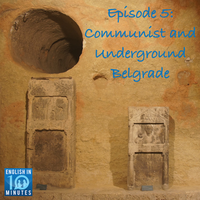
Nick: And then my favourite thing that we saw was this, uhh, another kind of cave which was storage for gunpowder, also during the Austro-Hungarian period, but there are a lot of Roman tombstones and Roman sarcophagi inside there as well, so it was really atmospheric.
Wendy: Yeah, and apparently that was a nightclub for many years, which I find hard to believe that they would allow people to dance and drink, you know, right around all of these ancient ruins, but apparently they didn't really get damaged, so that's good.
Nick: And according to Jovana again it was the number seven rated nightclub in the whole world, uhh, at one point, but then they've closed it down now because they realised the value of the site as a heritage site. And so then finally we finished off in a wine cellar, which was also in a cave, and we had a nice glass of wine to finish off the tour.
Wendy: We did, and that was a great way to end, I thought.
Nick: Indeed, and so that's, uhh, some of the things you can do if you go to Belgrade.
