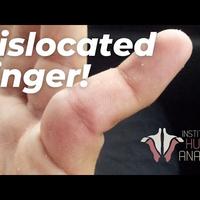
WATCH: Relocating My Patient's Finger
Welcome to The Anatomy Lab everyone. Today we're going to talk about some of the most commonly
dislocated joints in the human body. Now, shoulder is definitely up there but right next to that
are the fingers. And unfortunately, I had an 80 year old patient who dislocated one of her fingers
but, in all of her pain, she was kind enough to let me record me popping it back into place. So,
we'll let you see that and obviously discuss some of the relevant anatomy and other things
you need to consider when it comes to finger dislocation. So, let's jump right into this.
So, in order to help us with this finger dislocation discussion,
we are going to utilize Geoffrey, the real human skeleton. He's so excited to be back on camera,
then we'll move to an actual cadaver hand to show you some other relevant anatomy when it comes to
popping things back into place. But Geoffrey's skeletal hand here we're
going to use is the right hand. This is about the same position my hand is in forgive. My little
rock climbing wound there but again, the position of Geoffrey's hand here. Now, some of the relevant
bones that we're going to talk about where I'm laying the probe, these are called the metacarpal
bones and there's five of these and they would be found essentially in the palm of your hand.
Now, the thumb one's a little shorter and that's the first metacarpal bone
and you can see that here and we have one, two, three, four and five. And then the bones of the
digits or the fingers - most of us have a pretty good idea that the majority of our fingers or
digits have one, two, three phalanges with the thumb only having - let me get that in camera,
one and two and you can again see that on - grab that there Geoffrey, one and two.
Now, this whole idea of these joints or these dislocations comes from understanding these bones.
Now, let's name some of the joints but I just want to give you guys a quick definition
of a joint. Now, in Grey's Anatomy, and I have to clarify, I'm not talking about the TV show, I'm
talking about this thick grey's anatomy medical book that's been around way before the TV show
but it has a definition about joints and it says joints are simply the meeting places of bones.
So, our two bones just touch each other. So you can see we'd have a joint here, a joint there,
a joint there - there are so many joints even in the wrist that you could find here. But the
relevant joints are going to be here, here and here. And this first joint, because it's between
a metacarpal and a phalange, crazy name, they call it a metacarpophalangeal joint or an MCP joint.
The joints within the actual finger, moving from the MCP joint down to these joints,
because these joints are between two phalanges, say here and here, they would call this joint an
interphalangeal joint. But then there's another interphalangeal joint a little bit further down.
So, they distinguish between the one that's closer versus the one that's further. The word for closer
to the point of origin in anatomy is called proximal, the word for further is distal. So,
simply put they call this one - or the PIP joint and then this one down here would be called
the distal phalangeal joint or the DIP joint. Now, there are some of those joints that are
more commonly dislocated than others and the one that tends to be the most commonly dislocated
is this PIP joint in either one of those fingers there and that's the joint that
my 80 year old patient actually dislocated. So, let's jump over to another cadaver dissection
to kind of fully understand what I had to do to help this patient out. So now that we've taken
a look at the bones and the joints on Geoffrey, let me show you the back side of a real human hand
to go over some other tissues that could be affected or related to a finger dislocation.
So, here's the back side of a right hand, kind of the equivalent of my hand here. You can see
my knuckles or these are my MCP joints we talked about just a second ago and there
are the MCP joints on the cadaver. But, what we really want to focus on are these tendons
on the dorsal or the back side of the hand and they would extend down into each individual
finger here and they came from these muscles that are up in the back side of the fore arm.
One other thing we have to mention is Cornelius back here. Cornelius is our plastic skeleton,
what we like to refer to as our synthetic skeleton. He's named after the chimpanzee
in the Planet of The Apes movie, the original - one was the best ending of all time in the 70s,
it's amazing, watch it. But, back to the whole idea here, he has donated his hand for us to
take a look at here and it's much better for us to use a plastic skeleton that is put together with
strings than trying to move Geoffrey's real bones into all sort of different contorted positions.
So, let's talk about a couple of different types of joint dislocations. So again, to orient you
- this is the back side of a right hand. Here are our metacarpal bones and then here are all of the
phalanges. Now, the most commonly dislocated joint is the PIP - that proximal interphalangeal joint
here. Now, the question we have to ask ourselves is which way does it dislocate? Does it go
dorsal, like so, or does it go more volar, which would be towards the palm of the hand like so?
No way you can get a good look there, so dorsal versus volar here. Now,
most commonly they go dorsally and dorsal dislocations are associated with, I guess,
less collateral damage. You don't get quite as much soft tissue injuries involved with dorsal
dislocations because you have to imagine that there are collateral ligaments on either sides
of these joints to help hold the bones together and often times when they go in this direction,
it tends to tear some of the tissues on the anterior aspect of the finger under here
and sometimes it'll even get what they call an avulsion fracture or pull a piece of the bone off.
So, what are some of the other things you need to consider besides the bone just being out of place
with finger dislocations? Well, I hinted at this a little bit earlier but are there some associated
fractures? And that's why we'll often get an x-ray in the clinic to confirm that. And what
are the other surrounding tissues behaving like? Remember these tendons on the back side of the
hand here and in the case of that dorsal dislocation where the bone comes back
and like so, those tendons and those muscles that are upstream could be
pulling and contracting this direction like so and holding that bone in the dislocated position.
Some people who have tried to pop their joints back into place without going to the
doctor's office or into the clinic often report that their muscles are so tight that they just
can't get it to go back into place, and we'll talk about that when we talk about
reducing the joint or popping it back into place. Now, one of the other things we want to talk about
is pain. Now, obviously it's going to be painful. You see in the movies all the time people will be
like "Oh, I just pop that thing back into place" or pop that shoulder back into the place - no pain
medications required and frankly, it does happen. I have had friends during basketball where they've
come up to me and it's a clear dorsal dislocation, they're just like "Get it back into place". And in
the cases where you know, there's a very small risk of fractures or other associated like - I
guess you could say collateral damage, we've got the finger back into place and they bend it,
they tape it up and they get back in the game. Now, in the case of the lady that I'm mentioning,
the 80 year old patient, I asked her "Do you want me to give you what we call a nerve block?"
and I'll explain what a nerve block is on this hand right here. A nerve block
is associated with these nerves that I'm pulling up, these string like things you can see here.
So, we've got two of these strings or nerves coming down here and they're going to run down
both sides of the finger. We call them digital nerves - there's technically dorsal digital nerves
and proper palmar digital nerves and what happens is we actually will stick a needle of
lidocaine into the web spaces and so you guys have all had the web spaces in your fingers
right there. And what we do is we'll inject and as we push through, we are injecting the lidocaine as
we go deeper and deeper, deeper through the soft tissue in those spaces to completely bathe these
digital nerves that are going down the side of the finger so the whole finger essentially gets numb.
So when it comes to popping the joint back into place or reducing it, that's the technical term
for popping it back in place, a joint reduction - if it's a dorsal dislocation, we have a specific
protocol compared to a volar dislocation like so. So, a dorsal dislocation we would put slight
hyperextension on the joint and then pull forward traction and slide it into place.
Now, think about why that's important to put it into slight hyperextension - that's to put less
tension on those tendons that could potentially be freaking out back here. If these tendons have any
tension on them from the muscles up this direction and pulling the finger back like so or pulling
it further into dislocation, you'd want to put it into a position where you get less tension
on that. And doing that slight hyperextension kind of puts slack in the tendon - you could
think of it like that way, and then so, we've come here and then slide it forward.
If it's a volar dislocation, you'll do a little bit of flexion because you have tendons on the
other side and that would help put less tension on those other tendons and then slide it forward.
So, enough about me showing this on the actual skeleton in the cadaver, let's show
you what I did with the patient and see what she thought about the shot and how it worked out.
Okay are you ready? - I'm ready.
- Okay. So, it's a dislocated PIP joint in her middle finger here - dorsal dislocation
where the middle phalanx is on top of the proximal phalanx. So, what we're going to do
just provide some traction, some hyperextension and that was really easy actually.
Bend your finger for me. - I still prefer the shot.
[Laughter] - So, as you can see, she would definitely recommend the nerve block to
anybody who's getting their joint reduced or their finger pop back into place. You could
also see she got her full range of motion back in that finger. Now, patients will often get a
splint for comfort and protection and the timing or how long they'll be in the splint will depend
on the severity of the dislocation. Now, if we're ever knocking on the
door or suspicious of tendon ruptures or avulsion fractures again, where a piece of the bone gets
pulled off by a tendon, those patients will often get referred to a hand specialist or orthopedics
where they will consider some surgical procedures or repair because you don't
want to mess around with these hands because they're magical and they do a lot of things.
Thanks for watching everyone and as always, it's time for my shameless plug for support for the
channel. If you like anatomical artwork, you can see it behind me, we'll put that
link in the description. We again always have our snazzy Institute of Human Anatomy t-shirts. Like,
if you feel like it, subscribe, blow up that comment section below and in the meantime,
while you're typing like crazy, protect those fingers and we'll see you in the next video.
