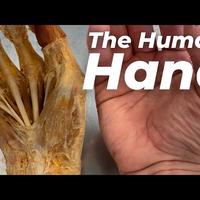
The INSANE Complexity of the Human Hand
This video is sponsored by Brilliant.
Find the link in the description below.
Do you have any idea how incredible it is that you are effortlessly able to wiggle your
fingers like that?
Think about this for a moment.
How many muscles are pulling on tendons which are yanking on bones which are moving your
digits?
Think about the ligaments that are attached to those bones preventing the bones from just
flying out of place as you wiggle your fingers.
The hand is amazingly complex and that's why in today's video, I wanna show you the various
tissues and structures that are involved with this incredible gripping machine.
It's gonna be a fun one.
Let's do this.
First and foremost, I wanted to give a quick heads up about the content of today's video.
Now, obviously, this is gonna be on the hand which means I'm going to be showing a lot
of the human hand on the cadavers and it's been my experience here in the lab that seeing
fingertips and fingernails specifically tends to evoke some strong emotions from a lot of
different types of people and I think it's because the fingertips are not abstract.
Meaning, you don't see a brain or the liver or the kidneys or the heart off if ever at
all but you see your fingertips and fingernails every single day.
So, it's much more real.
So, the reason why I'm bringing this up is because if this is not something you wanna
see or if you like, as you're watching the video and you realize you don't wanna continue
watching, I'm not gonna be heartbroken, I completely understand but I did just wanna
give a fair warning ahead of time but if you're ready, let's go ahead and check it out.
Let's start off by discussing the bony anatomy of the hand and just the sheer amount of bones
inside of the hand itself and luckily for us, we have Jeffrey to lend us a helping hand,
specifically his left hand and as you can see, we're looking at a palmer view of the
left hand as you compare it next to mine.
But I want you to understand there are 27 bones in just from the wrist down to the fingertips.
You have eight carpal bones.
You have five metacarpal bones.
These are the bones that are just deep to your palm and then you have 14 individual
phalanxes.
That's these individual bones inside of the digits.
Now, there is some differences because you have three phalanxes in these four digits
but only two phalanxes inside of the thumb and that might make you think that the thumb
is more simple than the other digits which I guess is kind of true in terms of joint
quantity but in terms of capability and movement, the thumb is gonna be a lot more interesting
than the other digits but we need to discuss the joints involved with moving all of these
bones because a joint is described as the location where two or more bones are basically
just interacting or articulating with one another and what we can see here is when if
you have 27 bones, you're gonna have a lot of joints.
There is a huge amount of joints just between these eight carpal bones but if we focus more
on the ones that we can see the movement like the metacarpophalangeal joints, and that sounds
like a mouthful, metacarpophalangeal.
That's really easy actually.
It's the location where the metacarpal bones are meeting the phalanges but no one wants
to say metacarpophalangeal so everyone just says "MP joints".
Then beyond that you have the interphalangeal joints.
The interphalangeal joints are really again, we're just gonna say IP joints but you're
gonna have two of them in these digits but you're only gonna have one of them in the
thumb itself.
Now, that's a lot of joints and they're capable of a wide variety of motions and you can just
wiggle your fingers to be able to see all of those but the one that whenever I bring
up like actions of the hand or if I ask my students, "hey, what makes the hand so unique?"
The thing that most people are bursting at the seams to say is having an opposable thumb.
What does that mean?
Opposable thumb.
Well, it means that you are in opposition to your pinky and ring finger.
So, you're able to do this.
Right?
You can literally swing the thumb out and then bring your ring finger and your pinky
finger to meet them.
Now, I mean you can do that with the other but in reality, opposition is truly classified
by just being these two - meeting these two digits right here and you may be wondering
what's so special about wrapping your thumb around?
Well, it gives the hand what's called a prehensile adaptation.
So, prehensile is really just a fancy way of saying, gripping, grasping.
It's an appendage that's capable of reaching out and literally wrapping around something.
So, a monkey's tail would be another example of a prehensile appendage but your hand is
capable of grabbing and manipulating a wide variety of things.
Now, it primarily evolved and adapted to life in trees, grabbing branches, but what's cool
is your hand and over millions of years, we've gotten used to actually manipulating tools
as well.
Believe it or not, your hand does not just exist in the way that it is to hold your phone,
right?
Your hand is actually there for climbing, manipulating, and just grabbing tools to perform
tasks.
I mean, just think about typing on a keyboard for instance.
Think about holding a hammer, your hand, the ability to oppose is very, very important.
So, there's a reason why people are talking about this opposable thumb and the way that
they do but if we're talking about generating that movement and the muscles that are there,
well, we're gonna need to take a look at a different cadaver to pull that off.
So, let's jump over to another cadaver to check that out.
You are looking at a right upper limb.
So, if I kinda show this, you can see where we've cut the clavicle.
We have the scapula still here.
The entire brachium and humerus.
We have the antebrachium or the arm and then that gives us the right hand.
So, you're looking at here the dorsal side of the hand and you can just see the incredible
amount of tendons that are traversing in there and if you look closely in between those tendons,
you can also see some muscle tissue.
I can rotate it over and you can see those fingertips and fingernails and you can also
see the incredible nature of the palmer side of the hand.
Now, when we're talking about muscles that move the hand, we have to quickly distinguish
between what are called extrinsic muscles and intrinsic muscles.
Extrinsic muscles are just gonna be muscles that move your hand but are going to be outside
of the hand.
Intrinsic muscles are muscles that move the hand that are inside the hand.
So, if we show that here, look at the muscles of the forearm.
In just the forearm alone, right?
Between the posterior and anterior compartment, you have 20 muscles in this area.
These are what are called extrinsic muscles.
Not all of them because of the 20 that are in your forearm, 15 of them are going to actually
move the digits or the wrist in some capacity.
So you have 15 of the 20 total here, extrinsic muscles that move the hand.
Then inside of the hand, so looking closely, you can see several muscles in here, there
are going to be 11 total muscles inside of the hand or intrinsic hand muscles that move
the digits and so that gives you a grand total of 26 muscles that move the hand or wrist
the digits in some capacity.
Now, you may also be wondering, well, what's keeping the bones, those 27 bones from just
flying all over the place and that's gonna be ligaments.
Now, unfortunately, we can't see many ligaments here but you can see a couple like the transverse
carpal ligament here which is going to be important for the carpal tunnel but I've seen
different numbers from different texts suggest that inside of the hand, that would be super
deep down inside of here, you are going to have over 100 ligaments that are keeping all
27 of those bones together to prevent them from flying all over the place as you are
contracting all of these muscles.
Now, the reason why I say it's around or it's over 100 and I can't give you an exact number
is because it kinda depends on how you classify the ligaments, but if we just settle the fact
that it's over 100, that's a pretty safe thing to bet on.
But one of the cool things is muscles are actually gonna be different than tendons.
So, you're looking at tendons here that their muscle bellies are gonna be located up here
in the forearm.
So, you have, yes, you have 26 different muscles that are going to be moving the hand and then
that also means that you're gonna have these tendons that are going to be traversing and
going all around through here as well.
So, absolutely incredible.
Now, in terms of making those muscles work, you have to have nerves going to those muscles
and for the hands, you have three nerves that basically go to the entirety of the arm more
or less and that's gonna be the median nerve, which - I did an entire video pretty much
devoted to the median nerve cuz that's important for carpal tunnel syndrome so you should definitely
go check that out.
Then, you have the ulnar nerve which Jonathan did a video all about that one which is commonly
described as being the funny bone if you hit its exposed area here in the elbow but then
there's another nerve called the radial nerve and the radial nerve is really awesome because
it goes like the entirety of the backside of your upper limb but I want you to think
about this.
You have the radial nerves supplying all of these muscles causing them to contract and
move back and forth and then you have the median and ulnar nerve that's in charge of
all of these muscles and then what's happening is these nerves, they just start branching
and branching and branching innervating the skin as well as the various muscles that are
going to be inside of the hand.
Absolutely incredible.
Now, another thing to focus on is going to be adipose or fatty tissue.
Now, we've removed all of that.
Let's get this nice and close so you can see in the palm here but there was a considerable
amount of adipose tissue here in the palm and that probably would make sense to you
that you would need adipose tissue here for gripping as if post to like think of how little
adipose tissue is going to be on this dorsal side of the hand 'cuz I don't know about you
but I'm not gripping things with the back of my hand.
I'm like trying to warp it.
That just doesn't make sense.
It makes sense that you would need to have adipose tissue on the palm or surface of the
hand in order to provide some cushion as you're gripping things.
Speaking of grip, we need to discuss something called fingerprints.
Now, I'm sure you know exactly what fingerprints are and you can go ahead and look at the fingerprints
on your own hands
Now, it's been commonly taught and described that fingerprints help to improve grip and
I'm sure there is some of that involved in its function but if you remove the finger
prints, it's not as if you can't grab anything.
Remember, grip is primarily a product of being prehensled and been able to actually grasp
and wrap around and then pinch, right?
That's where the most of that grip is going to happen but fingerprints are what are called
friction ridges.
So, they're definitely going to gives some kind of improvement to your gripping ability
but another hypothesis that personally makes more sense to me is that fingerprints are
actually there in order to help improve your textural sensation.
So, if you're like running your fingers over the surface of say like wood or plastic, you
can better understand what those feel like and just get a better understanding of the
overall feel.
That to me makes a whole lot more sense for fingerprints but another thing you'll also
find on the hand that you don't really find in various other places in the body is extreme
sensation.
I mean, there are some other places such as the lips and the genitals for instance but
the sheer amount of actual nerve endings located in your fingertips is obscene and that's because
your hands are what you go around analyzing your environment with.
It makes complete sense.
I don't know about you but it's like, if I want to see how something feels, I don't rub
my knee across it, that just really doesn't make much sense.
So, again, you're gonna have a ton of nerve endings located inside of your hand.
Next, let's talk about fingernails because a lot of people think the fingernails exist
in order to like scratch and claw but that's not really the case.
Let's go ahead and look at the fingernails here.
So, you can see the fingernails like so on this cadaver.
Now, what they do is they actually provide a strut So, I'm pressing against the opposite
side of the thumb here and as I do that, picture like if the cadaver was pinching with these
digits here.
When that happens, the fingernails provide an actual resistance to that force, right?
It's like this rigid resistance on the other side of the force being applied.
It makes it easier to pick things up.
That's the purpose of your fingernails.
I mean, don't get me wrong, they're nice to be able to scratch.
They're nice to be able to - if you need to claw your way out of a situation, to do that
but the real purpose is there to provide resistance as you are grabbing and picking up things.
And then, we also have what are called palmer flexion creases.
So, I'm actually gonna take off my gloves in order to show you this but I mean, you
can look at your own hands but as you go like this with your hands, you're gonna notice
that you're gonna have creases forming in your palms.
You're gonna see also on the palmer side of the digits.
These creases actually occurred in utero.
So, when you're developing inside of mom.
So basically, they exist by the tissue, the skin adhering to the tissue underneath so
that when you go like this, the skin doesn't just bunch up, right?
That would not be good if your skin is just bunching up as you're gripping and grasping.
That's not gonna make for an effective grip.
So, these creases exist to kinda keep the skin just attached down underneath so you
can go like this without bunching.
The hand is just absolutely incredible and believe it or not, this was a very, very broad-level,
high-level overview of the complexity of the hand.
There's so much more detail that we can really go into but that'll be for another video at
another time.
But one thing I do want to talk about is something I hear all the time is that the hand is so
complex that there's no way that nature could have evolved it, right?
Like this is - there's no way this could be a product of the evolutionary process and
I want you to understand that while the hand is definitely complex, I mean, the entire
video has been around its complexity, I want you to understand if you actually break down
the individual components, it's extremely simple.
So the hand is simultaneously simple and complex.
The fact is it evolved over millions of years out of necessity.
It's more just one tiny little adaptation at a time.
Tiny little adaptation at a time and when you add that together, you get this really
cool machine.
So, nature can very, maybe I shouldn't say easily but it's definitely within the realm
of possibility and obviously, it has happened for nature to engineer such an incredible
thing.
It's not as though all of the amazing complexity just randomly fell into place and all of a
sudden, you just have this graspy clawy thing.
It's really the product of tiny, little adaptations that all just accumulated together to make
this thing that once again you can hold your phone with.
If you're anything like me, then the word "complexity" can come with some complex emotions.
Well, it's probably obvious to most people that the world around and inside of us is
pretty complex.
We're always hoping to find an easy way to help navigate that complexity if not outright
simplify it.
When I was going through school, even if I was interested in the subject, I was always
trying to find a way to package and classify it so that I could wrap my mind around it
easier when necessary.
And that's why I'm such a big fan of today's sponsor, Brilliant.
Brilliant is an interactive online learning platform for STEM subjects.
That is math, logic, science, and computer science and Brilliant fully understands just
how complex Stem subjects can be which is why they've made it their mission in life
to help you navigate that territory appropriately.
Take their newly redesigned course, Calculus in a Nutshell for example.
Instead of being completely overwhelmed on day one, you can dip your toes into the pool,
so to speak, and get a great overview of the subject that will allow you to dive deeper
with our other courses in no time at all and you'll be learning with interactive visualizations
and challenges which is much more fun and engaging than your typical calculus textbook.
If you're interested, visit Brilliant.org/IHA or you just click the link in the description
below and the first 200 people there will get 20% off their annual subscription.
Thanks for watching everybody and I will see you in the next video.
