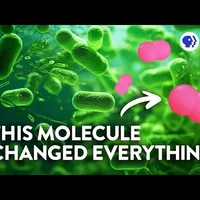
The Deadly Chemistry That Made Life Interesting - YouTube
- Hey, Smart People. Joe here.
There's been life on this planet
for at least 3.7 billion years.
But for most of that time,
life was really, really, really boring.
It was all just simple little cells squirming
around in water.
No cute furry things.
No weird bugs.
No trees. (alarm buzzes)
Just microscopic blobs blobbing.
And then, around half a billion years ago,
after about 3 billion years of boring,
something amazing happened.
Life exploded into all kinds of interestingness.
Worms.
Trilobites.
A five-eyed sea-creature called Opabinia.
And countless other complex lifeforms.
I mean, out of nowhere, life on Earth began a new chapter.
It's hard to put time scales like these into perspective.
If the history of life were a single day,
and life began at midnight,
life didn't get interesting until around 10:30 PM.
And that explosion of interestingness took place
in less than an hour on our history-of-life clock.
But why didn't life just stay boring?
What changed?
When we typically think of natural selection,
the process by which organisms evolve, change, and adapt,
we think of this gradual thing
that happens over huge time periods.
But that's not what happened here.
The ancestors of all life's complex creatures showed up,
the variety of life on Earth exploded like that.
And that's because, right before that explosion,
a new kind of chemistry entered the equation.
A chemistry that, in excess, could spell certain death,
but in the right doses was about to set the stage
for life as we know it today.
Understanding why this happened,
and what this new chemistry enabled,
might even tell us something important about
what life might look like elsewhere.
(gentle music)
When life first showed up on Earth,
the air was most likely made of nitrogen, plus some CO2,
water vapor, and small amounts of other gases.
There was hardly any oxygen.
So if you went back in time 3.7 billion years,
you'd immediately suffocate and die.
So early life was anaerobic: It didn't breathe oxygen.
Instead, it got all its energy
from minerals dissolved into the ocean.
Cells just sat there while seawater passed
through their membranes, absorbing dissolved compounds.
Those compounds interacted with other molecules in the cells
and set off chain reactions.
Electrons hopping from one molecule to the other,
molecules joining together or split apart,
and in the end, creating a famous molecule known as ATP.
ATP exists in every single cell
in every single living thing,
it's life's universal way
of storing energy cells need to function.
But this lazy anaerobic way to get energy
only produced enough ATP to take care of basic housekeeping.
Early boring lifeforms didn't have spare energy
they could use to grow bigger.
Now, since these early cells were basically nutrient traps,
it might seem like they should work like fishing nets,
the bigger the net, the bigger the catch.
But for cells, it actually doesn't work out that way.
As cells get bigger, it's true that they have
more surface area to let in nutrients,
but they also have much, much more volume.
And that volume grows faster than surface area.
So a bigger single cell can't catch
enough stuff to feed all its volume.
This meant that early anaerobic lifeforms were
pretty much doomed to stay small and boring.
Even today, organisms that don't use oxygen
to make energy are almost all
just single, microscopic cells.
But, around 2.4 billion years ago,
something happened that completely changed
the course of life.
Some of these simple cells learned a new trick.
A whole new way of making ATP, and lots of it.
They started doing photosynthesis.
Eating light and air to power your cells is pretty cool.
And it creates a waste product, oxygen gas.
Over the next few hundred million years,
early photosynthetic cells just churned this stuff out.
Oxygen levels went from almost nothing
to about 10% the amount of oxygen in our air today,
and the planet drastically changed, in a semi-deadly way.
According to one leading theory,
oxygen reacted with greenhouse gasses,
changing the makeup of the atmosphere
so that it stopped trapping as much heat.
That would explain why Earth's temperature plunged
1.9 billion years ago,
so much that it froze over from the poles to the tropics.
Oxygen started out as catastrophic.
But Earth's oxygen-rich atmosphere is also
the reason that we're around today.
By using oxygen, your cells metabolize food
completely differently than those early lifeforms.
You get way more ATP for every bit
of organic matter that you consume.
It's about 10 times more efficient
than those original anaerobic ways of creating ATP.
And life needed all of that energy to grow
and get more interesting.
So this period, called the Great Oxygenation,
often gets the credit for paving the way for complex life:
As the story goes, it created air that could be breathed,
and that air enabled life to get complex,
and the rest was history.
But that's not the full story.
Chances are, we would never have gotten
this incredible array of lifeforms living on every inch
of this planet if it weren't for a couple freak accidents,
and a crucial give-and-take between biology and some rocks.
So remember when Earth froze over after oxygen showed up?
Well, volcanoes pumped some greenhouse gases
back into the atmosphere,
and things gradually warmed up enough to thaw.
And then something happened between two microscopic cells
that, well, it changed everything:
At least 1.7 billion years ago,
one cell just gulped up another one.
The swallowed cell started living inside the other one.
It evolved into what we call the mitochondrion-
- [Announcer] The powerhouse of the cell!
(thunder crackles)
- An organelle whose main job is
to create ATP for its host cell.
Up until this point, all cells were prokaryotes:
simple bags of stuff without any division
of labor going on inside.
But suddenly, in this leap of evolution, that changed.
Some biologists think evolution
basically would have stalled if this hadn't happened,
because every single animal
and plant on Earth is made of eukaryotic cells,
complex cells whose ancestors were born
in that moment when one cell swallowed another
and took it hostage and squeezed all the energy out of it.
Meanwhile, the general blueprint
of single-celled organisms has hardly changed
in 3 billion years.
Prokaryotes didn't gradually morph into eukaryotes
through a bunch of gradual evolutionary steps.
(alarm buzzes)
This one evolutionary leap, basically a freak accident,
changed the entire course of life's history.
And this kind of freak event happened twice.
Around 1.25 billion years ago,
a eukaryotic cell cannibalized another cell.
This time, it was a photosynthesizing bacterium
that got gulped up.
Over time, that evolved into a chloroplast,
the organelle that does photosynthesis.
Today, every single plant has cells like this,
full of chloroplasts and mitochondria.
Forget gradual change.
Without sudden, huge leaps in evolution,
plants and animals just don't exist.
But what's weird is, even though, 1.25 billion years ago,
life already had the building blocks it needed
to create all sorts of complex plants and animals,
we didn't get this immediate burst
of interestingness at all.
In fact, some biologists call this time period,
from 1.8 billion years ago
to 800 million years ago, the "Boring Billion."
Evolution was happening, but really slowly.
Because even though photosynthesizing bacteria
were pumping out a bunch of oxygen,
it wasn't enough to support big, breathing animals.
The problem was, the amount of oxygen bacteria could make
likely depended on something else: phosphorus.
No one gives phosphorus any love.
Cells use phosphorus to make membranes, proteins, DNA.
Basically, no phosphorus, no cells.
And at the time, Earth had lots of phosphorus,
but it was mostly locked up in the crust,
not dissolved in the ocean, where the bacteria were.
Prokaryotes were starved for P,
so their population likely stalled
for hundreds of millions of years.
But over time, a series of ice ages created glaciers
that scraped up the ground,
freeing up some of the locked-up phosphorus.
Wind and rain wore down the continents,
washing a bunch of that phosphorus into the oceans.
Life finally had all the ingredients
that it needed to get interesting:
It had eukaryotic cells,
which would become the building blocks of complex organisms.
It had photosynthesizing cells pumping out oxygen.
And it had enough phosphorus to sustain all of this.
So, after around 3 billion years of life on Earth,
evolution wasn't on hold anymore.
Natural selection could do its thing,
and life exploded into zillions of different forms
in just hundreds of millions of years.
I know that sounds like a long time,
but as major evolutionary changes go,
it's basically overnight.
So how does life get complex?
Well, first, cells start living together,
and they split up tasks: some digesting the food,
others providing structure, some just for mating.
Eventually, some of these cell communes evolved
into simple animals.
And over time, animals kept getting bigger and weirder.
Some were shaped like ribbons and tubes.
They stopped staying in one place,
and started taking advantage of those big stores of ATP
to seek out other organisms for fuel.
Harvesting and hunting brought in more fuel
for their bodies, which let them get even bigger.
Organisms also got more complex as they evolved new tactics
for finding dinner and avoiding becoming dinner.
They grew heads and tails and armors and spines.
I mean, natural selection went wild.
While none of this would have happened
without oxygen in our atmosphere,
an oxygen-rich planet comes with a few risks.
I mean, quite possibly the first thing it did
to our planet was freeze it into an Earth-sized snowball,
which we already talked about.
That was not great.
But on the flip side, oxygen also gave us fire.
Nothing would burn on Earth without oxygen in the air,
and the more oxygen there is, the more flammable things are.
But when it comes to oxygen and life,
the big catch is that oxygen is toxic.
We all breathe air that's around 21% oxygen.
But if people are exposed
to higher concentrations of oxygen,
they can actually be poisoned.
'Cause the thing about oxygen is that it's super reactive.
To put it chemistry specific, it has two unpaired electrons,
which really want to form chemical bonds.
So oxygen yanks electrons off other molecules
whenever it gets the chance.
This is known as oxidizing,
and it's how we get things like rust.
If oxygen steals electrons from molecules in our bodies,
it creates unstable molecules called
free radicals that can damage cells.
Our bodies have some natural defenses against this.
Antioxidants are molecules in lots of fruits and vegetables
that can easily give up electrons to free radicals
and keep them from reacting with cells and doing damage.
But these defenses can get overwhelmed
if the oxygen concentration is too high.
And even if antioxidants aren't overwhelmed,
some free radicals still slip through,
slowly damaging our cells year after year.
Some scientists think we have oxygen to blame
for part of aging and age-related diseases.
In a way, oxygen itself both gives life and takes it away.
So, sure, the Great Oxygenation was pretty great.
But oxygen gas was not this elusive elixir of life.
It was a double-edged sword.
And it took much more than a burst of oxygen
to give us life as we know it.
The story of life on earth isn't just a story about biology.
It's a story about geology
and chemistry overlapping with biology.
We needed a planet that could support simple lifeforms
for billions of years.
We needed some of those lifeforms
to fill our air with oxygen.
And we needed some well-timed freak accidents
to create the building blocks of complex life.
Then we needed geological conditions to line up just right
before life could get interesting at all.
So, complex life might not be
the inevitable endpoint of generations of evolution.
You might need more than a planet
with just the right ingredients
at just the right distance from a star.
It kinda suggests that even if we do one day find
another planet with simple lifeforms,
that life may never get interesting or intelligent.
So, as we live on our planet covered
in incredible plants and animals, breathing this deadly,
flammable gas that also somehow gives us life,
the fact that we're here at all
might be even more remarkable than we thought.
Stay curious.
And as always, thank you for sticking
around to the end of the video,
and thank you to everyone who supports this show on Patreon.
We literally could not do this without you.
Much like oxygen, you give us life
and you keep these videos complex,
because summarizing the entire history of complex life
into one episode is not an easy task.
It takes us a lot of work to research
and put these videos together.
The support of our patrons is essential
to keep making videos the way
that we know that you love them.
So support at any level will help us keep doing that.
You can find out more information down in the description.
Go ahead and clicky-click the button
and we will see you in the next video.
Explanation of demo.
(crew member laughs)
Okay. Thank you.
I just read what it says.
(Joe grunts)
