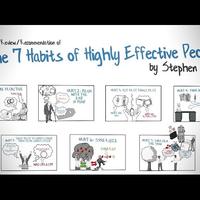
THE 7 HABITS OF HIGHLY EFFECTIVE PEOPLE BY STEPHEN COVEY - ANIMATED BOOK SUMMARY
I remember My grandma's favorite story was about
how everything cost two cents when she was young.
But now, everything constantly got more expensive.
And it was all because of the government.
These uneducated pigs didn't know how to control prices.
And when I was privileged enough to hear this story,
her complaining would last for hours and hours.
And that's exactly what reactive people do.
They always focus on the things that they cannot control.
It's not possible that a concept like inflation would exist.
And if it did, it's impossible that they wouldn't know about it!
On the other hand, proactive people realize, Look, even if my complaining were completely
objective, it doesn't help me.
So I'm going to focus on what I can control.
If a proactive person owns a business where he sells a product,
instead of focusing on how people these days don't appreciate good products anymore,
and how the government has horrible regulations, he focuses on,
“How can I improve my product, so my customers can't live without it?”
Do you realize how much responsibility, how much dedication,
how much hard work comes along with asking that question?
And what do you think our effort-minimizing brain is going to pick as default?
And that is exactly why most people focus on the things that they cannot control,
rather than focusing on the things that they can.
Habit number 1 is: be proactive.
Now imagine you're at a funeral, but this one's different from all the funerals
you've ever been to.
You're standing over the casket and you see yourself.
What do you have to say about yourself?
This is one of the most powerful questions you could ask.
Are you doing the things in your life, which are aligned with what you want to be
able to say?
Do you want to say that you were a good spouse?
If that's the case, how does coming home and instantly being negative
towards your spouse affect that?
Do you want to be remembered as a person who added value to society?
If that's the case, are you doing the things that will allow you
to say that, or are you scared of failure and choose comfortable
mediocrity instead?
Almost every one of us will have to readjust how we live when we ask that question.
Habit number 2 is: begin with the end in mind.
Now if I were to ask you, “What are the most important things to you?”
The most common answers I would get would be
either your wellbeing, or your relationships—your family, your
spouse, your children.
You would never ever say, “Organizing papers or watching TV…”
But how many of us spend more time organizing papers and watching TV,
than planning our nutrition and going to the gym,
or cultivating a healthy family environment?
There's a horrible disconnect between what we say
and how we actually allocate our time.
Habit number 3 is: put first things first.
Now imagine you're an author, and I'm an author.
And We both write interesting books, and we both have access to an audience of
about a 100,000 people.
I read your book and I love it.
So I decide to share it with my audience.
And as a result, you now have 1,000s of people buying your
book and reading your ideas.
You see this and think, “Who is this guy?
Let me take a look at his book.”
You start reading my book and think I have ideas that are valuable.
So you decide to share it with your audience.
And as a result, I now have 1,000s of people buying my book
and reading my ideas.
Notice how different this is from my creating a little creepy Amazon account,
finding your book and leaving a bad review, hoping that this will deter a few people from
buying your book, which will in turn somehow get them to buy
my book.
Habit number 4 is: think win-win.
Stop thinking of everything as a zero-sum game.
For you to win, another person does not have to lose.
Something I want my viewers to do is to subscribe to my channel,
but you will never hear me say, “Well, I worked really hard guys.
I dedicated so many hours to this.
Please subscribe.”
Look, who cares if I worked hard?
Who cares if I've spent days creating this video?
The real questions are, does it offer value to you?
And Why should you dedicate your time to subscribing, when you could be doing anything else that
you want?
Habit number 5 is something that I try to use every single day,
with every interaction that I have, and with every comment that I reply to,
and it is this: seek first to understand, then to be understood.
Now imagine there are two people, and a tree with five apples on it.
They are both too short to reach the apples, but if one of them sits on the other's shoulders,
he can reach all five of the apples.
This is called synergy.
The whole is greater than the sum of its parts.
Now I'll be the first to admit that you can't achieve this with everyone,
but you should always be looking for opportunities to create synergy.
With every synergistic opportunity you create, you can gather many more apples than you otherwise
would by yourself.
Habit number 6 is: Synergize.
A man has been trying to cut down a tree for hours.
And after a while his neighbor can't take it anymore,
goes over and says, “You know, if you sharpen the saw, you'll
be able to cut it down faster.”
And the man replies, “But, sharpening the saw is going to take
time.”
Now we might laugh at this story, but we do the same thing all the time.
We can't find 30 minutes a day, 4 times a week to go to the gym.
Our health deteriorates to a point, where we're physically incapable of being
effective.
We can't read a book for 15 minutes a day and mentally stimulate ourselves.
No!
These things take too much time!
And then we have the audacity to ask for little tips and tricks on how to be effective.
It's like telling your engineer, “Don't worry about the foundation,
where can we get the magic bricks that will float in the air?”
Habit number 7 is: sharpen the saw.
And these are the 7 habits of highly effective people by Stephen Covey.
